
As the smart ocean initiative gains momentum, digital transformation is accelerating across offshore oil and gas operations, wind farm maintenance, maritime law enforcement, and ocean-going vessels. Deploying private 4G/5G networks or extending public mobile coverage at sea has become essential to providing crew members, field personnel, and HD surveillance systems with high-bandwidth connectivity.
Yet deploying 5G far from shore raises a fundamental question: how can base stations installed on vessels or offshore platforms carry large volumes of traffic back to the terrestrial core network?
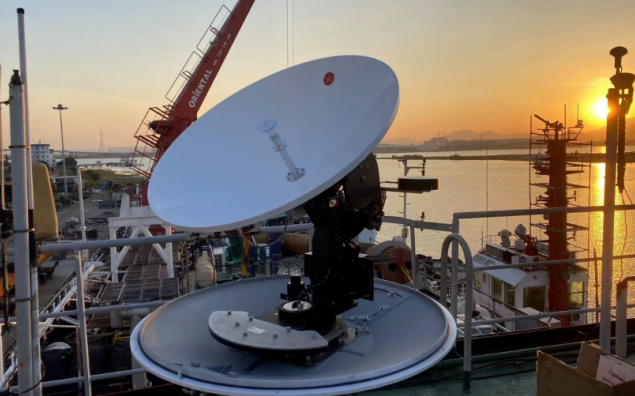
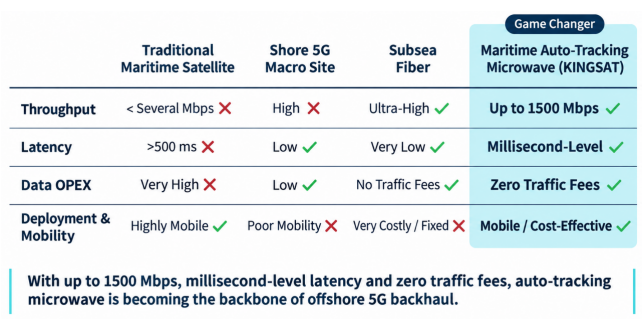
Maritime communications have traditionally relied on satellites, but high service costs and limited bandwidth can make it difficult to support 5G-scale traffic. Subsea fiber, meanwhile, is expensive to install and cannot follow moving vessels. Against this backdrop, maritime auto-tracking microwave links are emerging as a critical option for offshore 5G backbone backhaul, offering throughput of up to 1,500 Mbps, millisecond-level latency, and no traffic-based data charges.
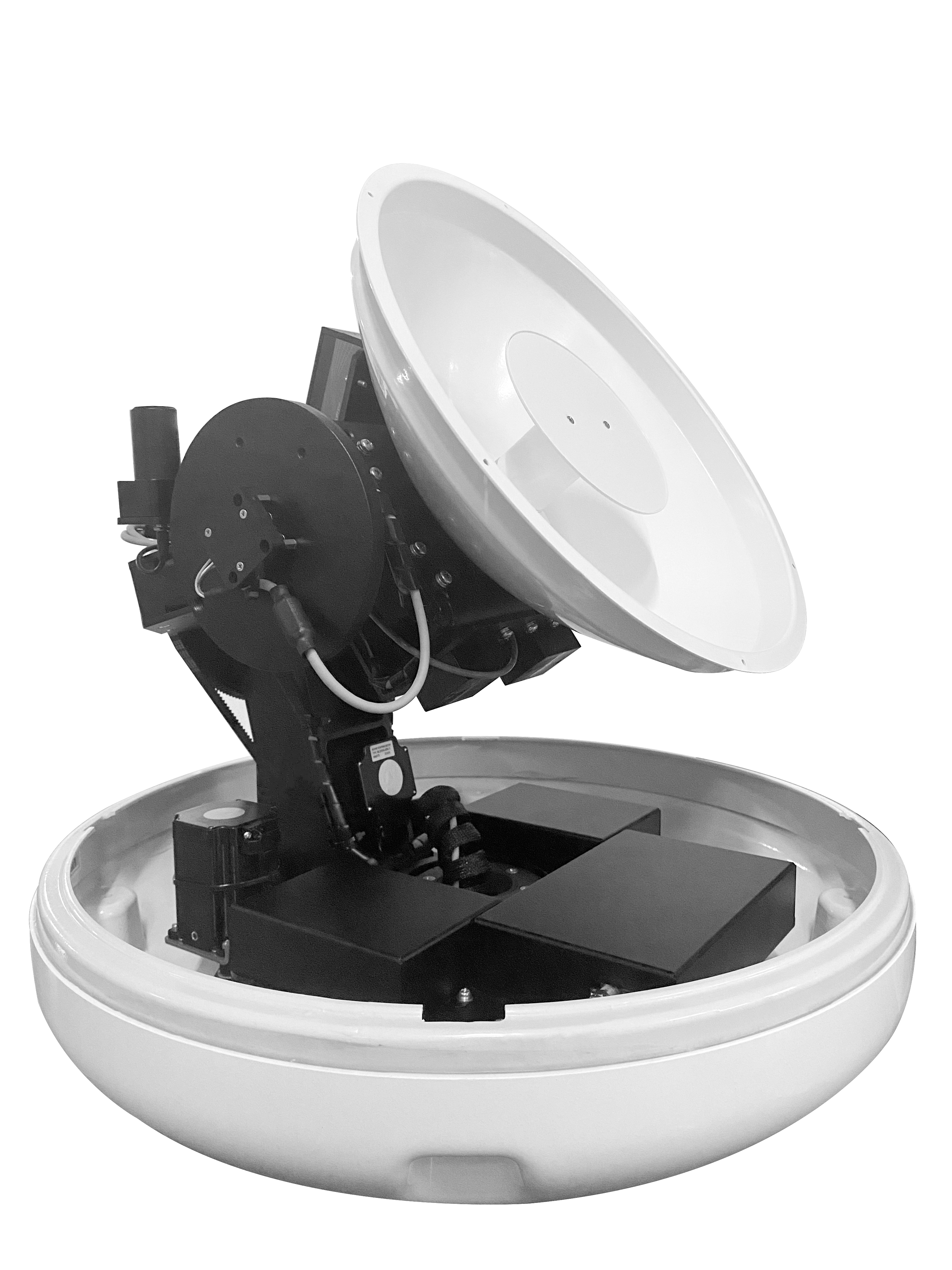
Drawing on its expertise in maritime RF engineering and high-dynamic-range stabilized servo systems, KINGSAT has developed an auto-tracking microwave antenna system for shore-to-vessel and vessel-to-vessel links spanning approximately 30–100 km. The aim is to provide offshore 5G networks with a high-speed, stable connection that functions like mobile wireless fiber.
1. Industry Challenges: Three Obstacles to Maritime 5G Backhaul
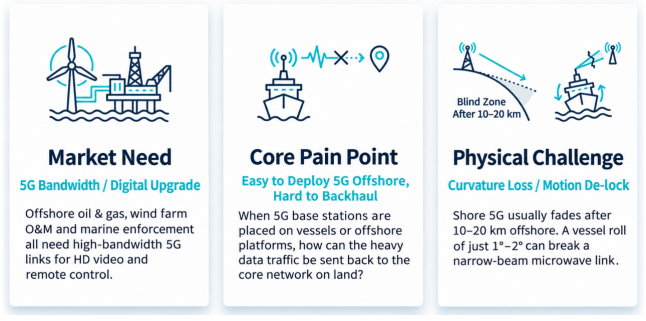
Extending terrestrial 5G connectivity into offshore waters presents three major backhaul challenges:
1.1 Satellite Backhaul: Limited Bandwidth and High Service Costs
- Bandwidth constraints: Traditional maritime satellite links may offer guaranteed uplink rates of only a few Mbps. Aggregating multiple HD video streams and other data-intensive 5G traffic can therefore overload the link.
- High operating costs: Satellite connectivity is commonly priced through monthly bandwidth subscriptions or usage-based plans. Supporting 5G-scale traffic can lead to substantial operating expenditure (OPEX).
- High latency: Round-trip latency over geostationary satellite links often exceeds 500 ms, making such connections unsuitable for some latency-sensitive industrial remote-control applications and stringent ultra-reliable low-latency communication (URLLC) requirements.
1.2 Earth Curvature and Line-of-Sight Limits: Restricted Coastal 5G Coverage
Earth curvature and multipath propagation over the sea can limit the effective reach of shore-based 5G macro base stations, often to approximately 10–20 km in the scenario described here. Vessels traveling beyond this range may lose public mobile coverage and require offshore relay stations to extend connectivity.
1.3 Vessel Motion Makes High-Gain Microwave Alignment Difficult
High-capacity microwave transmission over tens of kilometers requires high-gain directional parabolic antennas, often with beamwidths of only about 3.5°–6°. But vessels continually roll and pitch in wind and waves. Even a 1°–2° change in orientation can move a narrow beam off target, potentially disrupting the backbone link.
2. The KINGSAT Solution: Dynamic Auto-Tracking Microwave Backhaul for Offshore 5G
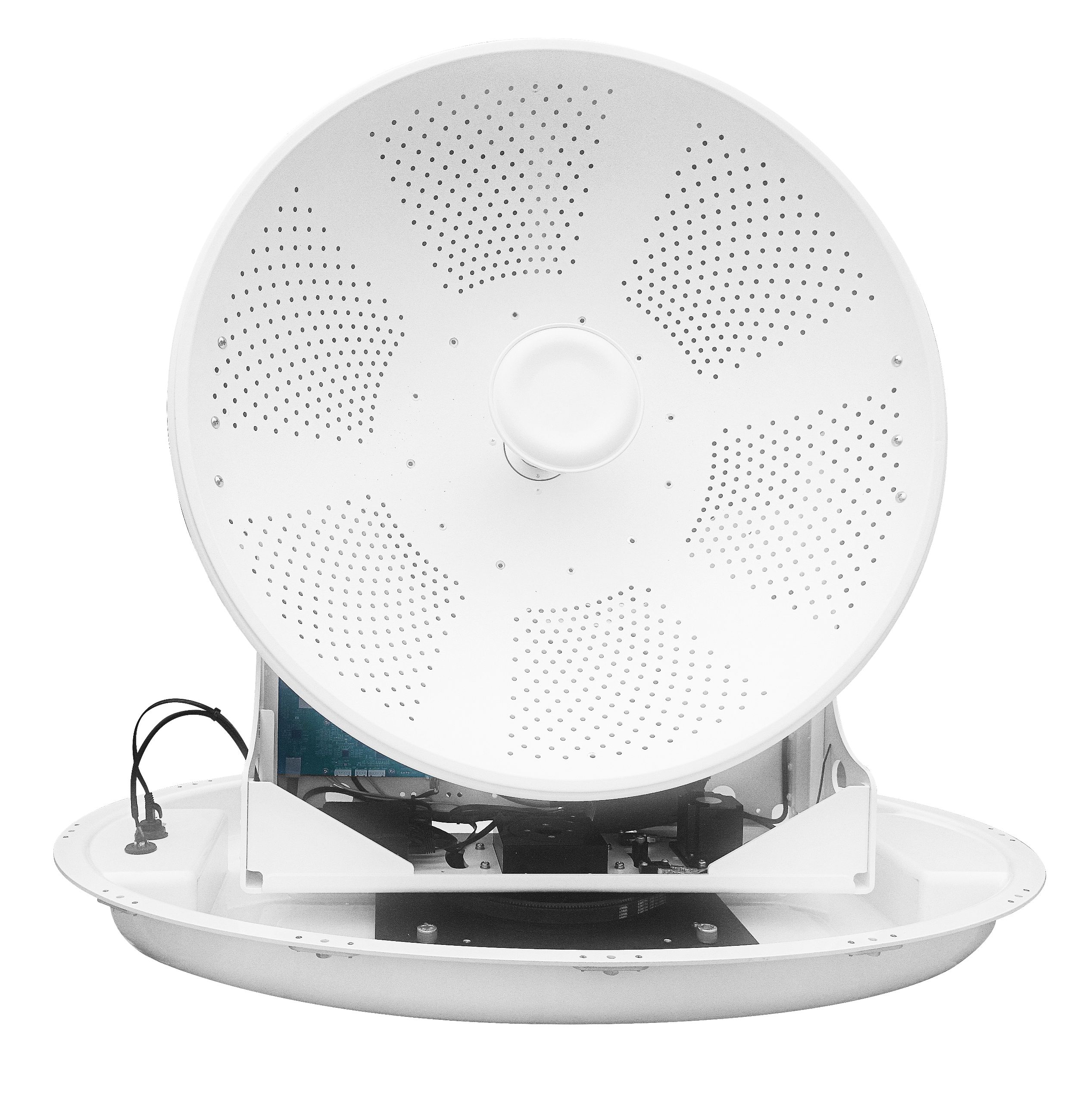
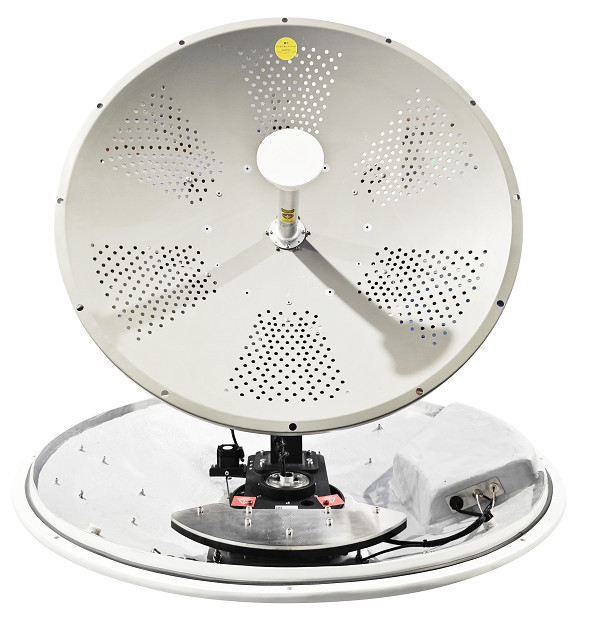
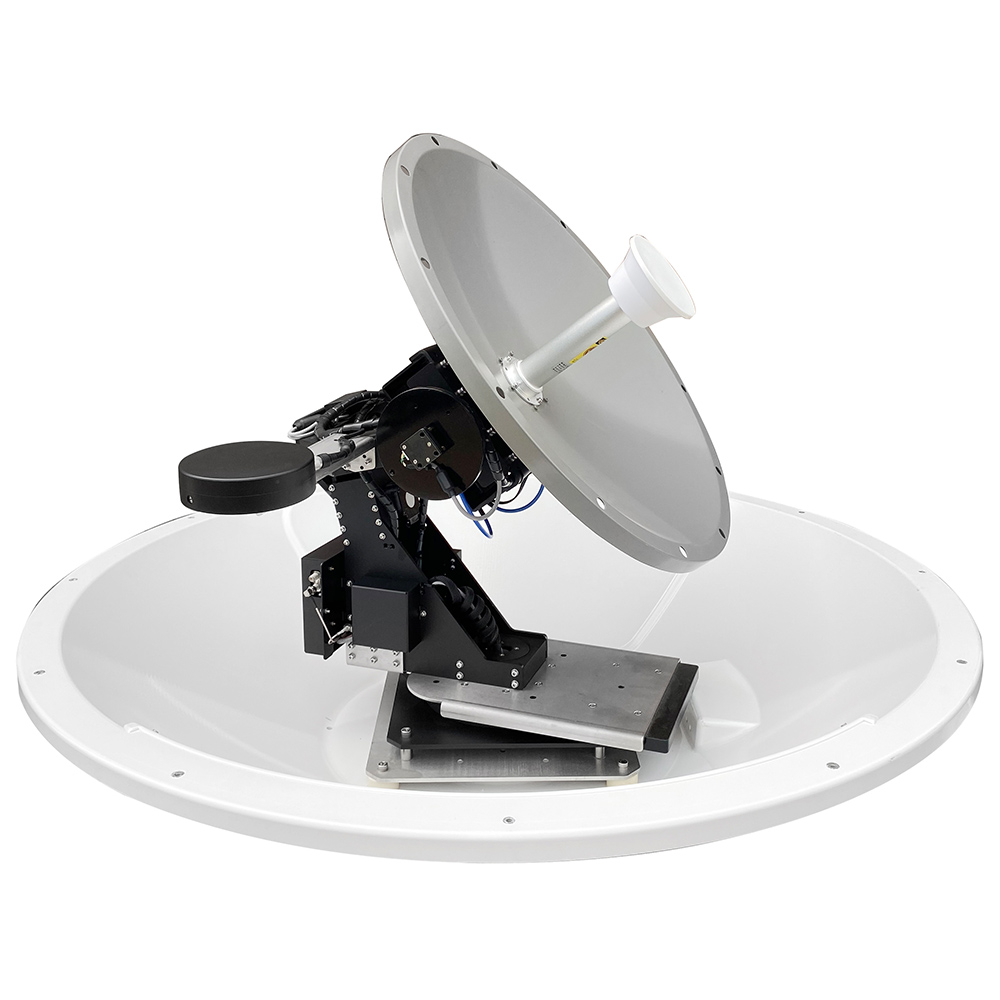
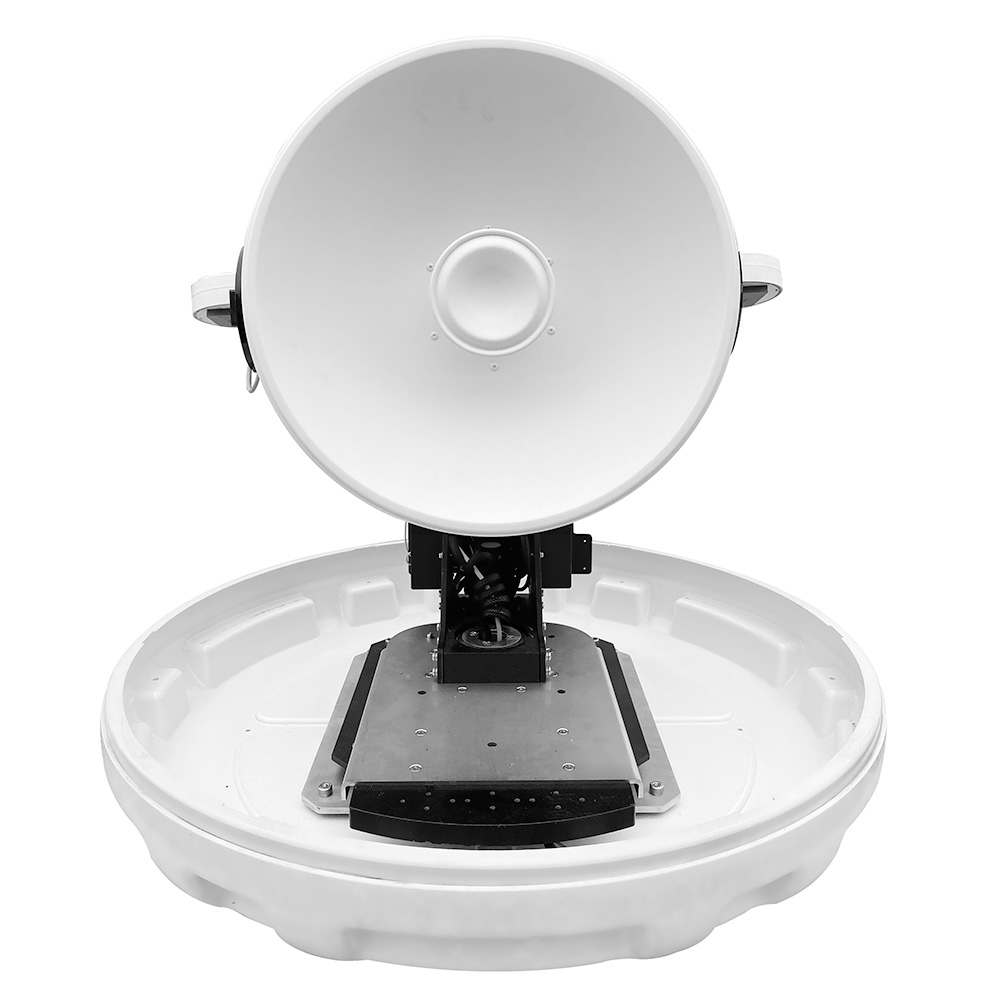
To address offshore 5G backhaul and relay-network challenges, KINGSAT combines stabilized servo-tracking algorithms with highly integrated industrial-grade RF technology in a microwave auto-tracking system that connects shore-based and maritime nodes.
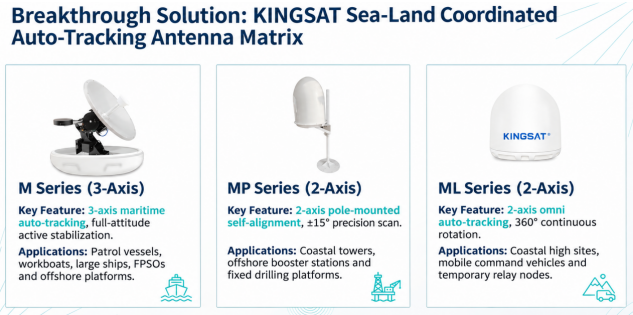
2.1 KINGSAT Auto-Tracking Antenna Portfolio
2.2 Deployment Example: Multi-Vessel Relay Backhaul and 5G Coverage
Consider a maritime law-enforcement operation in which several vessels relay 5G traffic through a chain of microwave links near a coastal outlet:
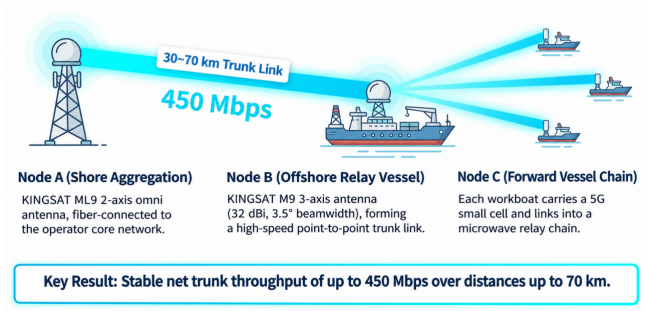
- Shore-based aggregation point: A KINGSAT ML9 dual-axis auto-tracking antenna is installed on a tall coastal building or tower, with a fiber connection to the mobile operator’s core network.
- Offshore relay vessel: A KINGSAT M9 three-axis auto-tracking antenna (32 dBi gain; 3.5° beamwidth) establishes a high-speed point-to-point microwave backbone link of approximately 30–70 km to the shore-based ML9.
- Multi-vessel extension: The relay vessel forwards traffic to other working vessels farther offshore through cascaded microwave links. Each vessel carries a 5G small cell to serve the surrounding waters, creating a shore–vessel–vessel relay network. The example describes up to 450 Mbps of net backbone throughput over a distance of up to 70 km.
2.3 Core Technologies Behind KINGSAT Maritime 5G Backhaul
2.3.1 Up to 1,500 Mbps Throughput and Millisecond-Level Latency
- The antenna system integrates carrier-grade high-speed microwave radio hardware. A typical configuration operates in the 5.8 GHz band, with customization options covering 1.4, 6, 7, and 8 GHz, as well as millimeter-wave frequencies.
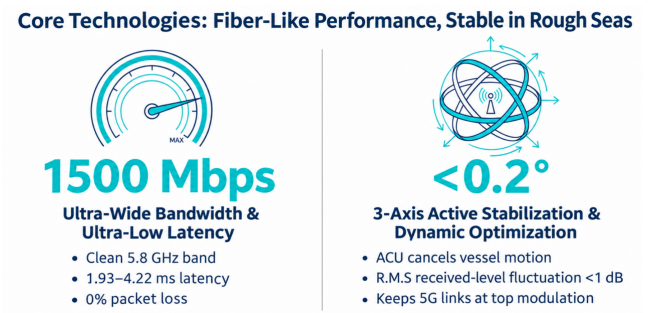
- Single-link throughput can reach up to 1,500 Mbps. In tests conducted in the 5.9 GHz band, reported transmission latency ranged from 1.93 to 4.22 ms, with a measured packet-loss rate of 0%, delivering a fiber-like backhaul experience for offshore 5G base stations under the stated test conditions.
2.3.2 Three-Axis Active Stabilization and Dynamic Tracking Optimization
- The antenna control unit (ACU) uses high-precision inertial navigation sensors and stabilization algorithms to compensate automatically for vessel motion and keep the microwave beam directed toward the remote antenna.
- Continuous fine tracking keeps pointing error below approximately 0.2°. The source reports received-signal fluctuations of less than 1 dB RMS in rough seas, helping the radio maintain high-order modulation and sustained 5G backhaul throughput.
2.3.3 Long-Range VHF-Assisted Acquisition for Offshore Link Establishment
- Both antenna systems incorporate narrowband VHF data radios operating in the 100–200 MHz range.
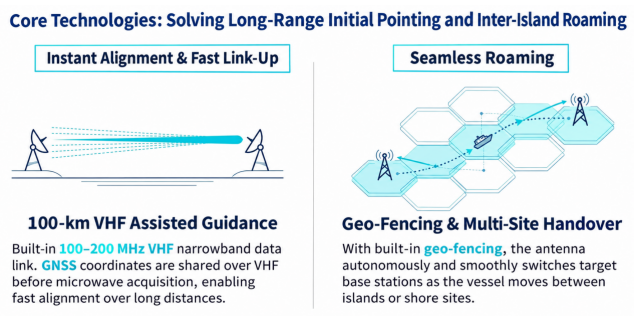
- Before establishing the microwave link, the two ends exchange GNSS coordinates over VHF near the line-of-sight limit. They then calculate azimuth and elevation, enabling rapid initial alignment and link acquisition across distances of tens of kilometers.
2.3.4 Geofencing and Intelligent Handover Between Base Stations
- With multi-base-station recognition and geofencing, the antenna can select and smoothly switch between island-based or coastal stations as a vessel moves along its route. The system is designed to keep backhaul services running during these transitions.
3. Customer Benefits: Why Choose Microwave for Maritime 5G?
KINGSAT maritime auto-tracking microwave backhaul addresses both technical and commercial barriers to scaling offshore 5G networks:
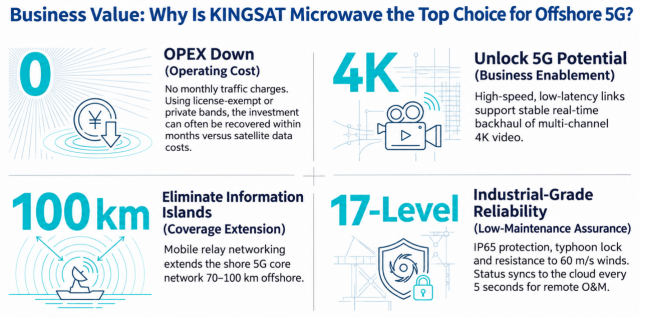
3.1 Lower Operating Expenditure (OPEX)
- No recurring traffic charges. Where applicable, microwave links can operate in license-exempt or dedicated private-network spectrum. After the initial hardware deployment, there is no satellite-style per-GB traffic charge or bandwidth subscription for the microwave link itself. Compared with costly satellite data plans, the original proposal estimates payback in a matter of months.
3.2 Unlocking 5G Performance with High Throughput and Low Latency
- With backbone capacity ranging from hundreds of Mbps to gigabit-class rates and per-hop latency of only a few milliseconds, microwave backhaul helps deliver the high bandwidth and low latency expected of 5G. Alongside crew connectivity, it can support multiple real-time 1080p/4K video feeds for maritime monitoring and law-enforcement evidence collection.
3.3 Extending Mobile Coverage Farther Offshore
- By cascading three-axis microwave links between moving vessels, coastal 5G connectivity can be extended approximately 70–100 km or farther offshore in suitable deployments. This allows 5G services to travel with working vessels and reduces connectivity gaps at sea.
3.4 Reliability in Harsh Conditions and Remote Cloud-Based Management
- The source specifies IP65 ingress protection and a typhoon-resistant mechanical locking bar. It also states a wind-resistance rating of up to 60 m/s (Beaufort force 17). Critical components use industrial-grade hardware and vibration-resistant, anti-loosening structures.
- A centralized microwave management platform receives antenna status updates every five seconds, supporting remote fault diagnosis and automated recovery functions. This reduces the need for hazardous on-site maintenance at elevated installations.
Conclusion
The future of 5G depends on connectivity across diverse environments, and the ocean is among the most demanding. Where fiber is impractical and satellite bandwidth is costly, KINGSAT auto-tracking microwave antennas combine precision stabilization and high-throughput RF technology to create a high-speed wireless corridor between offshore assets and the mainland.
With a robust microwave backbone in place, 5G connectivity can reach across challenging waters and support the next generation of smart maritime operations.
Contact us: sales@kingsat-tech.com Official website: www.kingsat-tech.com
Youtube: http://www.youtube.com/@kingsatmaritimeantennas4640