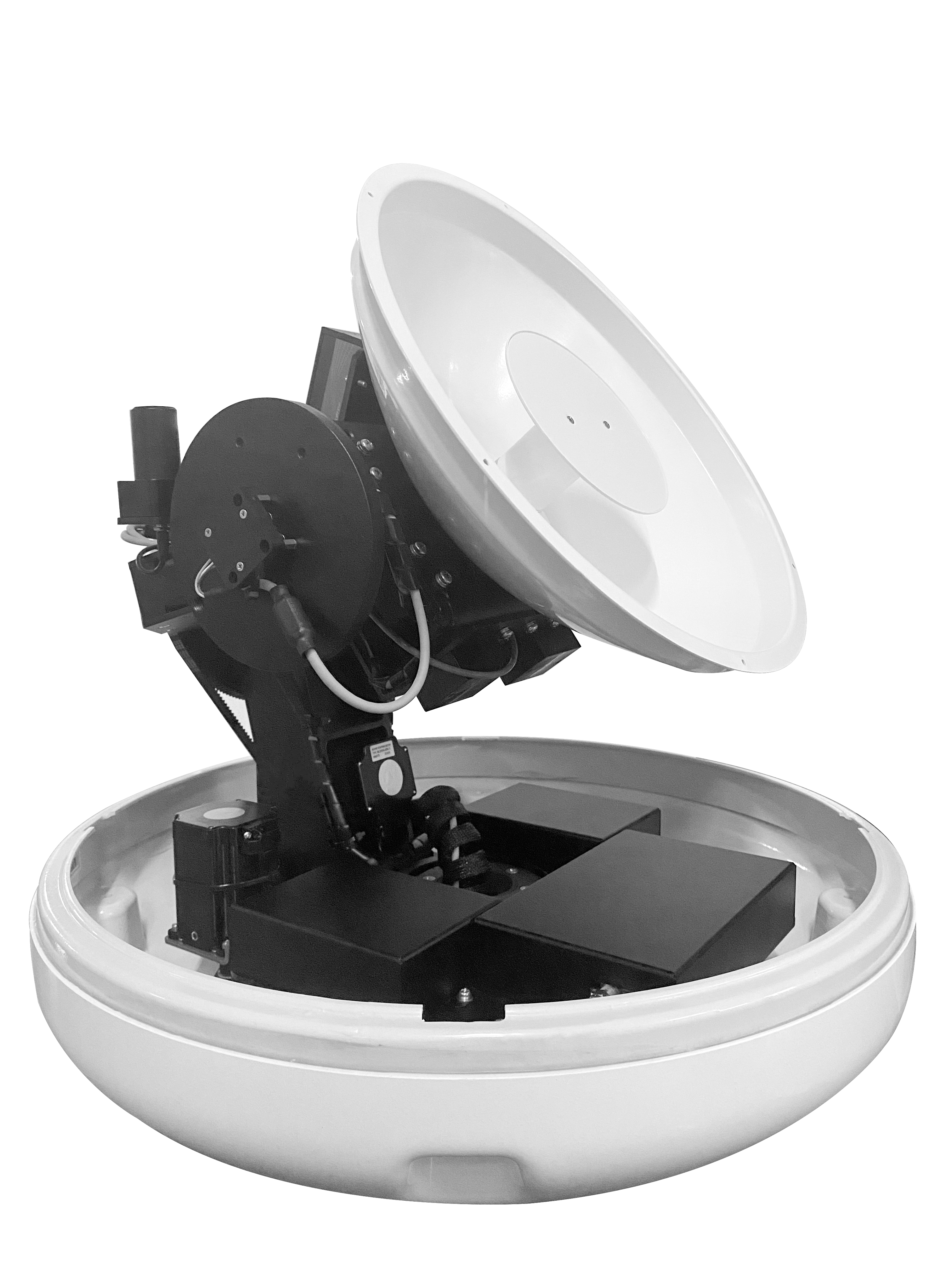

In maritime applications such as offshore wind farms, oil and gas platforms, nearshore patrols, and offshore engineering operations, high satellite data costs and limited bandwidth have long been major constraints on offshore digitalization. How can operators reduce the burden of recurring satellite communication costs? With microwave auto-tracking technology, enterprises can build their own high-bandwidth, low-latency microwave backbone networks for nearshore operations, providing fiber-like connectivity without the ongoing cost of satellite data usage.
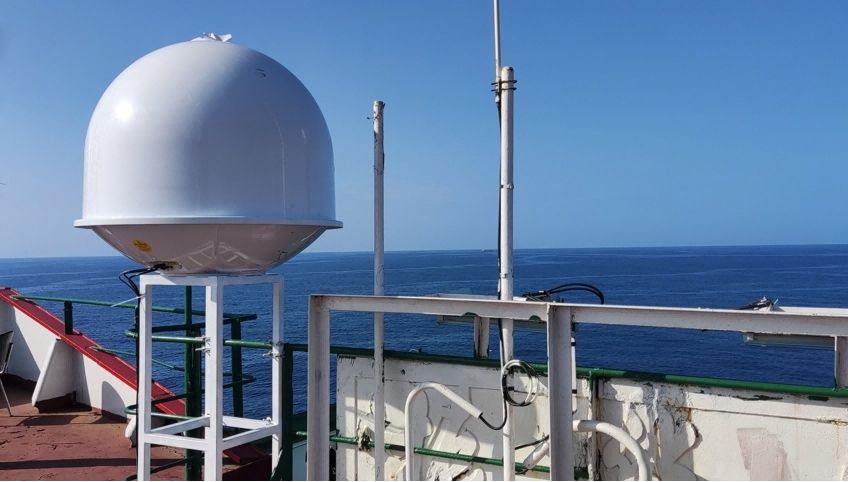
I. Why Is Satellite Communication So Expensive? Let’s Look at the Bandwidth Costs
For offshore wind, oil and gas platforms, nearshore patrols, and similar projects, communication costs can account for a significant share of operating expenditure (OPEX). Traditional maritime VSAT services are typically billed monthly or based on data usage, while committed information rate (CIR) bandwidth can be particularly expensive. How quickly can a satellite link become saturated? Take a common CCTV application as an example: four 720P HD cameras require approximately 2.4 Mbps of dedicated uplink bandwidth. On a VSAT link, this translates into persistently high monthly bandwidth costs.
Some operators have tried shore-based 4G LTE or low-band 5G networks as alternatives. However, in the 690–900 MHz bands, network operators typically limit per-terminal access speeds to below 2 Mbps. Network performance also deteriorates significantly as the distance from shore increases, making these networks unsuitable for industrial-grade data backhaul.
By comparison, wireless microwave access offers a substantial throughput advantage:
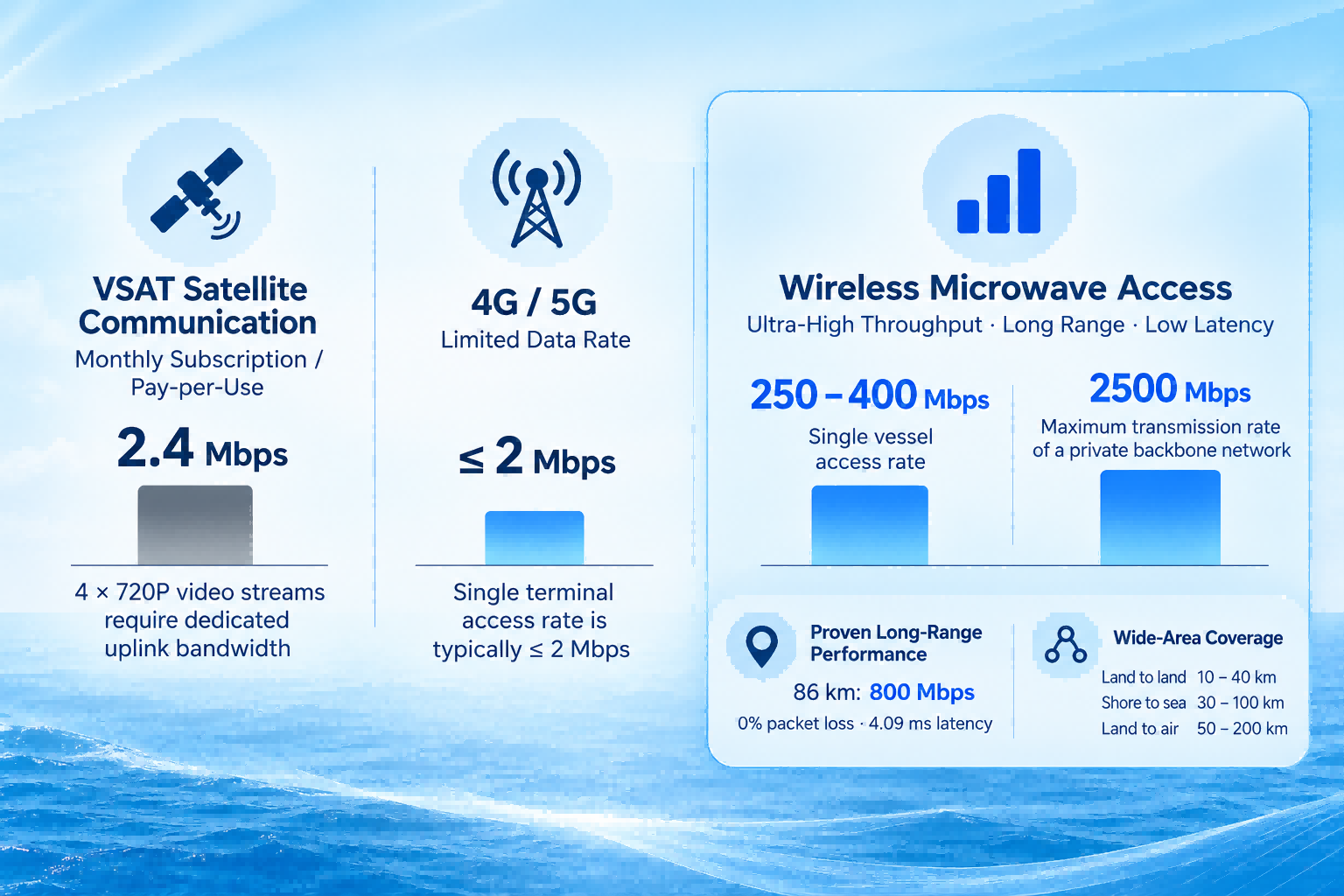
- Ultra-high throughput: Microwave access for a single vessel can deliver 250–400 Mbps, while a private microwave backbone network can support transmission rates of up to 2,500 Mbps.
- Proven long-range performance: In an 86 km nearshore P2P (point-to-point) field test, a high-gain auto-tracking microwave system equipped with a 90 cm antenna achieved an aggregate throughput of 800 Mbps, with 0% packet loss and an average latency of just 4.09 ms.
- Wide-area coverage: Microwave auto-tracking links can support transmission distances of 10–40 km for land-to-land links, 30–100 km for shore-to-sea links, and 50–200 km for land-to-air links.
These field results show that a private microwave network does more than address bandwidth limitations. It can also reduce the long-term reliance of maritime communications on usage-based connectivity.
II. Why Do Communications Costs Keep Rising as Bandwidth Demand Grows?
Spending more on bandwidth does not necessarily mean getting a faster network. So what is driving communications costs higher?
1. Bandwidth is rented—the more you use, the more you pay:
VSAT is essentially an ongoing subscription-based communications service. As HD video, IoT devices, and onboard applications continue to grow, more bandwidth must be purchased, driving up long-term OPEX.
2. Offshore digitalization is driving growing bandwidth demand:
Modern offshore operations are no longer limited to basic voice and messaging. They increasingly rely on real-time HD CCTV monitoring, AIS/VDR/IoT sensor data backhaul, and remote coordination among multiple parties. Expanding satellite bandwidth to support these applications inevitably increases communications costs.
3. Vessels are constantly moving, making fixed antennas difficult to keep aligned:
Traditional fixed microwave antennas cannot compensate for vessel motion, heading changes, and attitude variations caused by wind and waves. As a result, they can easily lose alignment with the target base station and drop the link. Meanwhile, cellular signals weaken significantly tens of kilometers offshore, often forcing vessels to switch back to more expensive satellite communications.
III. Moving Beyond Monthly Data Charges: How Does a Microwave Backbone Work?
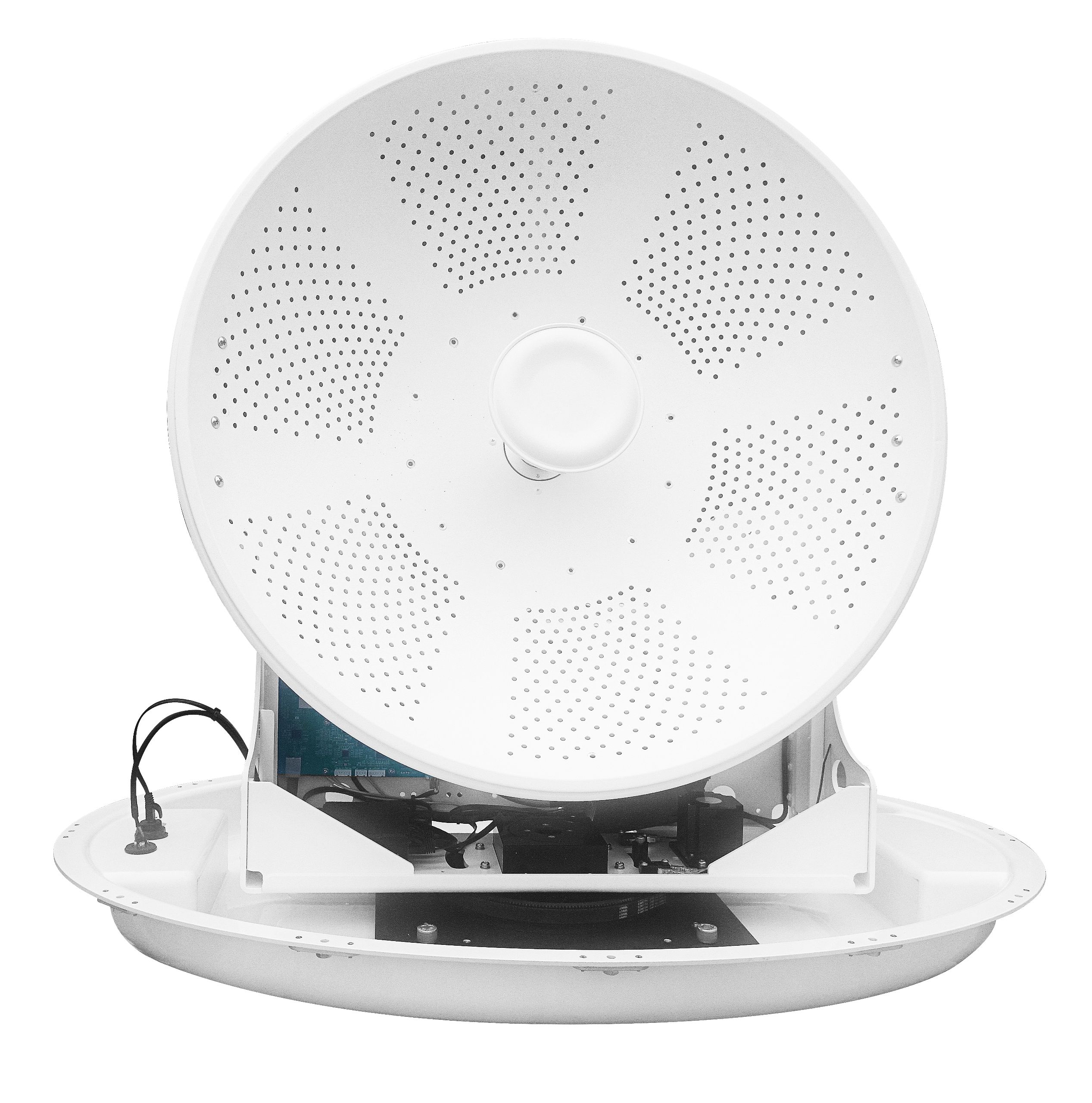
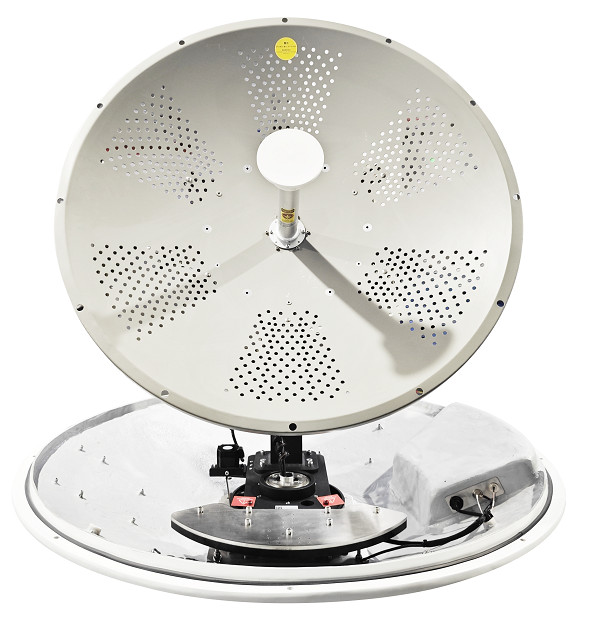
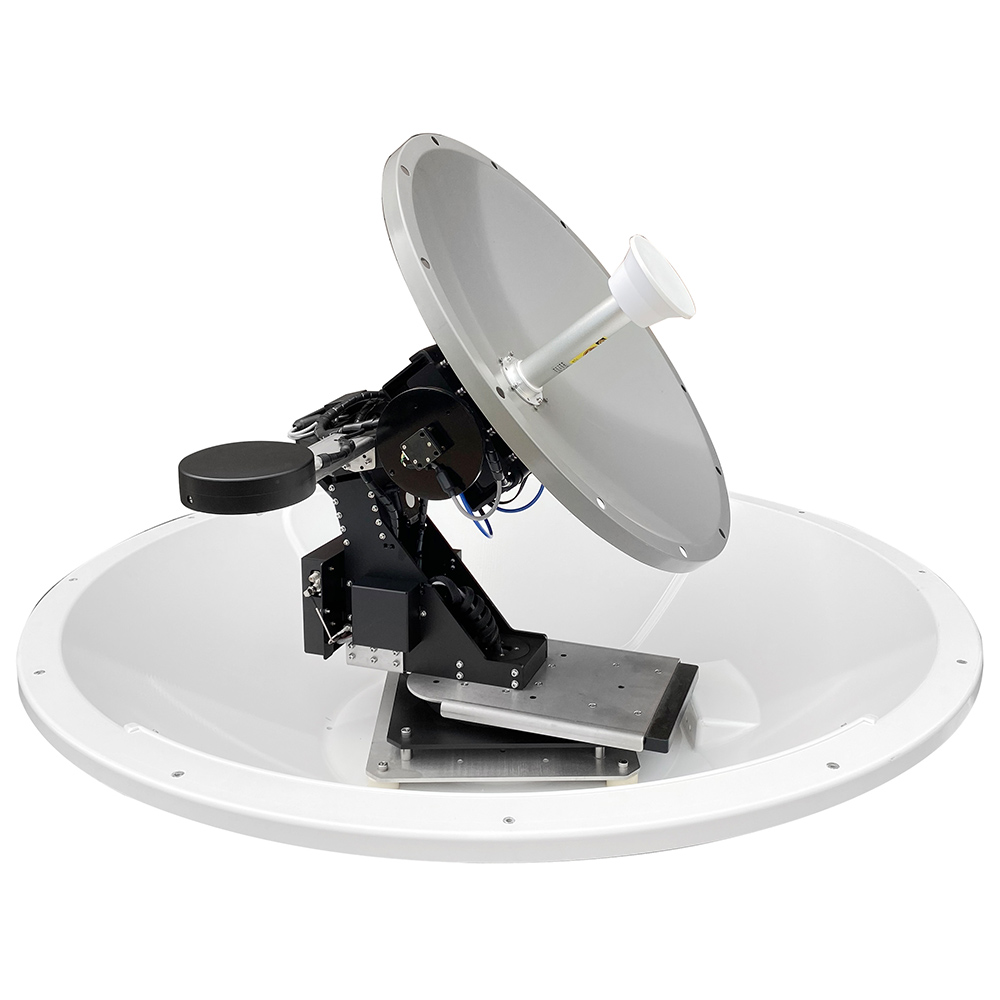
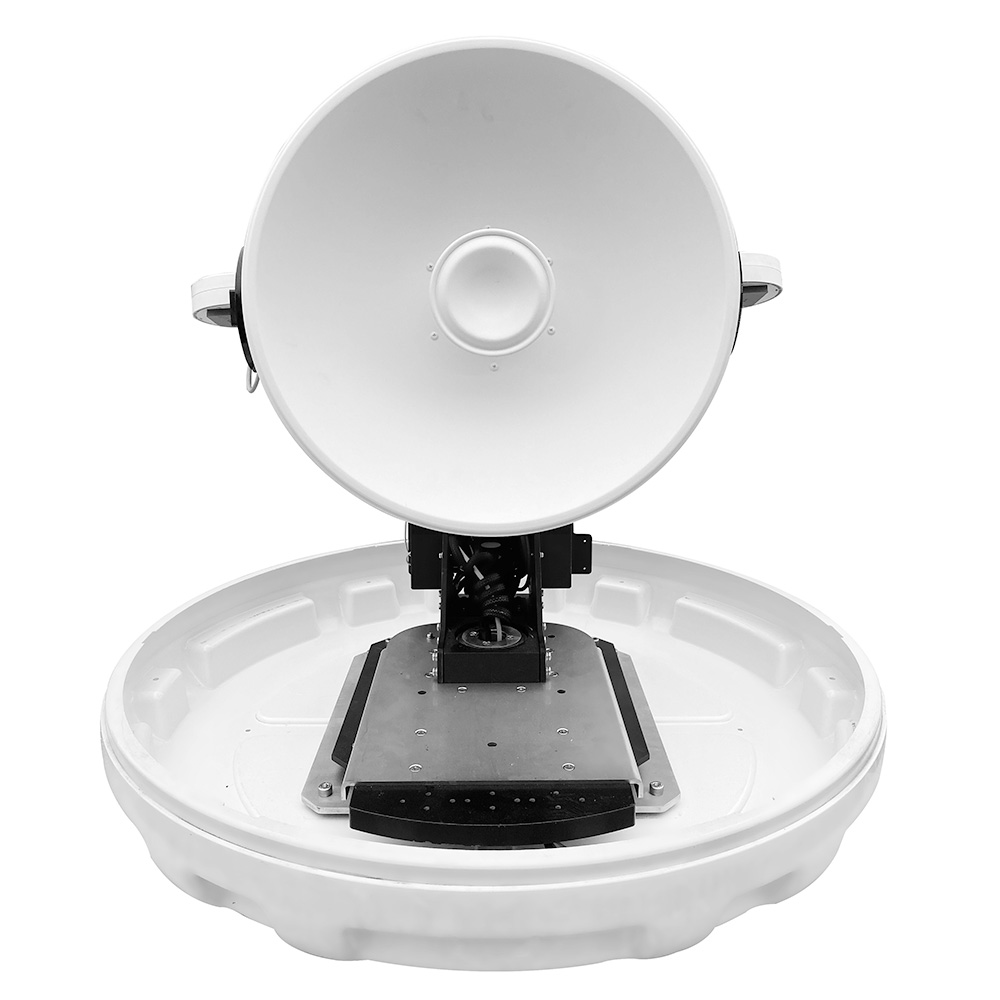
To address the challenge of high-bandwidth transmission under changing sea conditions, KINGSAT developed its Microwave Auto-Tracking Antenna System. Instead of relying on recurring bandwidth and data charges, operators can invest in their own network infrastructure and build a fiber-like offshore wireless backbone.
The operating principle is straightforward: a fixed station onshore or offshore provides network access, while an auto-tracking antenna on the vessel continuously tracks the target base station. As the vessel moves, the antenna adjusts its pointing accordingly, maintaining a stable, high-speed microwave link between the two ends.
For this offshore high-speed link to operate reliably, one fundamental challenge must first be solved: how can the antenna remain accurately aligned while the vessel is constantly moving?
- Three-Axis Stabilized Servo Tracking Platform: Using a three-axis stabilized servo platform and patented tracking technology, the antenna maintains pointing accuracy of < 0.2° and an RX level RMS of < 1 dB even as the vessel moves continuously in wind and waves, keeping it precisely aligned with the target base station.
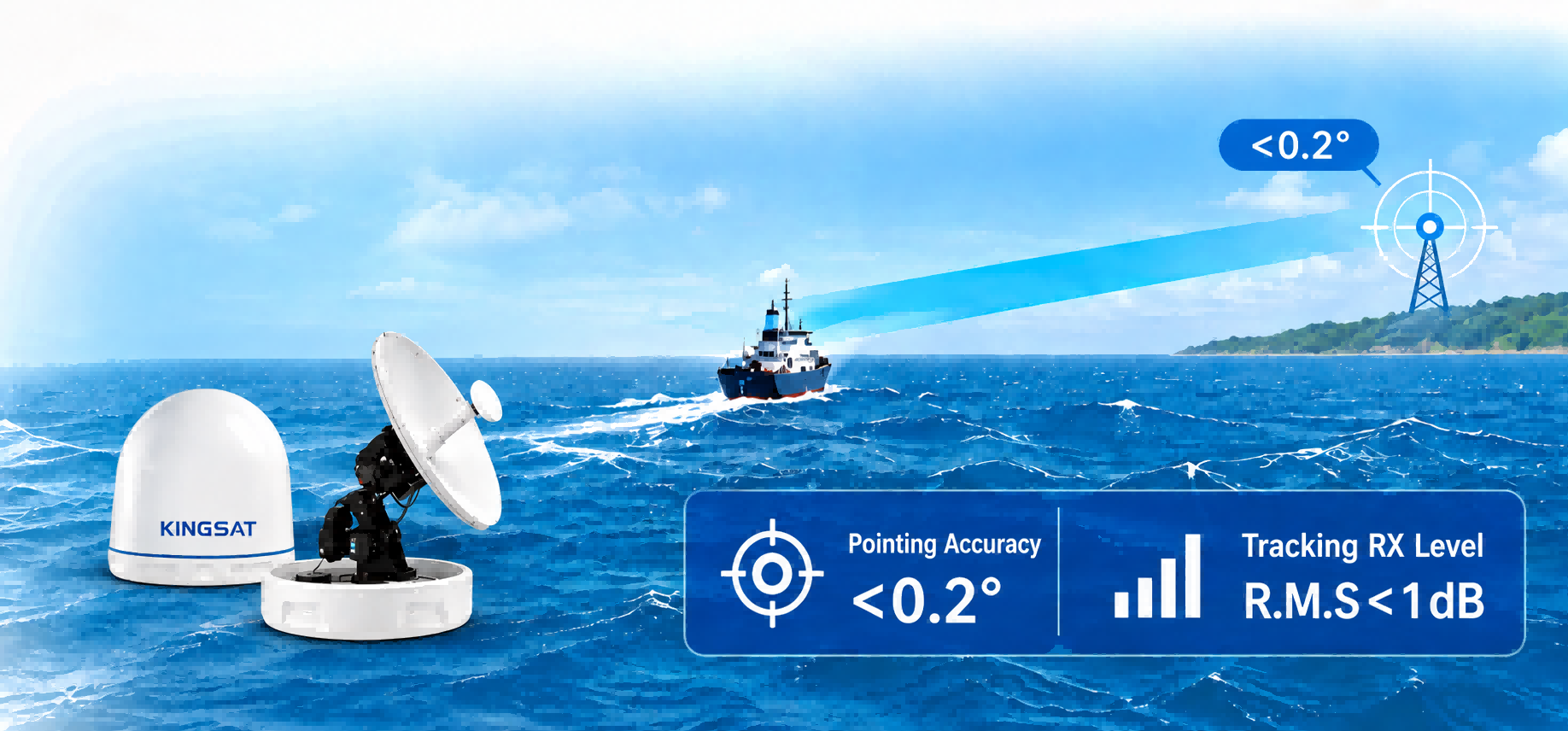
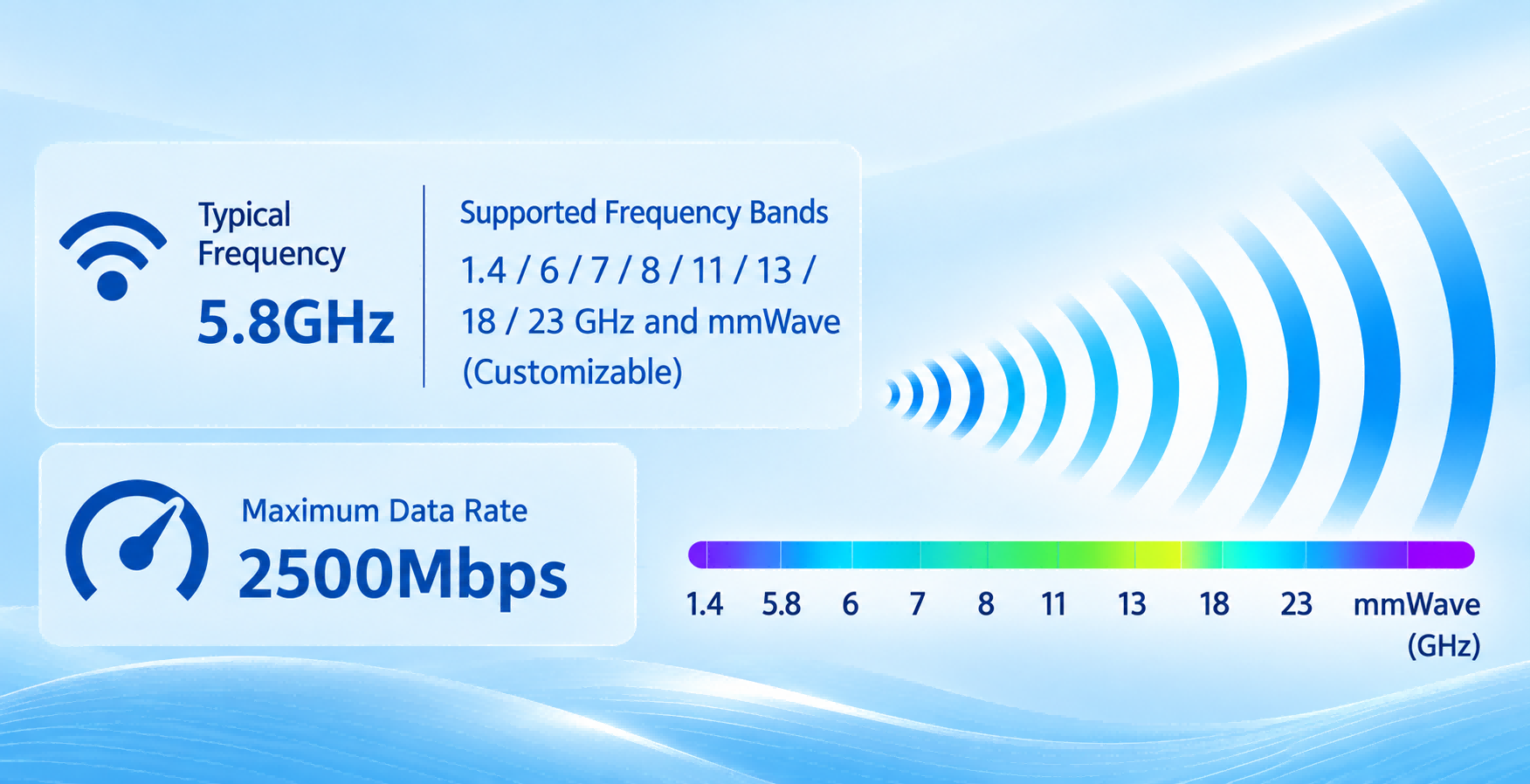
- High Bandwidth with Flexible Frequency Options: The typical operating frequency is 5.8 GHz, with customization available for 1.4 GHz, 6 GHz, 7 GHz, 8 GHz, 11 GHz, 13 GHz, 18 GHz, 23 GHz, and mmWave bands. Transmission rates can reach up to 2,500 Mbps, providing mobile platforms with fiber-like, high-bandwidth, low-latency backbone connectivity.
- Broad Modem Compatibility: The ACU/antenna system can integrate with or support mainstream modem platforms including Radwin, Cambium, Ceragon, and UBNT.
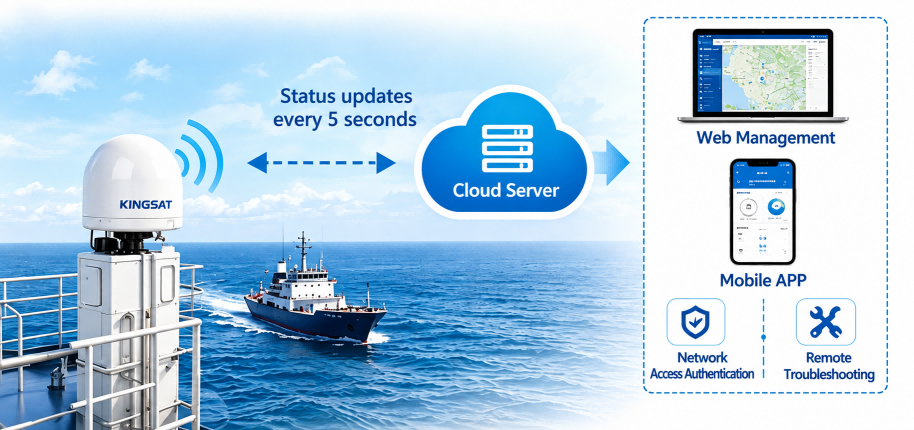
Cloud-Based Intelligent O&M and Status Reporting: Once connected to the network, the antenna can report operating status to the cloud server every five seconds, including azimuth, elevation, AGC signal strength, coordinates, and other data. Remote management, network access authentication, and online troubleshooting are supported through a web interface and mobile app.
IV. How Does It Perform in Real-World Applications?
Beyond specifications, real-world performance matters more. KINGSAT microwave auto-tracking antennas have already been deployed in a range of demanding applications:
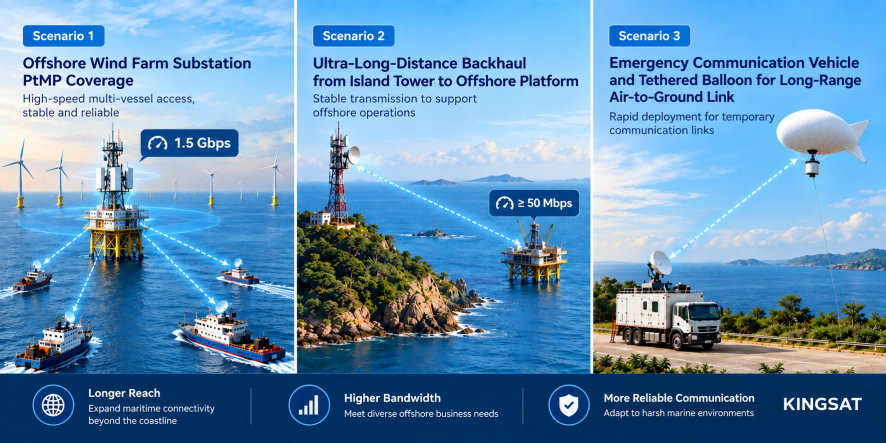
Scenario 1: PtMP Coverage from an Offshore Wind Farm Substation
A Radwin carrier-grade point-to-multipoint microwave base station and four 90° sector flat-panel antennas are deployed at an offshore substation with fiber access, providing base-station bandwidth of up to 1.5 Gbps. Nearby service vessels are equipped with KINGSAT M6 three-axis auto-tracking antennas. While underway, the antennas can automatically obtain position coordinates and accurately align with the offshore substation. The vessel-side modem supports bandwidth of up to 250 Mbps, providing high-speed Internet connectivity between the offshore substation and multiple service vessels.
Scenario 2: Ultra-Long-Range Backhaul from an Island Tower to a Nearshore Work Platform
A fixed-station antenna is deployed on a tower at an elevation of 164 m on Nanji Island, with fiber connectivity, forming a microwave link to an offshore work platform 80 km away. The platform is equipped with a KINGSAT auto-tracking antenna (MP/M Series), providing stable access bandwidth of at least 50 Mbps per platform and supporting real-time transmission of two HD video streams and one voice channel.
Scenario 3: Long-Range Air-to-Ground Link Between an Emergency Communications Vehicle and a Tethered Balloon
A KINGSAT ML4 two-axis auto-tracking antenna is installed on the ground-based emergency communications vehicle, while an inverted M6S three-axis tracking antenna is deployed on the tethered balloon. Built-in VHF narrowband data radios at both ends exchange latitude and longitude data in real time and automatically calculate the required azimuth and elevation angles for alignment and target lock. This enables a 50 km long-range, high-speed microwave backhaul link, with synchronized visual monitoring through the cloud platform.
Conclusion: Why Is a Private Microwave Backbone Better Suited to Long-Term Operations?
For maritime projects with sustained high-bandwidth requirements, a private microwave backbone can reduce reliance on recurring satellite data charges. By shifting from monthly data charges (OPEX) to a one-time investment in network hardware (CAPEX), operators can achieve 400–2,500 Mbps of fiber-like mobile connectivity while supporting continuous data transmission with no traffic-based fees.
As a manufacturer of maritime auto-tracking antennas, KINGSAT draws on more than seven years of microwave signal-tracking expertise to provide a complete microwave backbone solution, from hardware selection and link simulation to cloud-based operation and maintenance.
Contact us: sales@kingsat-tech.com Official website: www.kingsat-tech.com
Youtube: http://www.youtube.com/@kingsatmaritimeantennas4640