
As offshore oil and gas operations expand into deeper and more remote waters, networks of central processing platforms (CPPs), unmanned satellite platforms, floating production, storage and offloading (FPSO) vessels, and support vessels are moving toward smarter, increasingly autonomous operations. Ultra-high-definition video surveillance, real-time SCADA control, and drone inspections all demand high-bandwidth, low-latency connectivity. Conventional VSAT services can be costly and latency-intensive, while fixed microwave antennas can lose alignment as vessels and floating structures move with the waves. Combining three-axis stabilization with a geofencing-based seamless handover topology, KINGSAT delivers a private offshore communications network with aggregate throughput of up to 1,500 Mbps and millisecond-level latency—a “mobile fiber-like link at sea.”

1. Challenges: Three Critical Obstacles to Offshore Connectivity
Offshore oil and gas installations operate in harsh marine conditions, creating three fundamental challenges for wireless communications:
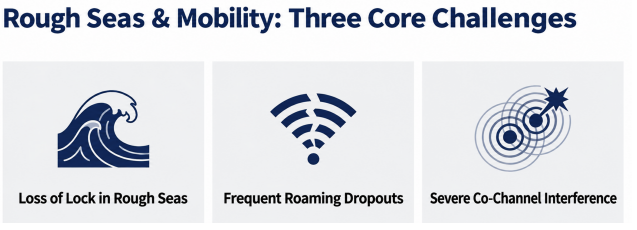
- Beam misalignment in rough seas: FPSOs and vessels experience motion in six degrees of freedom. With narrow beamwidths typically ranging from 3.5° to 6°, high-gain microwave antennas can lose pointing accuracy—and the link itself—even after small changes in orientation.
- Connectivity gaps and roaming challenges for mobile nodes: As workboats or drones move between platforms, fixed antennas cannot track them dynamically, while omnidirectional antennas may lack the range and gain required. The result can be repeated interruptions and degraded performance in overlapping coverage areas.
- Long-range transmission and co-channel interference: Over links spanning tens of kilometers, sea-surface multipath reflections and salt-laden conditions complicate the delivery of hundreds of Mbps to gigabit-class capacity while limiting interference between links operating on the same frequency.
2. Solutions: Three-Axis Stabilization and Geofencing-Based Seamless Handover
To address these challenges, KINGSAT brings together motion-compensated antenna stabilization, a layered multi-node network topology, and intelligent geofencing-based roaming in an integrated wireless communications architecture.
2.1 Millisecond-Level Motion Compensation: KINGSAT M-Series Three-Axis Stabilized Antennas
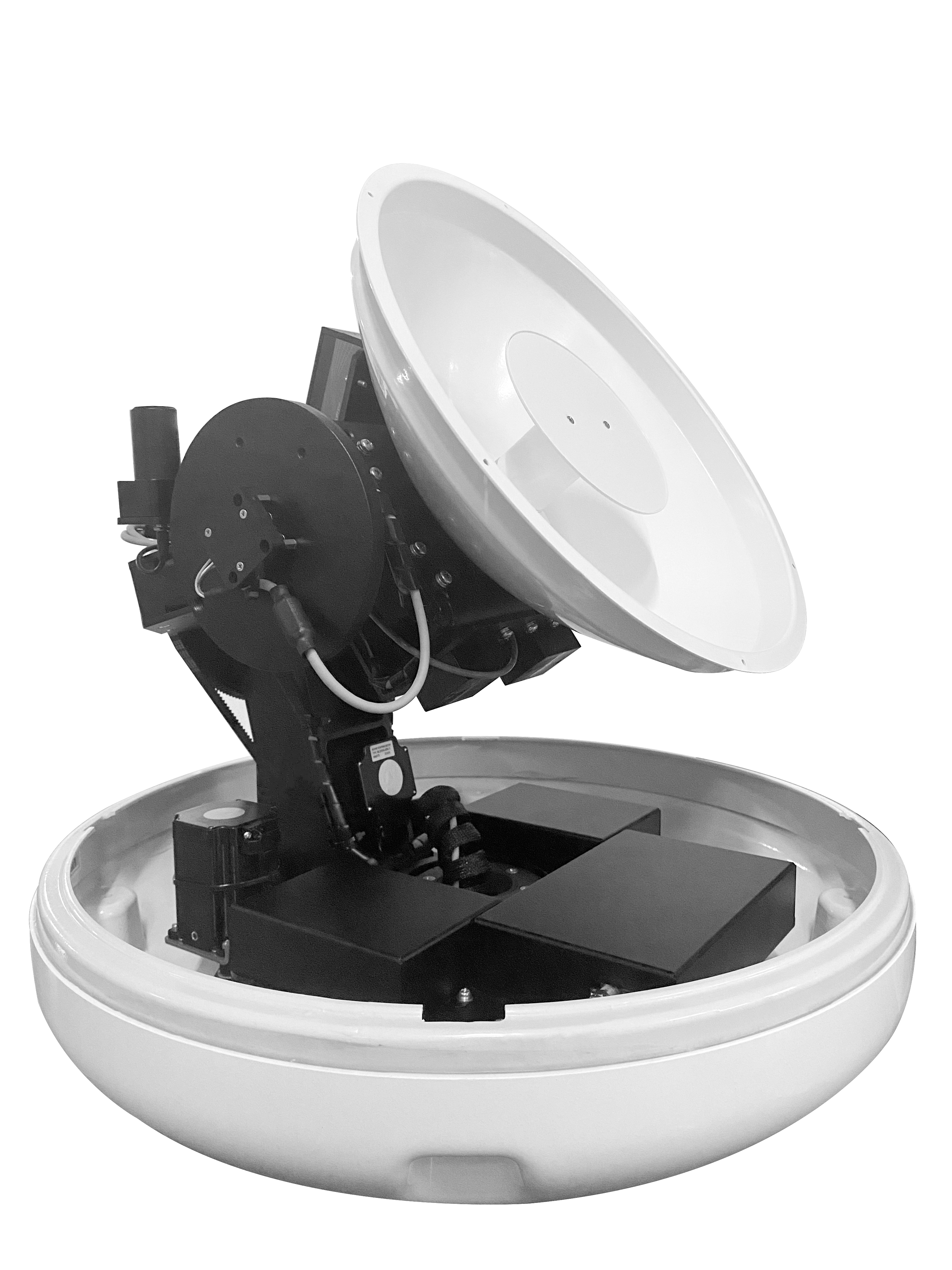
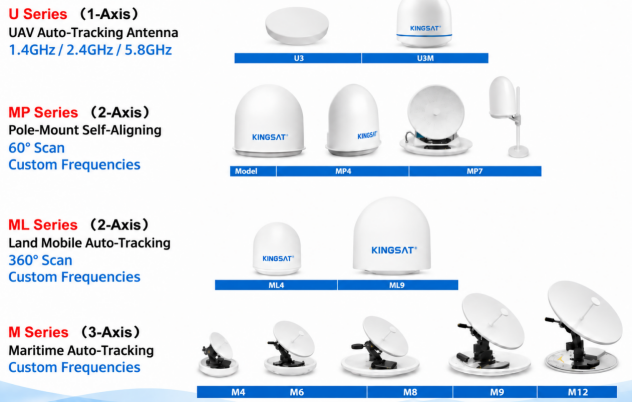
On moving vessels and floating platforms, KINGSAT M-Series three-axis auto-tracking antennas use high-precision gyroscopes and a three-axis servo system to compensate for wave-induced motion in real time, helping keep their high-gain beams (30 dBi and above) aligned with the target. On fixed installations, MP-Series pole-mounted, self-aligning antennas form a resilient array of base-station nodes.
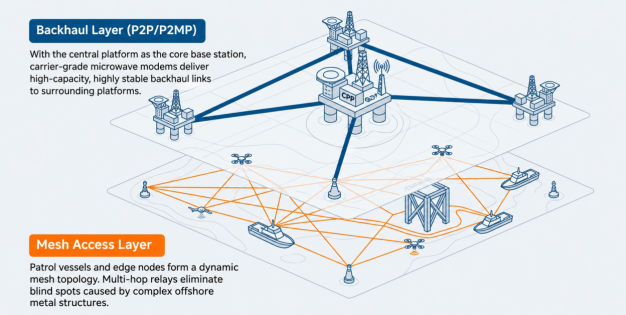
2.2 Flexible Network Coverage: Integrating P2P/P2MP Backhaul with Mesh Networking
- Backhaul layer (P2P/P2MP): The central platform acts as the hub, using carrier-grade microwave modems to provide high-capacity point-to-point and point-to-multipoint backhaul links to surrounding platforms.
- Self-healing access layer (Mesh): A mesh topology connects patrol vessels and edge nodes, enabling multi-hop forwarding and helping extend coverage around blind spots caused by large metal structures.
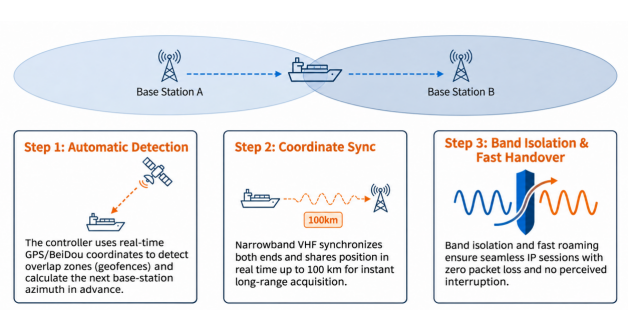
2.3 Seamless Roaming: Intelligent Geofencing and Real-Time VHF Position Synchronization
- Geofencing-based handover: Using real-time GPS/BeiDou coordinates, the controller detects when a node enters overlapping base-station coverage and calculates the bearing to the next station in advance to support a smooth RF link handover.
- Narrowband VHF position synchronization: The two endpoints exchange position and orientation data in real time over distances of up to 100 km, enabling rapid target acquisition during initialization or beyond-line-of-sight operation.
- Frequency isolation and fast roaming: Frequency-planning measures and fast-roaming protocols are designed to minimize interference, packet loss, and perceptible disruption to active IP sessions during handover.
3. Benefits: Fiber-Like Performance, No Recurring Bandwidth Fees, and Marine-Grade Reliability
- High throughput and ultra-low latency: With aggregate throughput of up to 1,500 Mbps and reported latency of 1.93–4.22 ms, the network is designed to carry dozens of 1080p video streams alongside real-time SCADA traffic.
- No recurring traffic charges and a potentially faster payback: A privately owned microwave network avoids the recurring satellite bandwidth fees associated with VSAT services. The proposed payback period is 1–2 years, depending on deployment costs and operating conditions.

- IP54 protection and weather-resistant design: UV-resistant ASA radomes and mechanical locking mechanisms are designed for demanding offshore environments, including salt spray and strong winds, with a stated availability target of 99.99%.
- Simplified deployment and remote maintenance, without a ship’s gyrocompass: The system is designed for straightforward installation and startup. A graphical web interface supports remote diagnostics, reducing the need for on-site troubleshooting and maintenance.

Conclusion: A Connected Offshore Future Across Sea, Land, Air, and Space
Connecting a cluster of offshore oil and gas platforms requires more than high-capacity radios. It calls for equipment built for marine conditions, precise RF alignment, and a flexible network topology. By combining three-axis auto-tracking antennas, geofencing-based handover, and multi-node mesh networking, KINGSAT offers a high-speed, low-latency, reliable private communications solution for challenging offshore operations—a mobile, fiber-like network at sea.
Looking ahead, the KINGSAT microwave auto-tracking antenna system is positioned to support integration with 3GPP 5G Non-Terrestrial Network (NTN) backhaul architectures, connecting satellite networks (LEO, MEO, and GEO), high-altitude platform stations (HAPS), and terrestrial and maritime private networks. This approach can help offshore energy operators build more integrated communications across sea, land, air, and space.
Contact us: sales@kingsat-tech.com Official website: www.kingsat-tech.com
Youtube: http://www.youtube.com/@kingsatmaritimeantennas4640