
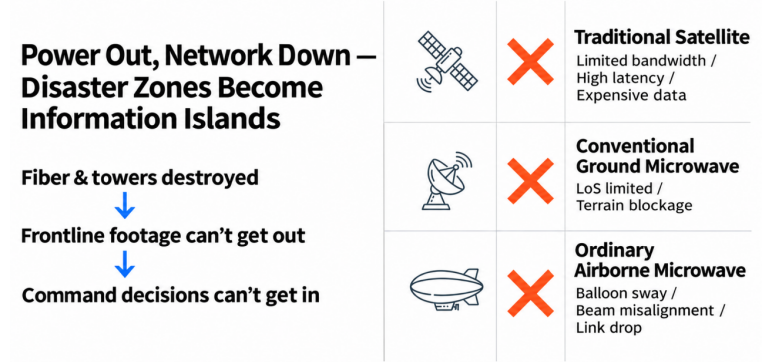
When earthquakes, severe flooding, typhoons, or landslides strike, terrestrial fiber-optic cables and cellular towers are often among the first pieces of infrastructure to be damaged or destroyed. With power and connectivity cut off, affected areas can quickly become isolated: live footage cannot reach command centers, instructions struggle to reach frontline teams, and valuable rescue time is lost.
Conventional emergency communications often rely on portable satellite terminals or satellite-equipped response vehicles. However, limited satellite capacity, high data charges, and latency can make it difficult to support multiple 1080p video-conferencing feeds, UAV reconnaissance streams, and large volumes of simultaneous onsite traffic.
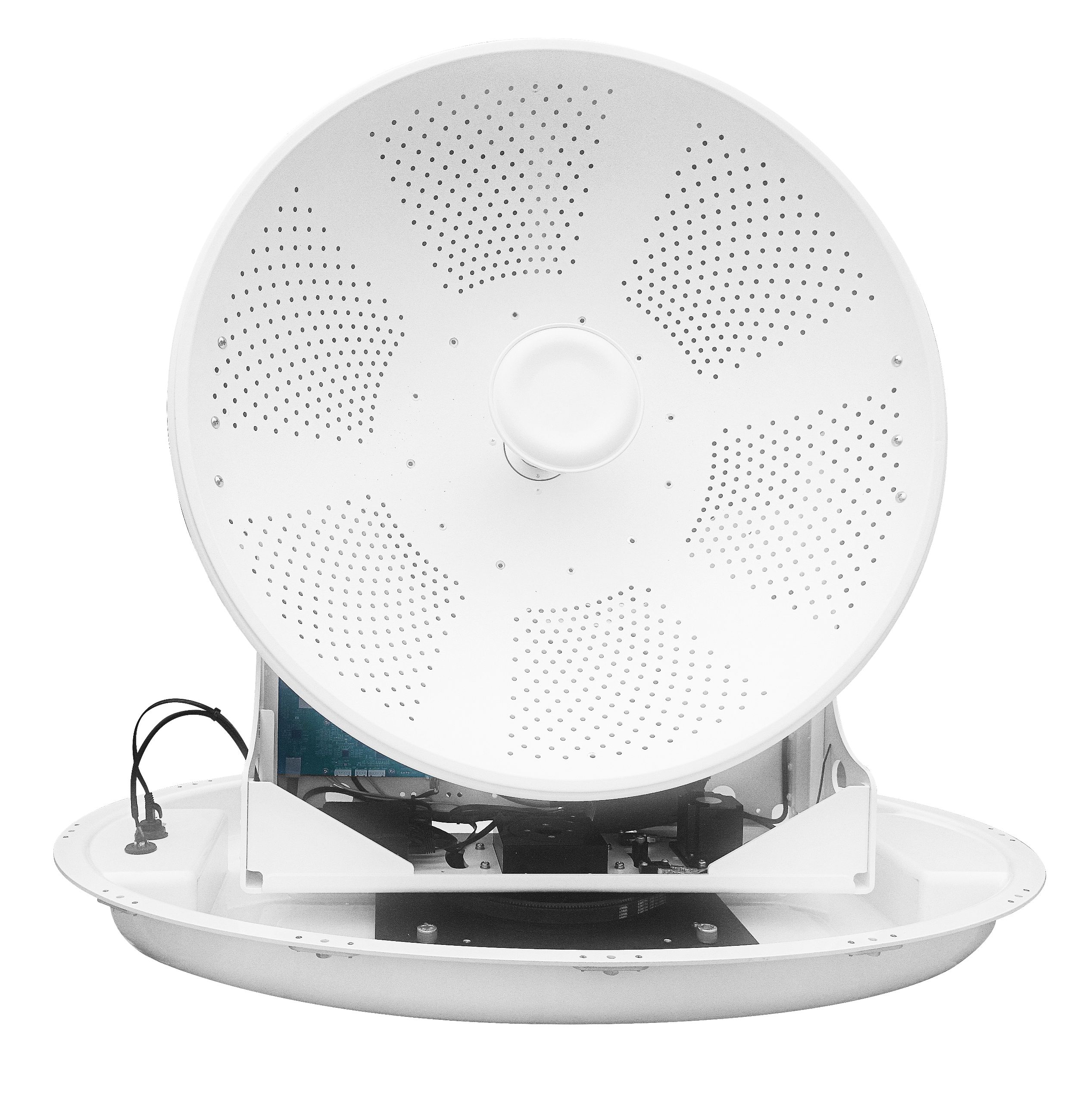
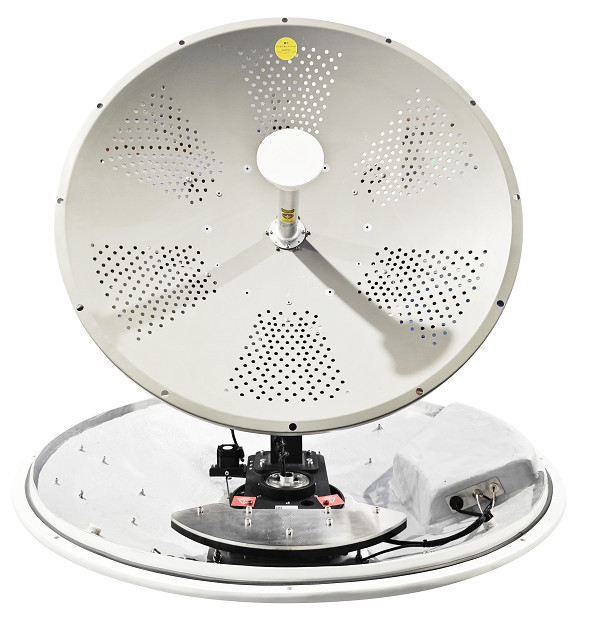
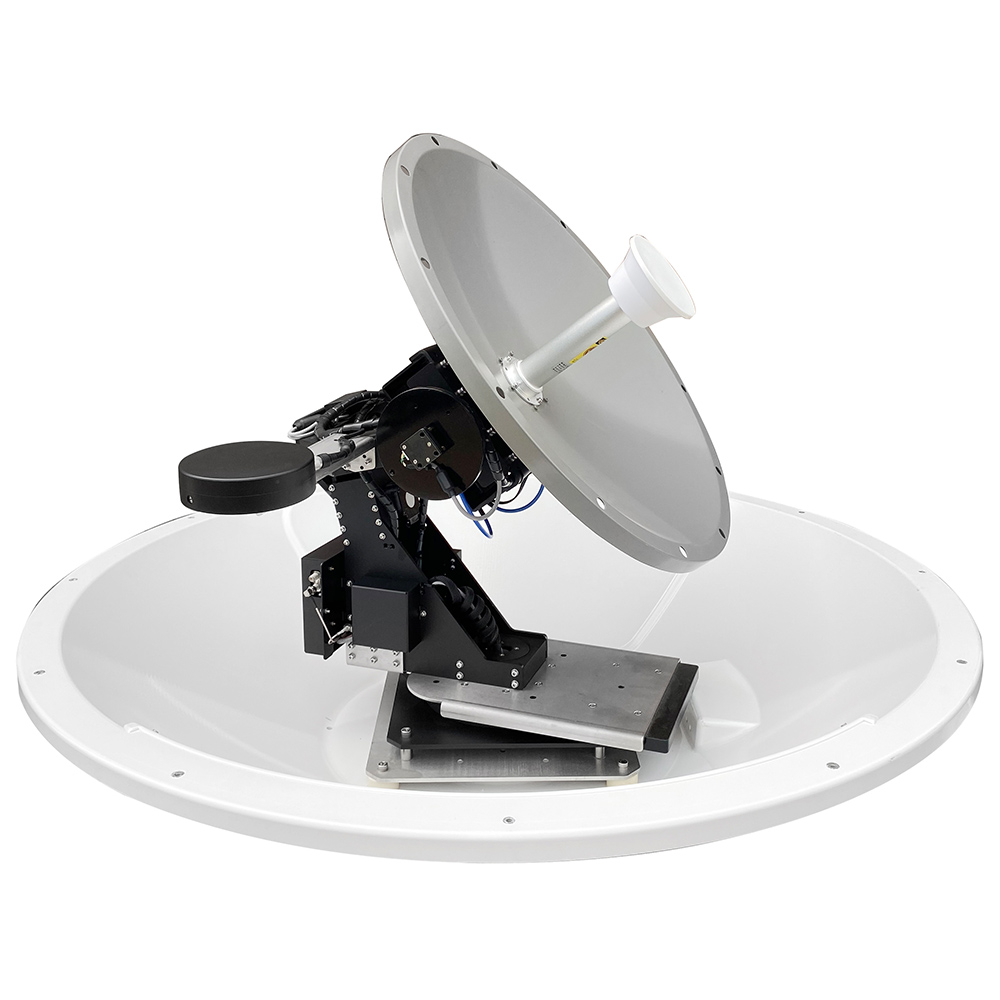
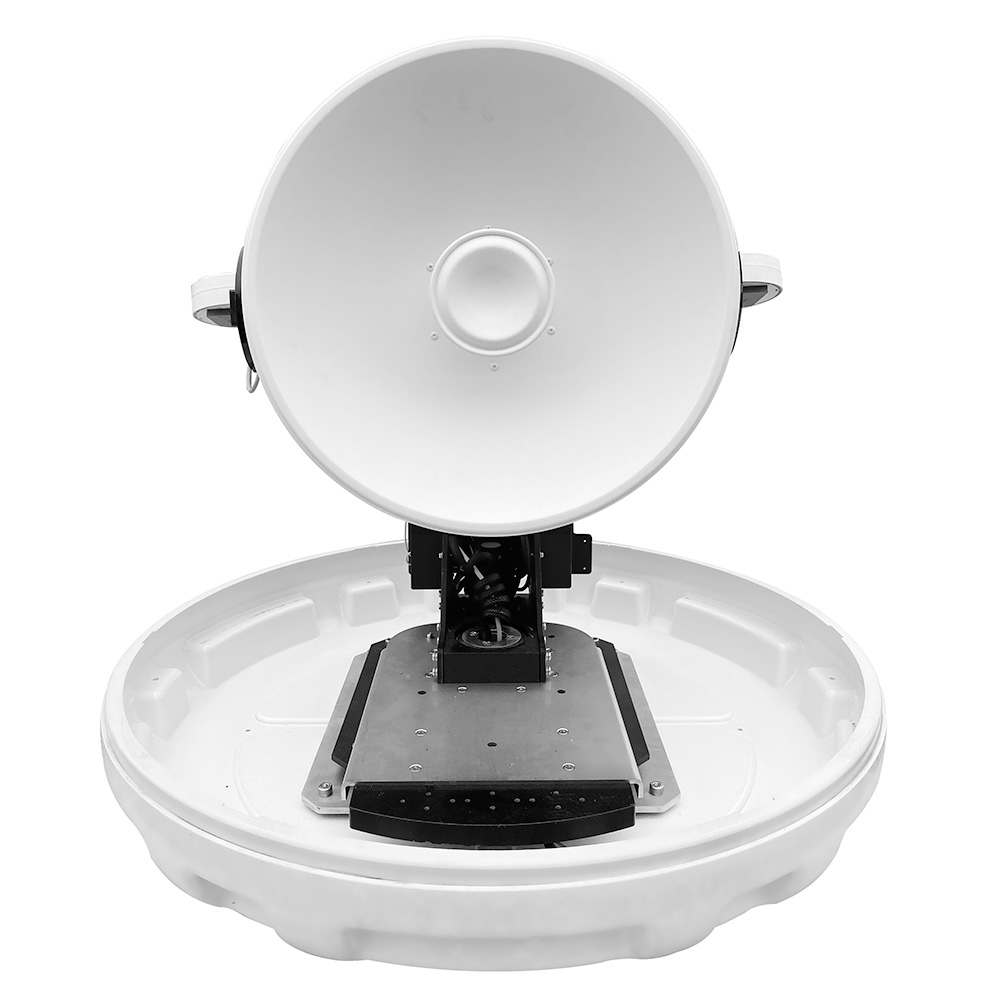
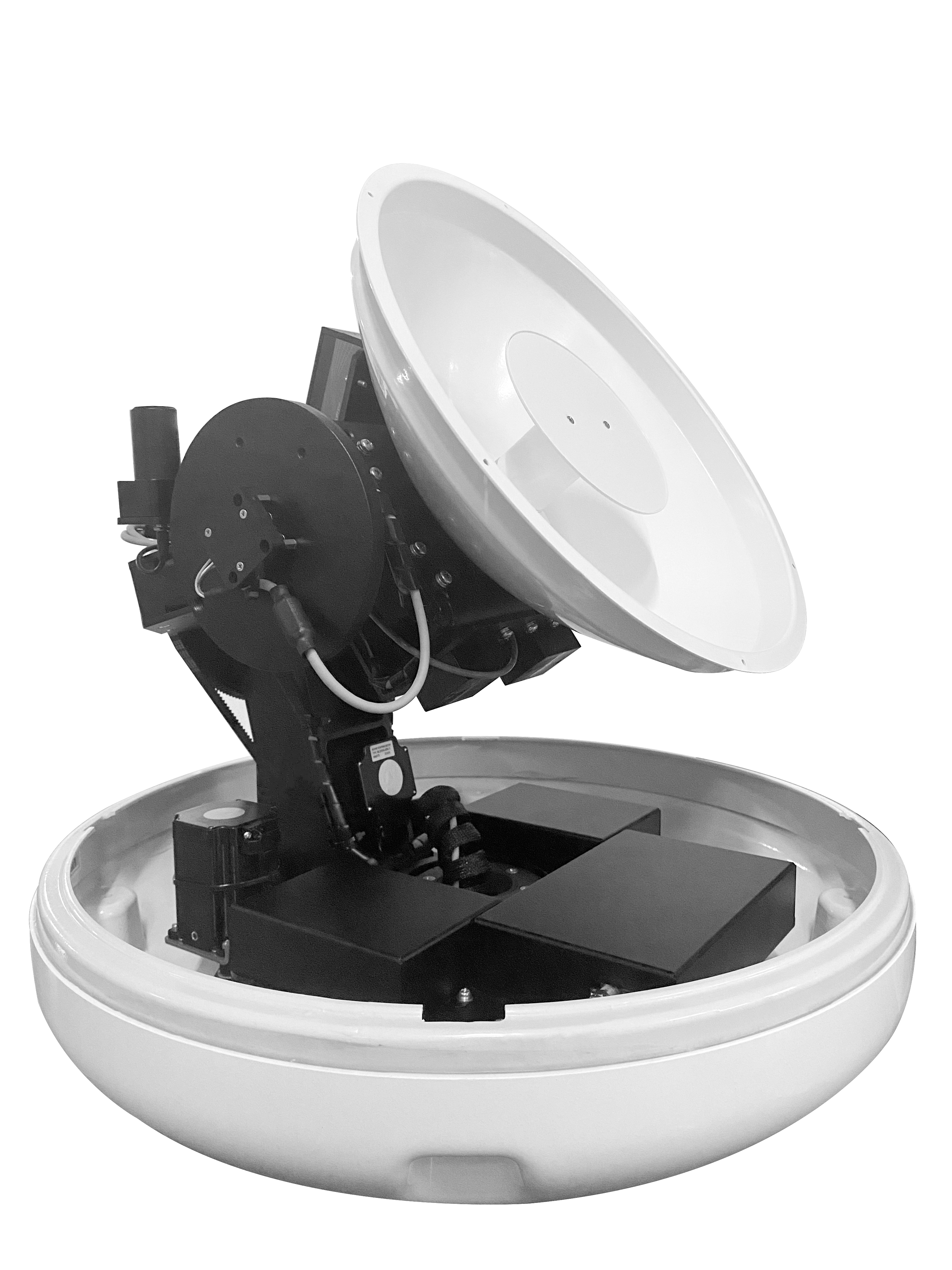
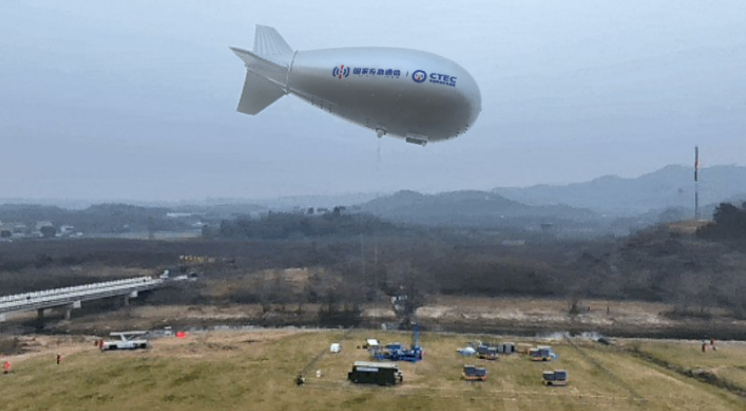
Traditionally, point-to-point microwave links have connected shore-based towers to vessels at sea or terrestrial towers to fixed stations. KINGSAT brings a different approach to disaster response in terrain-obstructed environments: mounting its M6S suspended, three-axis auto-tracking microwave antenna beneath a tethered balloon or airship. At the heart of a high-capacity, rapidly deployable air-to-ground backhaul system, the antenna helps establish a high-bandwidth, low-latency wireless link from hard-to-reach disaster areas to the wider response network.
Challenges: Damaged Infrastructure and Obstructed Line of Sight
Major disaster-response operations expose three fundamental limitations of conventional emergency communication systems:
1.1 Terrain Obstructions Limit Ground-to-Ground Microwave Links
High-bandwidth microwave transmission over tens of kilometers requires a clear line of sight (LoS). In mountains, wooded valleys, and urban disaster zones, ridgelines and collapsed structures can block the path between ground-based communication vehicles, preventing a direct microwave backhaul connection.
1.2 Platform Motion Makes Narrow-Beam Alignment Difficult
To overcome terrain barriers, response teams may deploy communications payloads on tethered balloons or airships. This introduces two challenges:
- Long-range, high-capacity microwave links depend on high-gain directional antennas with narrow beamwidths, typically around 3.5°–6°.
- Winds and air currents can cause an airborne platform to rotate, sway, and drift. A conventional fixed microwave antenna may then lose alignment with its counterpart, interrupting the link.
1.3 Suspended Mounting Requires Specialized Mechanics and Control
When an antenna is mounted upside down beneath a balloon's payload gondola, its mounting geometry, azimuth and elevation reference frames, and gravity-sensing orientation differ from a conventional installation. Standard ground-based servo-control algorithms and mechanical travel limits therefore cannot be applied unchanged, placing additional demands on the antenna control unit (ACU).
2. Solution: A 50 km Air-to-Ground Microwave Backhaul Link with the Suspended M6S
To address these challenges, KINGSAT has adapted its three-axis, self-stabilizing tracking technology—developed for demanding offshore conditions—for use on low-altitude aerostat platforms, creating an integrated airborne and ground-based emergency communications solution.
2.1 System Architecture and Data Flow
The system operates through four interconnected layers:
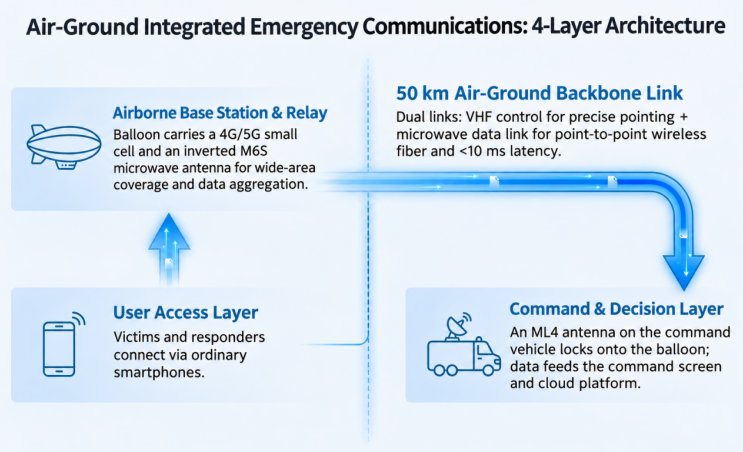
- Ground-user access: Affected residents and frontline responders can use ordinary smartphones—without dedicated terminals—to connect to the airborne 4G/5G cellular coverage (LTE-Uu / NR-Uu) for calls and emergency messages.
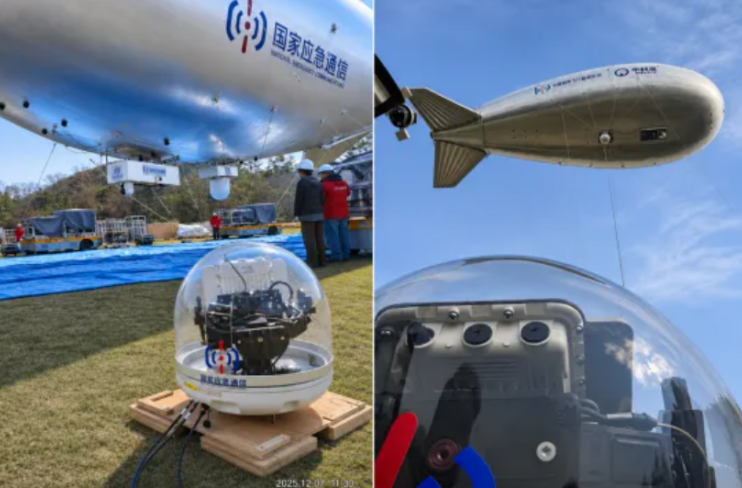
- Airborne base station and relay payload: A tethered balloon or airship carries a 4G/5G small cell alongside the KINGSAT M6S suspended three-axis auto-tracking microwave antenna, with an integrated microwave modem and narrowband radio. The small cell provides cellular coverage to users on the ground, while the M6S carries aggregated voice and data traffic over a microwave link toward the command network.
- Air-to-ground backhaul: The airborne M6S and a vehicle-mounted ground antenna establish two complementary links. A narrowband control link exchanges GNSS coordinates and altitude information to support initial antenna pointing without a pre-existing microwave connection. A high-capacity microwave data link then provides point-to-point backhaul over distances of up to 50 km, with throughput in the hundreds of megabits per second and claimed single-hop latency below 10 ms.
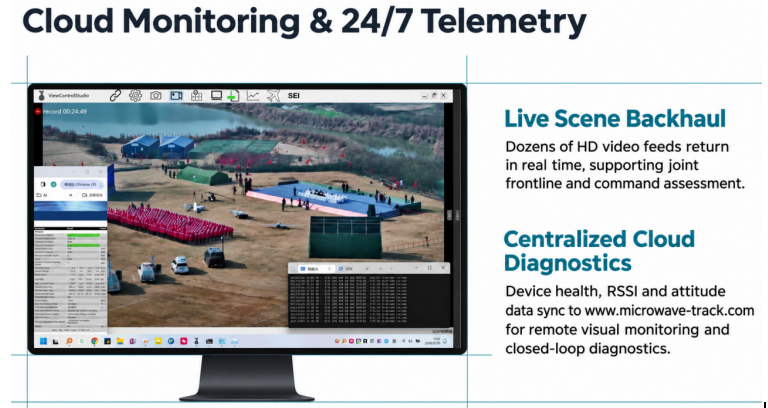
- Command and network aggregation: A KINGSAT ML4 two-axis tracking antenna, mounted on a mobile command vehicle, tracks the airborne platform. Traffic is routed to command-center displays and the wider communications backbone. Antenna telemetry is also sent to the centralized cloud platform at www.microwave-track.com for around-the-clock remote visualization and diagnostics.
2.2 Core Technologies Behind the KINGSAT Solution
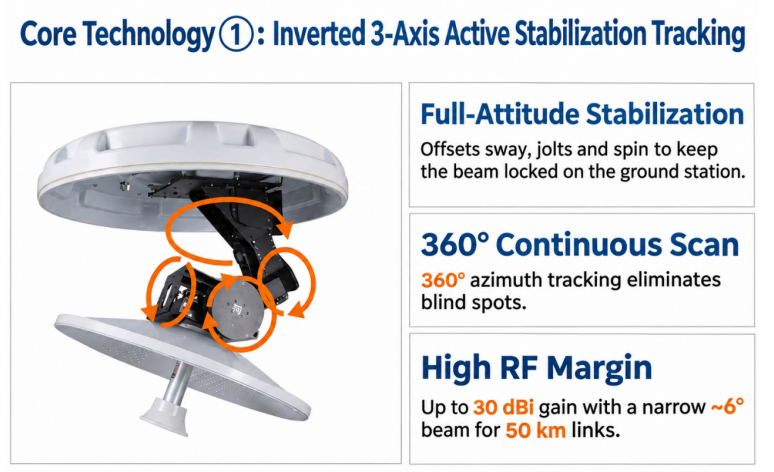
Suspended Three-Axis Active Stabilization and Tracking — M6S
Designed for balloon and airship gondolas, the KINGSAT M6S uses a fully automated three-axis servo-tracking architecture:
- Full-attitude stabilization: An suspended-mount motion-compensation algorithm continuously corrects for sway, vibration, and rotation caused by air currents, helping keep the antenna beam aligned with the ground station.
- Continuous 360° tracking and high gain: The azimuth axis supports continuous 360° tracking. With an antenna gain of 30 dBi and an approximately 6° beamwidth, the M6S is designed to provide link margin for microwave transmission at distances of up to 50 km.
Narrowband-Assisted Initial Pointing for Links up to 50 km
Even when public mobile networks are unavailable and no microwave link has yet been established, KINGSAT uses a dual-link approach combining narrowband radio signaling with broadband microwave backhaul:
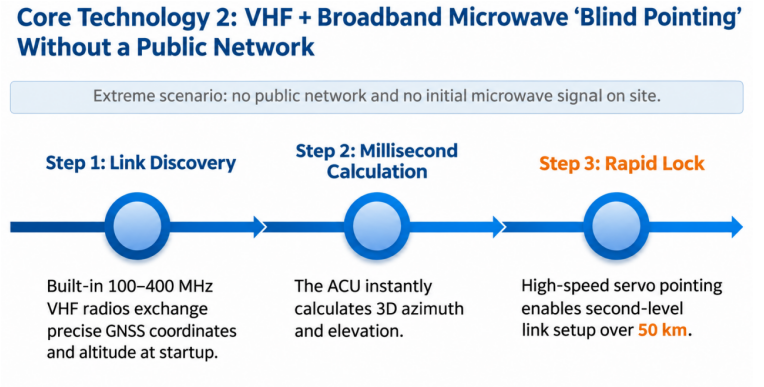
- Both the airborne M6S and ground-based ML4 incorporate a narrowband data radio specified for 100–400 MHz operation.
- The narrowband link enables the two units to exchange precise GNSS latitude, longitude, and altitude data at startup, taking advantage of lower-frequency propagation characteristics.
- Using this information, the antenna control units (ACUs) calculate azimuth and elevation angles and drive the servo motors to point the antennas toward each other. The system is designed to establish a link within seconds, even across a separation of up to 50 km.
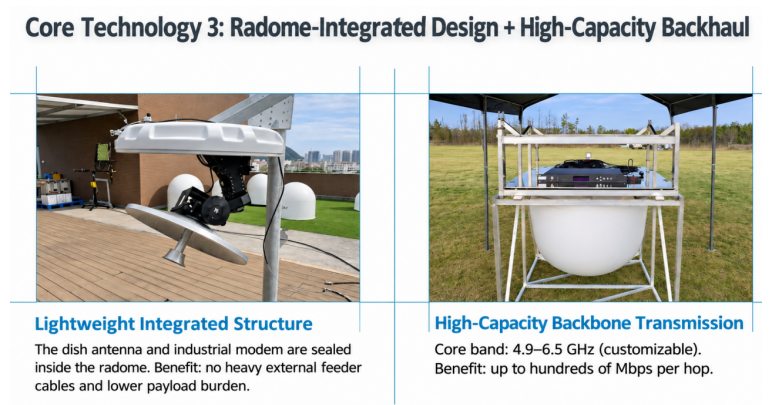
Integrated Radome Design and High-Capacity Microwave Transmission
- Integrated modem architecture: In both the M6S and ML4, the parabolic antenna and industrial-grade high-throughput microwave modem are housed within the radome, with configurations supporting platforms such as RADWIN and Cambium. The integrated design reduces the need for external RF feeder cables and helps limit payload weight on the balloon gondola.
- High-capacity backhaul: The primary operating range is 4.9–6.5 GHz, with customization options for other emergency-use bands such as 1.4 GHz. A single hop can deliver net throughput in the hundreds of megabits per second, depending on the configuration and link conditions.
3. Customer Benefits: Reliable Connectivity When It Matters Most
The KINGSAT M6S suspended-mount solution offers four practical advantages for emergency response:
3.1 Deploy in Minutes to Restore Critical Links Faster
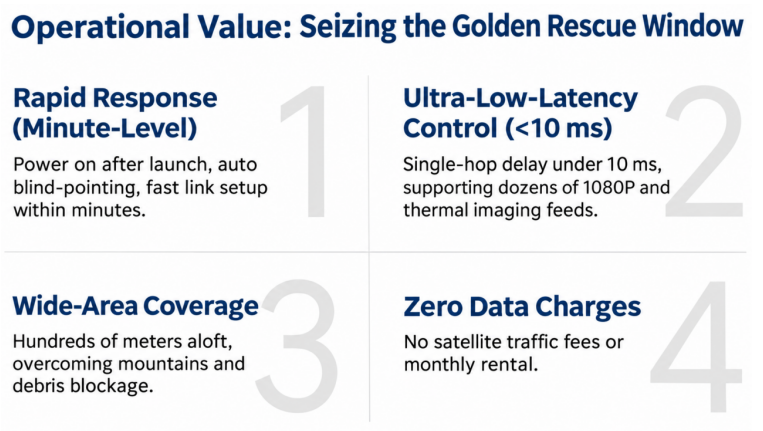
Conventional temporary microwave links may require personnel to access towers and manually fine-tune antenna alignment, a process that can take hours. With the M6S solution, a response vehicle can arrive near the affected area and deploy a tethered balloon. Once the airborne equipment is powered, narrowband-assisted positioning and automatic tracking help establish a long-range microwave link within minutes, over a distance of up to 50 km.
3.2 High Throughput and Sub-10 ms Single-Hop Latency
The microwave backhaul can provide substantially more capacity than some conventional satellite links. Throughput in the hundreds of megabits per second can support multiple 1080p UAV search-and-rescue video feeds, thermal-imaging streams, and command data. With a claimed single-hop latency below 10 ms, it is intended to support timely coordination between frontline teams and command centers.
3.3 Extend Coverage Beyond Terrain Obstructions
Positioning the communications payload hundreds of meters above ground can help clear line-of-sight obstacles created by mountains and damaged buildings. The elevated platform supports long-range microwave backhaul while the onboard small cell extends mobile coverage into areas that ground-based infrastructure may not reach.
3.4 Avoid Satellite Data Charges and Monitor Equipment Remotely
- No satellite data subscription for the microwave link: An independently deployed point-to-point microwave network does not require ongoing satellite traffic packages or satellite data subscriptions for that link. This can reduce recurring connectivity expenditure during training exercises and emergency deployments.
- Centralized cloud monitoring: Equipment status, received signal strength indication (RSSI), and antenna attitude data are transmitted to www.microwave-track.com for remote monitoring, visualization, and troubleshooting, helping command teams assess link performance at any time.
Conclusion
From offshore vessels operating in rough seas to emergency response platforms over disaster-affected terrain, KINGSAT is extending its self-stabilizing antenna-tracking technology into new environments. The suspended M6S auto-tracking microwave antenna is designed to maintain accurate alignment despite the movement of airborne platforms, helping establish vital air-to-ground backhaul links across terrain barriers when reliable communications are needed most.
Contact us: sales@kingsat-tech.com Official website: www.kingsat-tech.com
Youtube: http://www.youtube.com/@kingsatmaritimeantennas4640