
When natural disasters such as earthquakes, floods, typhoons, and landslides, or major emergencies like large-scale wildfires and industrial explosions, strike, conventional communication networks in affected areas, including fiber-optic infrastructure and cellular base stations, are often among the first systems to be damaged. In many cases, communications are severely disrupted or completely cut off, leaving affected areas as “information islands.”
As a result, critical disaster data and high-definition video from the frontline cannot be transmitted to command centers in real time, while backend commands and decisions fail to reach the field. In emergency response and disaster relief, communications must always come first. The critical question remains: How can a high-bandwidth, low-latency “communications lifeline” be established within the golden window for rescue?
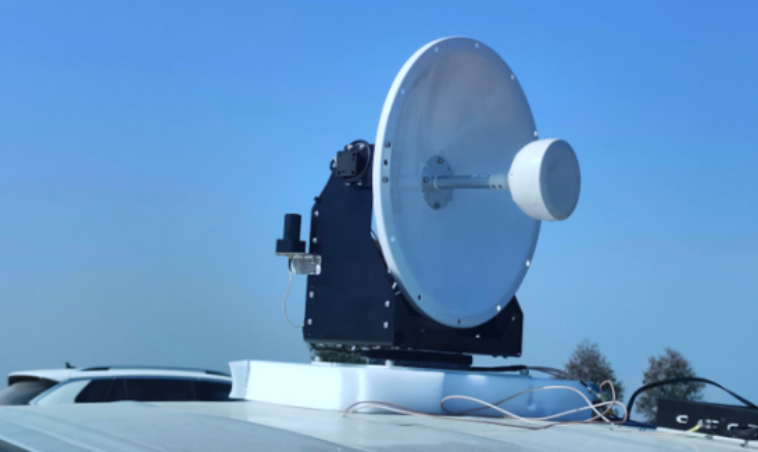
As an expert in wireless self-stabilizing tracking antennas, KINGSAT leverages deep expertise in maritime and land-based high-dynamic tracking to engineer a vehicle-mounted microwave auto-tracking backhaul system tailored for emergency response and mobile command operations.
The solution combines KINGSAT’s proprietary self-stabilizing tracking algorithms with an innovative narrowband-and-broadband link-establishment technology, serving as a “wireless fiber” backhaul solution for emergency mobile base stations. It enables deployment within minutes while providing high-bandwidth, low-latency backhaul connectivity.
I. Industry Challenges: Three Key Obstacles to Emergency Communications in Disaster Areas
When conventional communication networks are damaged, overloaded, or unavailable, rapidly establishing a temporary communication command center or coverage zone faces several critical technical challenges.
1. Slow Deployment and Difficult Alignment in Conventional Microwave Systems
Delivering high-bandwidth backhaul over tens of kilometers across rugged terrain requires high-gain directional parabolic antennas with ultra-narrow beams of just 3.5° to 10°.
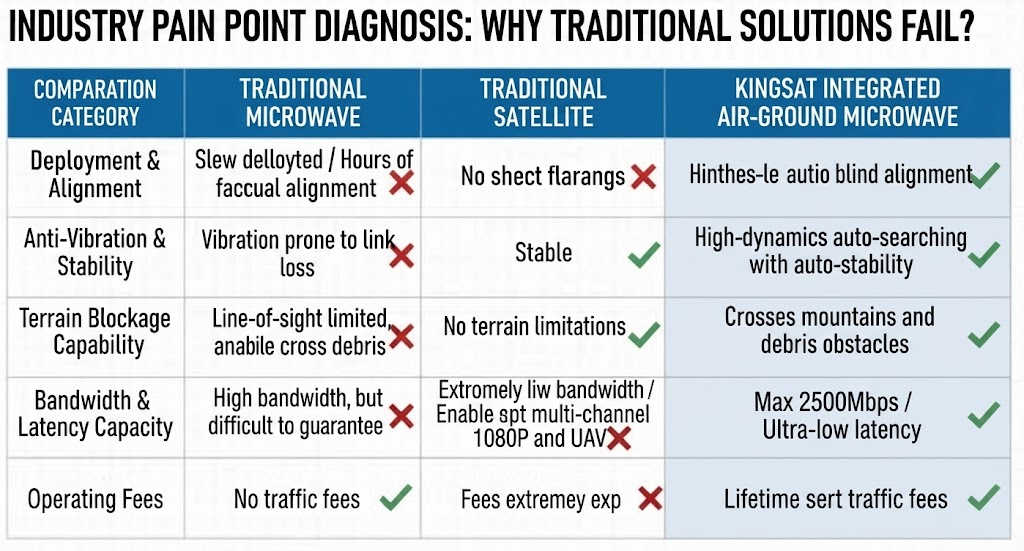
Conventional fixed microwave systems fall short in emergency scenarios. They demand hours of manual tower climbs for fine-tuning. Worse yet, in disaster zones, vehicle tilt from uneven terrain or transit vibrations can easily misalign these narrow beams, causing the link to drop entirely.
2. Terrain Obstructions Limit Ground-to-Ground Connectivity
Mountains, forests, and urban rubble can block the line-of-sight path between an emergency communication vehicle and a cellular base station or other undamaged backbone node located tens of kilometers away.
Without support from an integrated air-ground relay architecture, the effective range of ground-to-ground microwave links can be severely restricted.
3. Limited Satellite Bandwidth and High Connectivity Costs
Satellite communications easily handle basic voice and low-speed data, but steep service fees and tight bandwidth make them unsuitable for disaster zones. They simply cannot support the uninterrupted, simultaneous streaming of multiple 1080P surveillance feeds and drone reconnaissance footage.
II. KINGSAT Solution: Rapid Air-Ground Connectivity & Instant Link Establishment
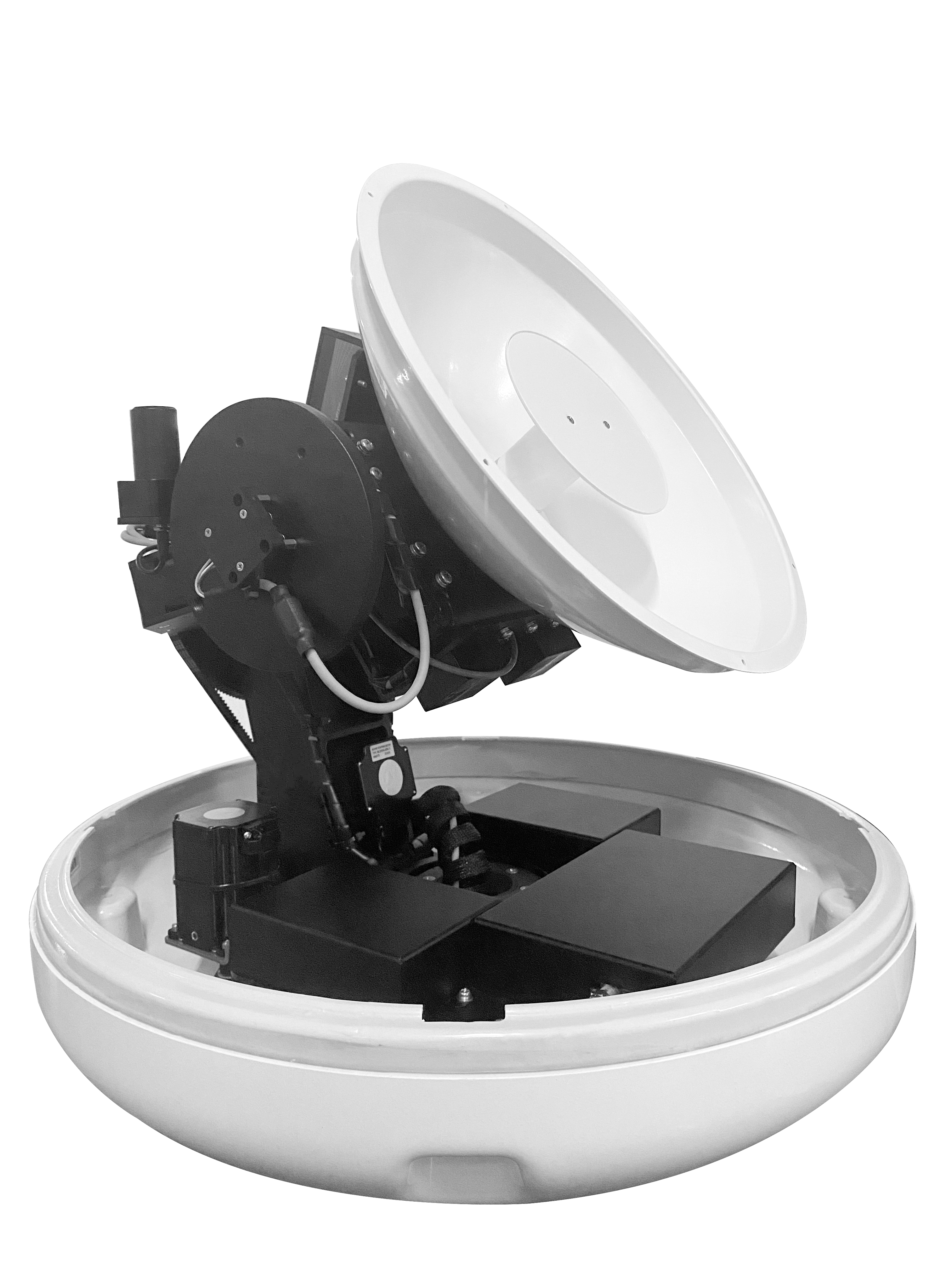
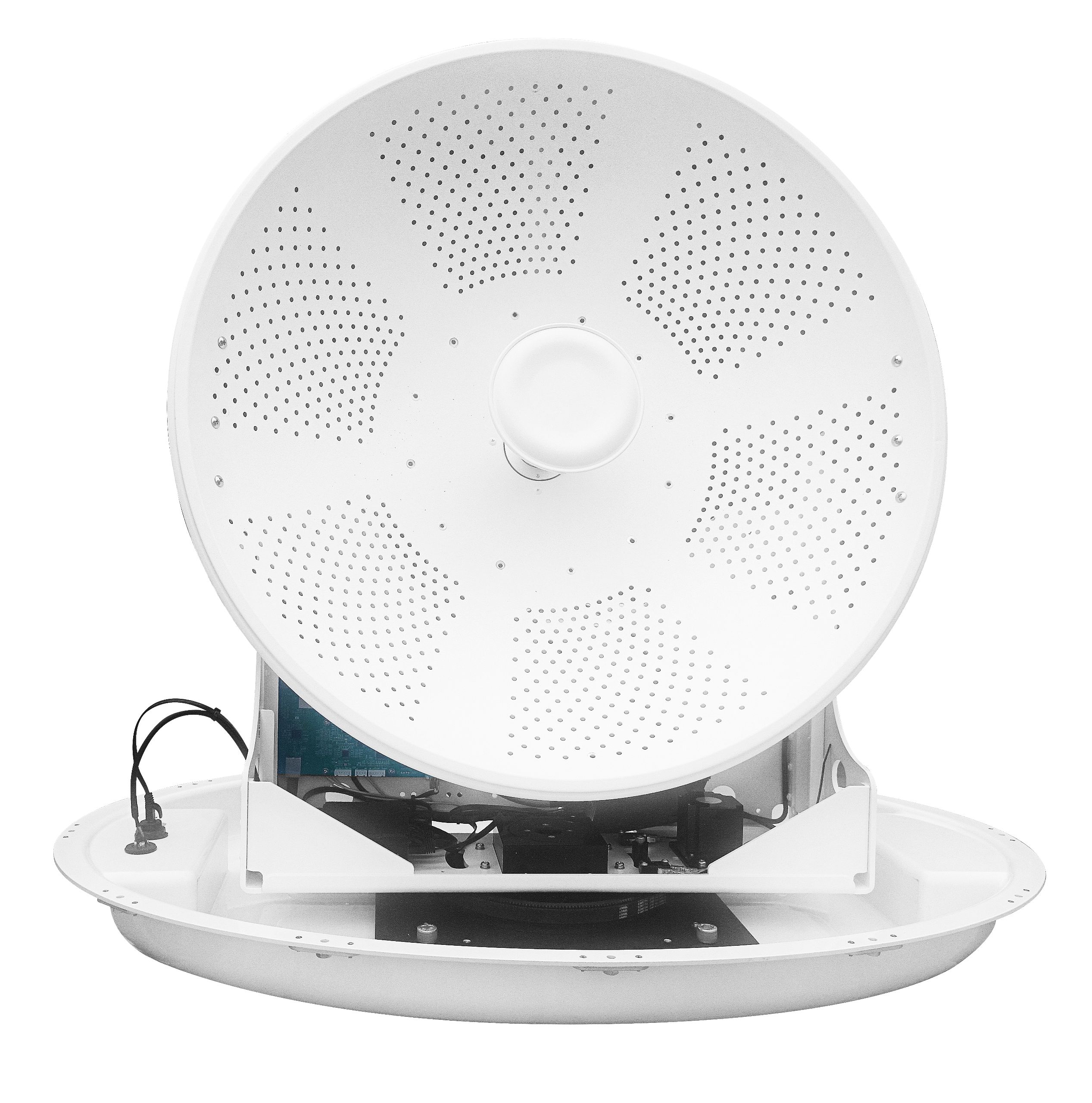
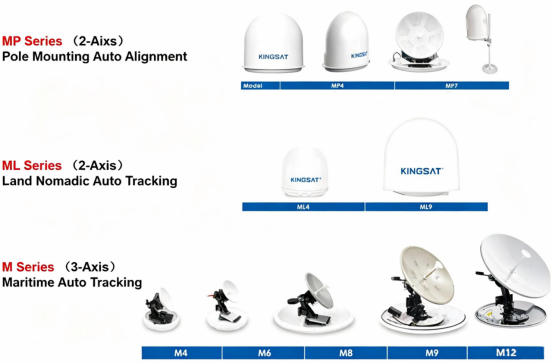
To meet the demanding requirements of disaster prevention, emergency response, and rescue operations, KINGSAT has developed a high-speed air-ground microwave backhaul solution centered on its ML Series land-based two-axis auto-tracking antennas for emergency situation.
Deployment Architecture and Two Core Scenarios
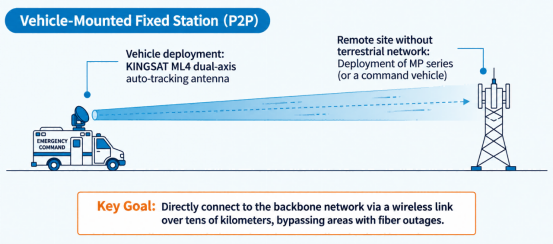
Scenario 1: Vehicle-to-Fixed-Station or Vehicle-to-Vehicle P2P Connectivity
- Vehicle Side:
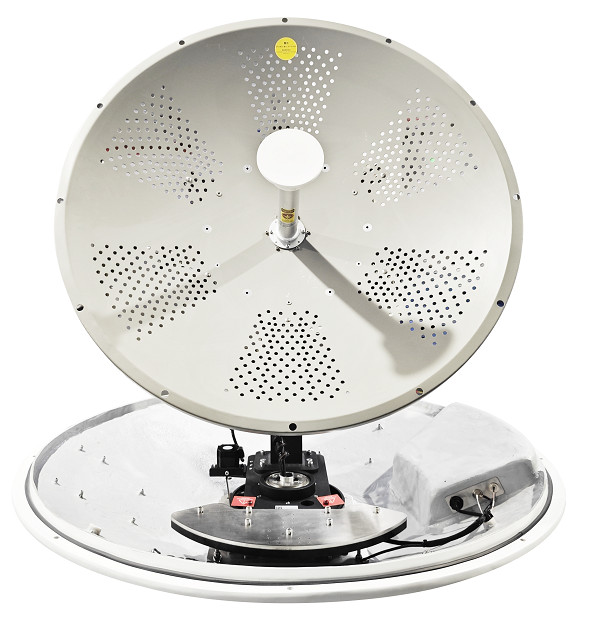
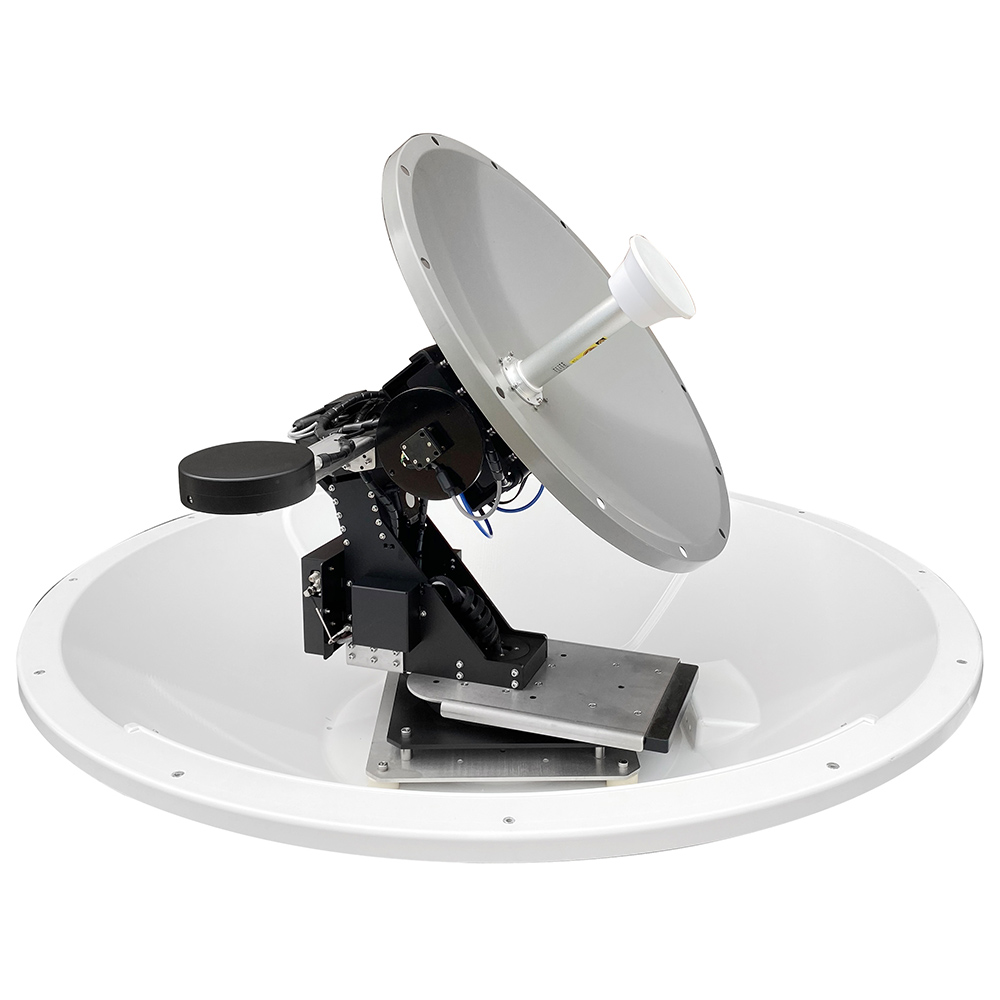
A KINGSAT ML4 two-axis auto-tracking antenna, integrated with a high-throughput microwave modem, is mounted on the roof of a mobile command or emergency communication vehicle.
- Base Station Side:
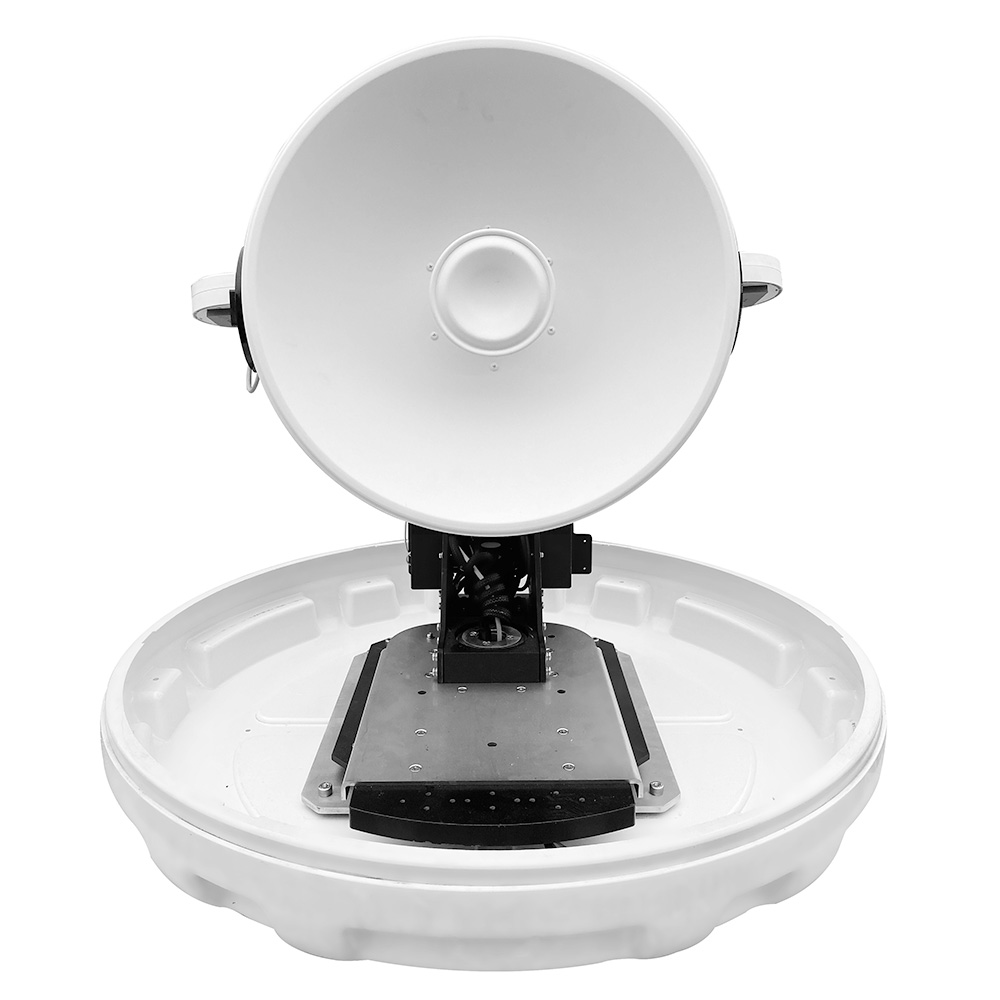
The vehicle establishes a wireless link with an undamaged remote fixed tower featuring an MP Series two-axis self-calibrating antenna, or connects directly with another emergency vehicle, rapidly restoring access to the backbone network.
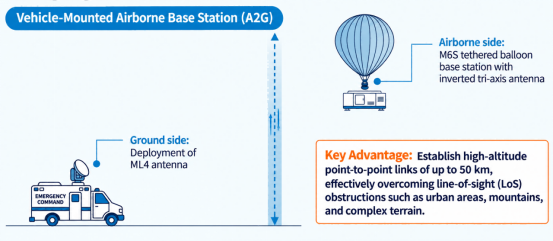
Scenario 2: Vehicle-to-Tethered Balloon Base Station High-Altitude Backhaul
- Airborne side:
A tethered emergency balloon is deployed at an altitude of tens or even hundreds of meters. An inverted KINGSAT M6S three-axis microwave auto-tracking antenna is installed on the airborne base station.
- Ground side:
An ML4 antenna is deployed on the ground-based command vehicle. The ML4 establishes a high-altitude point-to-point backhaul link of up to 50 km with the airborne M6S, helping overcome obstructions caused by mountains and buildings.
III. Four Core Technologies Behind KINGSAT Emergency Microwave Backhaul
1. 100 km VHF Narrowband and Broadband Microwave Fusion for Intelligent Alignment
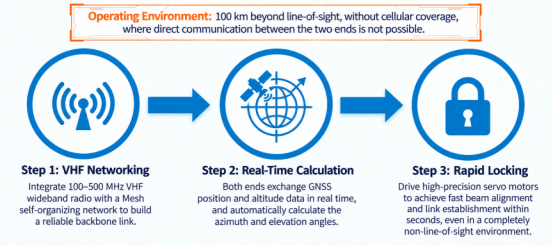
In disaster areas where public cellular networks are unavailable and the two terminals may not have direct visibility, KINGSAT has developed a dual-link architecture combining VHF narrowband data transmission with broadband microwave communication.
- Real-time position synchronization:
Both antenna systems—the vehicle-mounted terminal and the airborne or tower-side terminal—integrate 100–500 MHz VHF narrowband data radios.
- Precise alignment calculation:
Even when no microwave signal is available between the two sites, the VHF narrowband Mesh network can exchange GNSS latitude, longitude, and altitude information in real time.
The system automatically computes the required azimuth and elevation angles, driving high-precision servo motors to achieve rapid blind alignment and establish the microwave link within seconds.
2. Self-Stabilizing Tracking and Adaptive High-Dynamic Optimization
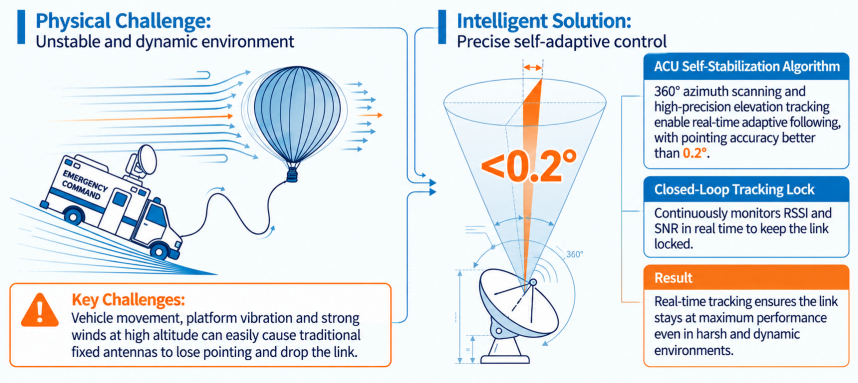
The KINGSAT controller (ACU) integrates self-stabilizing algorithms and a closed-loop optimization mechanism to handle vehicle tilt, slight vehicle movement caused by wind, and drift of tethered balloons caused by high-altitude winds.
- Adaptive tracking:
The antenna can perform adaptive tracking across a 360° azimuth range and a wide elevation range, with optimization accuracy controlled to less than 0.2°.
- Real-time signal optimization:
The system automatically tracks the peak values of RSSI (Received Signal Strength Indicator) and SNR (Signal-to-Noise Ratio), continuously correcting the antenna pointing direction as the vehicle or airborne platform moves. This helps maintain the maximum aggregated link throughput under vibration, wind, and other dynamic conditions.
3. Built-In High-Throughput Modem and Flexible Multi-Band Customization
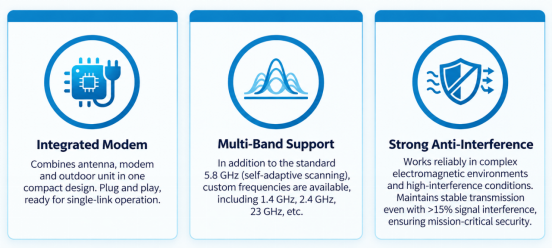
The KINGSAT ML Series integrates the antenna and modem into a unified system, eliminating the physical separation between a conventional antenna and an external microwave modem.
The system houses both a high-gain parabolic antenna and a high-throughput microwave modem inside the radome. It supports customized integration with mainstream microwave platforms such as Radwin, Cambium, and Ceragon. Designed for simplified deployment, the system offers power-on operation and single-Ethernet-cable connectivity.
The standard operating frequency is typically 5.8 GHz, featuring adaptive frequency scanning to avoid interference. Depending on national emergency spectrum planning and application requirements, customized options such as 1.4 GHz, 2.4 GHz, and 23 GHz are also available. The system can provide up to 2,500 Mbps of throughput, delivering fiber-like bandwidth for mobile emergency communications.
4. In-Band Interference Resistance for Emergency Communications
Disaster zones often feature complex electromagnetic environments, with a high risk of intentional signal jamming.
- In-band interference resistance:
The system can maintain normal transmission of base-station services and high-definition data when in-band interference reaches up to 15%.
IV.Customer Benefits: Building a “Wireless Fiber” Communications Lifeline
KINGSAT vehicle-mounted microwave backhaul solution does more than solve the challenge of establishing a communication link from scratch. It provides significant benefits for emergency response and rescue operations in terms of deployment speed, bandwidth, and operational efficiency.
⏱️ Technical Advantage: Minutes-Level Deployment to Safeguard the Critical Rescue Window
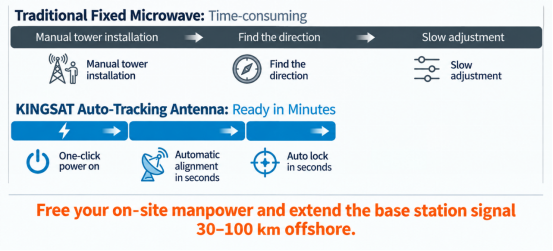
Compared with conventional fixed microwave systems, the KINGSAT supports power-on operation, automatic blind alignment within seconds, and rapid link lock.
Once the emergency communication vehicle arrives at the site, there is no need for personnel to manually determine the antenna direction or fine-tune the pointing angle. The antenna automatically rotates, aligns, and establishes the link, enabling the temporary base station to connect to a remote tower 30–100 km away within minutes for high-bandwidth backhaul.
⚡ Bandwidth Advantage: Up to 2,500 Mbps with Ultra-Low Terrestrial Latency (<10 ms)
- High-volume HD data transmission:
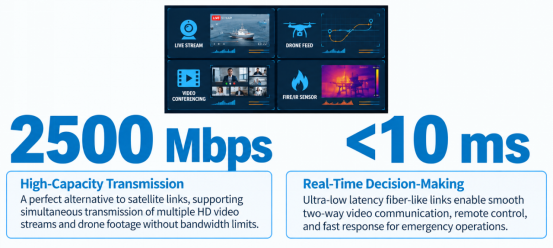
With throughput reaching up to 2,500 Mbps, the system delivers massive backhaul capacity for 4G and 5G mobile base stations. It effortlessly handles the simultaneous streaming of multiple 1080P surveillance feeds and drone-based infrared reconnaissance, completely eliminating the bandwidth bottlenecks and congestion typical of satellite connections.
- Low-latency decision-making:
With microwave link latency typically below 10 milliseconds, the system supports near-real-time video conferencing, command and situational assessment, and remote control of rescue equipment, enabling rapid coordination between frontline and remote command personnel.
📊 Operations and Maintenance: No Recurring Traffic Fees and Cloud-Based Remote Monitoring
- No recurring traffic charges:
Compared with the high recurring costs of maritime satellite connectivity and data services, a self-built microwave link requires a one-time infrastructure investment. When operating in applicable license-exempt spectrum, it can avoid recurring traffic and monthly subscription fees, significantly reducing the ongoing operating costs of emergency drills and disaster response operations.
- Real-time cloud-based status monitoring:
Cloud-based monitoring systems are deployed at both ends of the link. Once connected to the network, the antennas transmit status data, including azimuth and elevation angles, RSSI, operating temperature, and voltage, to KINGSAT cloud servers every 5 seconds.
Maintenance personnel can log in to the centralized platform at www.microwave-track.com to monitor dozens of emergency sites around the clock. This provides a unified view of equipment performance, enabling rapid remote troubleshooting and system adjustments.
Conclusion: Connecting the Digital Lifeline for Emergency Response with KINGSAT
In the critical moments following a disaster, time is life, and communications are command. KINGSAT’s vehicle-mounted and emergency microwave auto-tracking antenna systems use advanced VHF narrowband dual-link blind alignment technology and high-precision automatic stabilization and tracking algorithms to address two major challenges faced by mobile command vehicles in complex environments: rapid alignment and high-bandwidth long-distance backhaul across disaster sites, mountainous terrain, and adverse weather conditions.
As a provider of wireless backbone network solutions, KINGSAT is committed to delivering high-speed connectivity comparable to terrestrial fiber and connecting even the most isolated areas affected by disasters, helping maintain the critical communications lifeline for emergency response and rescue operations.
Contact us: sales@kingsat-tech.com Official website: www.kingsat-tech.com
Youtube: http://www.youtube.com/@kingsatmaritimeantennas4640