
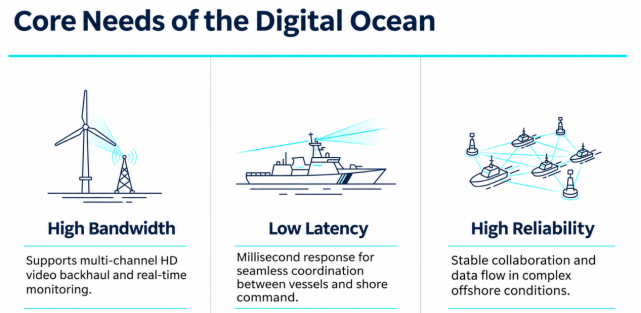
As the maritime economy enters a new era of digitalization and intelligent operations, the demands placed on offshore communications are changing rapidly. From intelligent operations and maintenance at offshore wind farms and real-time production monitoring on oil and gas platforms to HD video transmission from maritime law-enforcement vessels and coordinated operations involving unmanned vessels and research buoy networks, basic voice calls and narrowband text messaging are no longer enough. These applications increasingly require high-bandwidth, low-latency, highly reliable broadband connectivity.
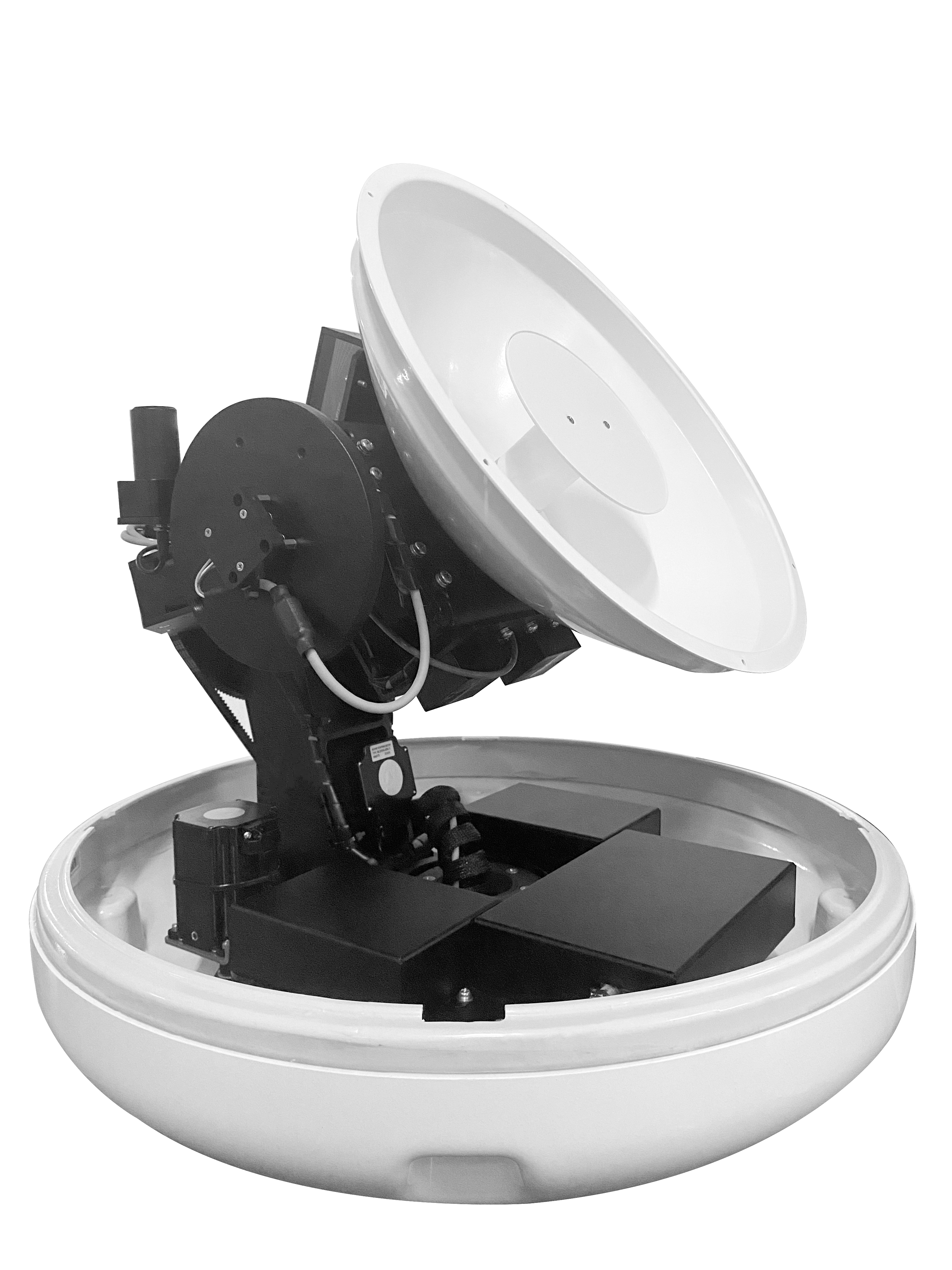
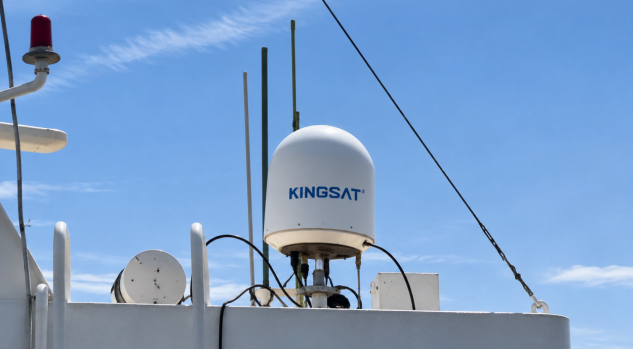
Drawing on its expertise in wireless communications and antenna servo-tracking technology, KINGSAT has developed an auto-tracking microwave communications solution. By overcoming the fixed line-of-sight alignment constraints of conventional microwave links, the solution brings fiber-like connectivity, with data rates ranging from hundreds of megabits to gigabits per second, to offshore and remote maritime environments. It is helping reshape how maritime networks are built and operated.
The Evolution of Maritime Communications: From Fixed Links to Dynamic Connectivity
Maritime connectivity has evolved from nearshore cellular coverage and satellite networks for open-ocean operations to microwave links capable of supporting moving platforms:
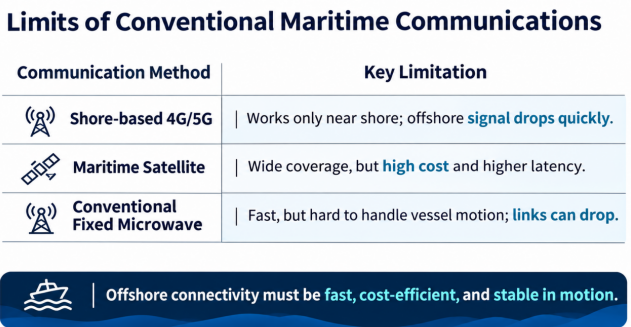
Nearshore 4G/5G cellular coverage: Within approximately 10–20 km of the coast, mobile network operators can often provide good signal coverage. Farther offshore, however, propagation loss and the Earth’s curvature limit line-of-sight (LOS) connectivity, causing signal quality to deteriorate sharply or connections to drop altogether. Even when offshore platforms use 4G IoT SIM cards, weak reception can prevent them from transmitting multiple HD video streams reliably.
Maritime satellite communications: Satellite systems, including geostationary (GEO), medium Earth orbit (MEO), and low Earth orbit (LEO) networks, provide extensive coverage and remain essential for long-distance voyages. However, data usage and service costs can make large-scale, frequent data transfers expensive. Depending on the satellite architecture and service, beam handovers and latency can also present challenges, limiting the extent to which satellite services can replace a high-capacity, terrestrial-style broadband backbone.
Conventional fixed microwave links: Microwave systems can deliver throughput from hundreds of megabits to gigabits per second with very low latency and without satellite-style per-data usage charges. Traditional installations, however, require highly accurate, fixed line-of-sight alignment between antennas, making them most suitable for stationary base stations or towers. On vessels, buoys, and floating platforms exposed to continuous motion, misalignment can interrupt the link.
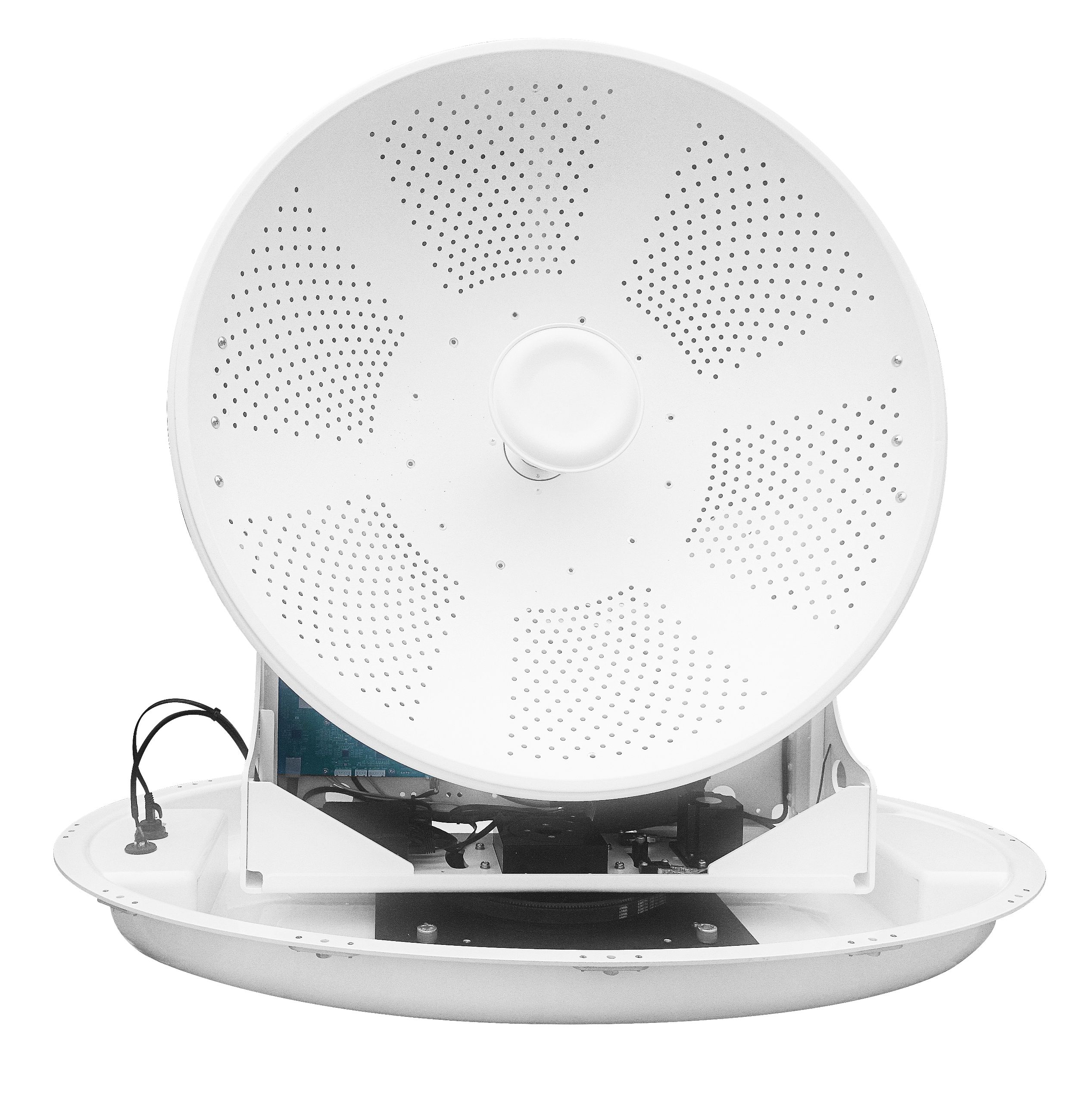
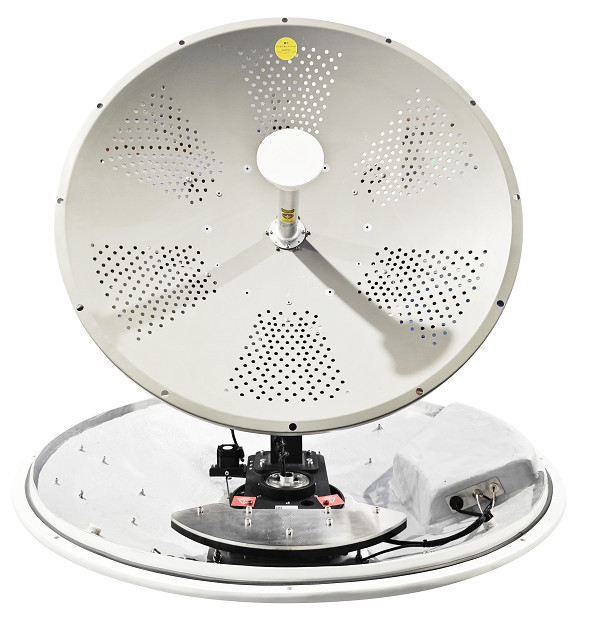
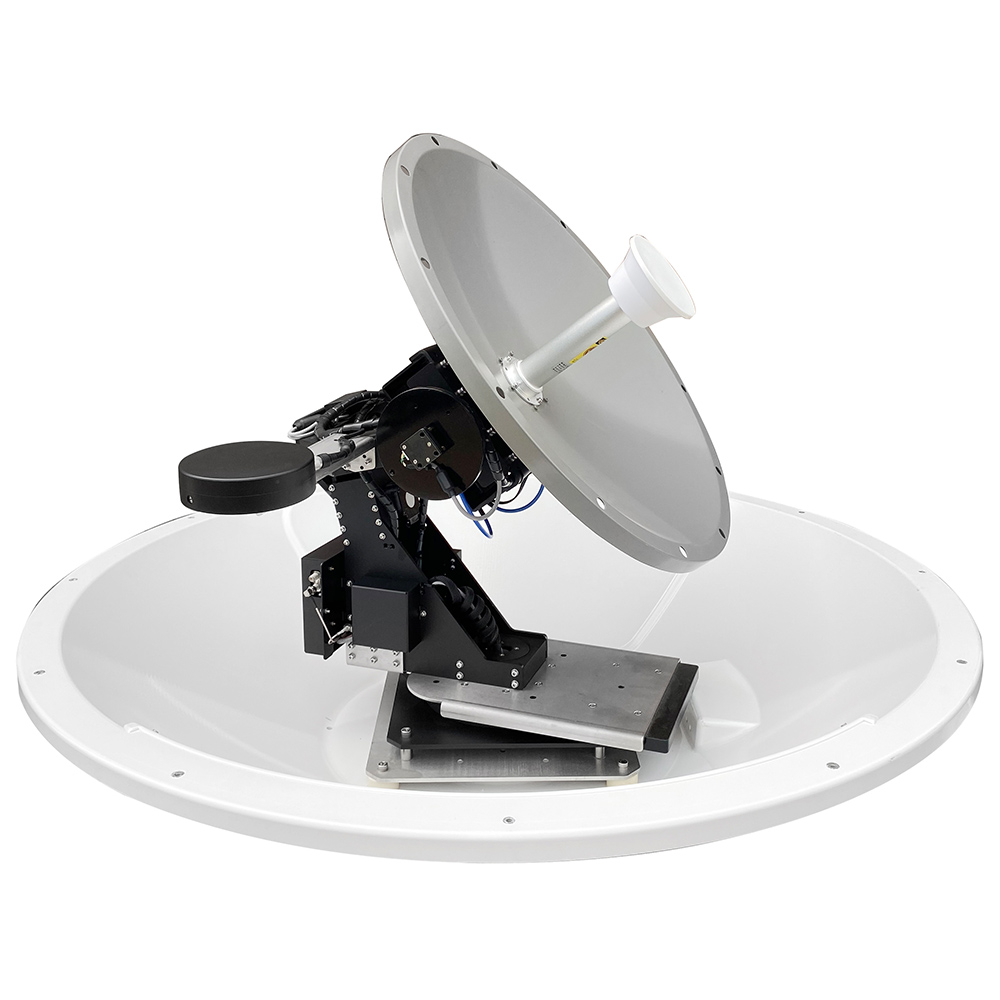
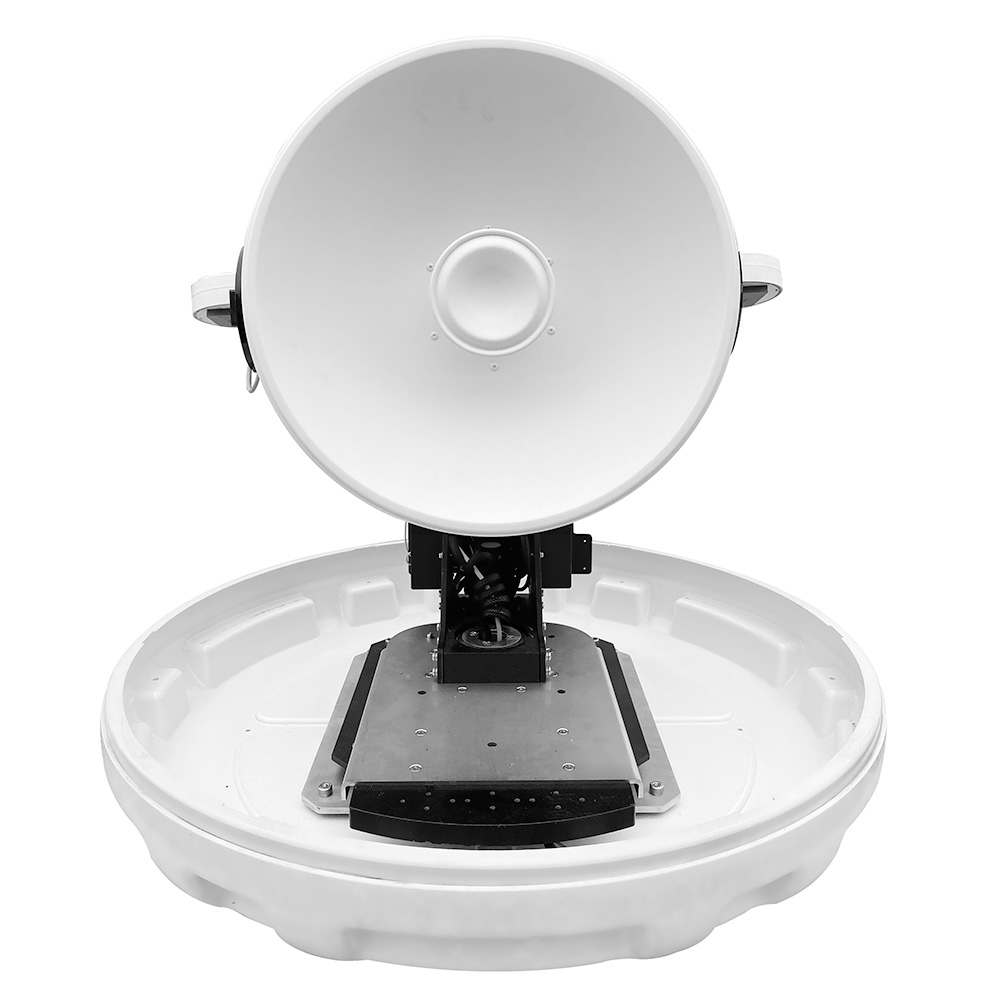
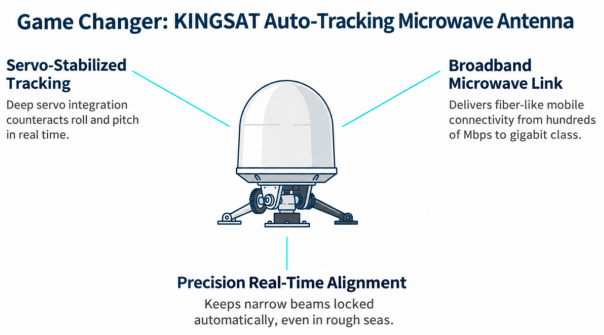
KINGSAT auto-tracking microwave antennas were developed to address this central challenge: maintaining precise alignment of narrow microwave beams while offshore platforms are moving and pitching in the waves.
Technical Innovation: How KINGSAT Auto-Tracking Microwave Systems Improve Maritime Connectivity
As a manufacturer specializing in maritime auto-tracking antennas, KINGSAT combines precision servo control and gyroscopic stabilization with broadband microwave communications. The resulting solution is designed for challenging sea conditions, enabling narrow-beam antennas to acquire a link automatically and maintain stable, real-time tracking despite vessel motion. Key capabilities include:
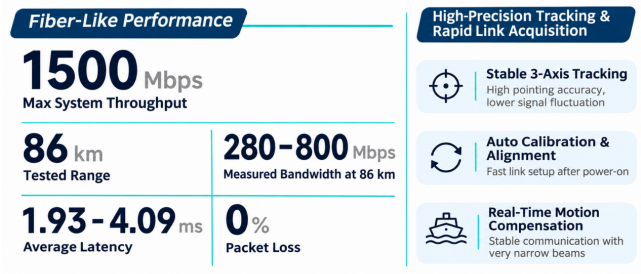
Fiber-like throughput: The system supports throughput of up to 1,500 Mbps. In a field test over 86 km, the link delivered 280–800 Mbps, with measured average latency ranging from 1.93 to 4.09 ms and 0% packet loss during the test.
High-precision closed-loop tracking and rapid link acquisition: In demanding sea conditions involving vessel roll and pitch, KINGSAT antennas maintain accurate pointing to help minimize signal fluctuations. Following power-up, the system can complete automatic calibration and establish the link quickly. Even with a narrow beamwidth, the servo-driven antenna mount continuously compensates for vessel motion.
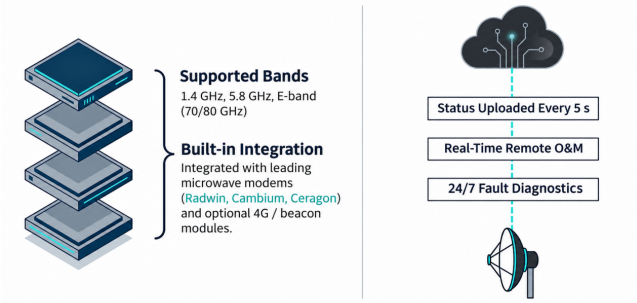
Long-range links and frequency-band customization: For ship-to-shore and ship-to-ship applications, KINGSAT auto-tracking microwave systems can support direct links over 30–100 km. In air-to-ground applications, the stated coverage range extends to 50–200 km. Configurations can be customized for frequency bands including 1.4 GHz, 5.8 GHz, and E-band (70/80 GHz).
Multi-system integration and cloud-based remote management: The system can integrate microwave modems from established vendors such as Radwin, Cambium, and Ceragon. Optional integrated 4G or beacon modules can facilitate remote commissioning and signal tracking. The antenna can also report operating status to a cloud server every five seconds, supporting remote monitoring, maintenance, and troubleshooting.
Applications: From Ship-to-Shore Links to Multi-Node Maritime Networks
KINGSAT auto-tracking microwave solutions go beyond conventional ship-to-shore links and can support a range of multi-node network topologies at sea:
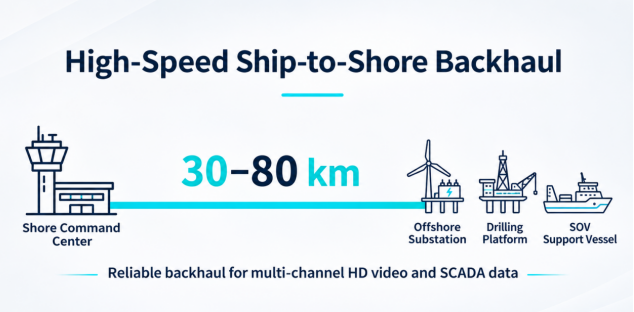
High-speed ship-to-shore and offshore backbone links: In offshore wind operations and oil and gas development, antennas can be installed on offshore substations, drilling platforms, or service operation vessels (SOVs). They can establish 30–80 km high-capacity microwave backbone links between substations and shore facilities or between service vessels and platforms, supporting the transmission of feeds from dozens of HD cameras alongside supervisory control and data acquisition (SCADA) data without loss of transmitted information.
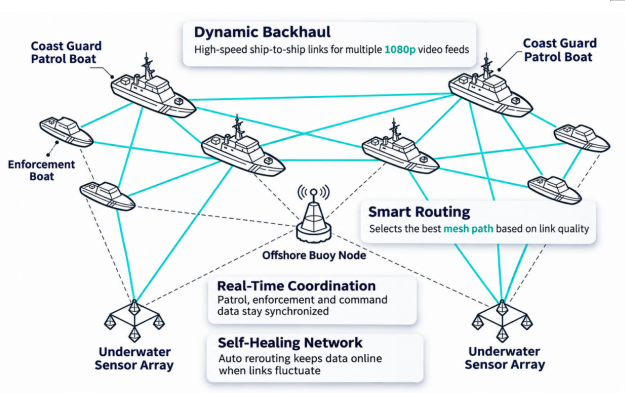
High-speed links between moving vessels: Coast guard patrol vessels, maritime patrol ships, and smaller enforcement craft operating offshore can use KINGSAT three-axis auto-tracking antennas to establish dynamic vessel-to-vessel microwave backbone links. These links can support multiple 1080p HD video feeds and real-time coordination between vessels and command teams.
Multi-node maritime and mesh networking: In marine aquaculture sites and research buoy arrays, a central buoy can use an auto-tracking microwave link for long-distance, high-speed point-to-point connectivity with the shore. Individual buoy nodes can then use mesh-networking modules and omnidirectional antennas to form a broadband mesh network. Routing can select suitable paths based on signal-to-noise ratio (SNR), enabling resilient, self-healing transmission of underwater sensor data and monitoring video.
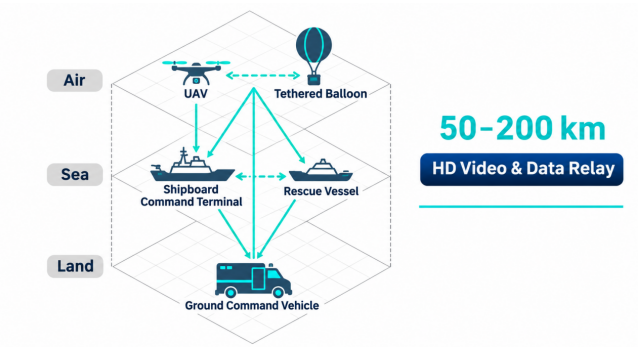
Integrated air–sea–land connectivity: For maritime search and rescue and emergency inspection missions, the system can connect unmanned aerial vehicles (UAVs), tethered balloons, ground-based emergency command vehicles, and vessel-based command terminals. The solution supports long-range HD video transmission and data relay across stated distances of 50–200 km.
Conclusion: Toward More Flexible Maritime Connectivity
As 5G non-terrestrial network (5G-NTN) architectures evolve, maritime communications are moving toward a more integrated model rather than relying on a single technology. Future networks will increasingly combine satellite systems across different orbital regimes, mobile microwave links and mesh networks, and nearshore cellular coverage.
With high bandwidth, low latency, no usage-based data charges for the microwave link itself, and robust tracking on moving platforms, KINGSAT auto-tracking microwave technology offers a practical connectivity option between nearshore cellular networks and offshore satellite services. KINGSAT will continue developing its antenna servo-control and wireless communications technologies to help maritime customers worldwide build networks that are more flexible, efficient, and cost-effective.
Contact us: sales@kingsat-tech.com Official website: www.kingsat-tech.com
Youtube: http://www.youtube.com/@kingsatmaritimeantennas4640