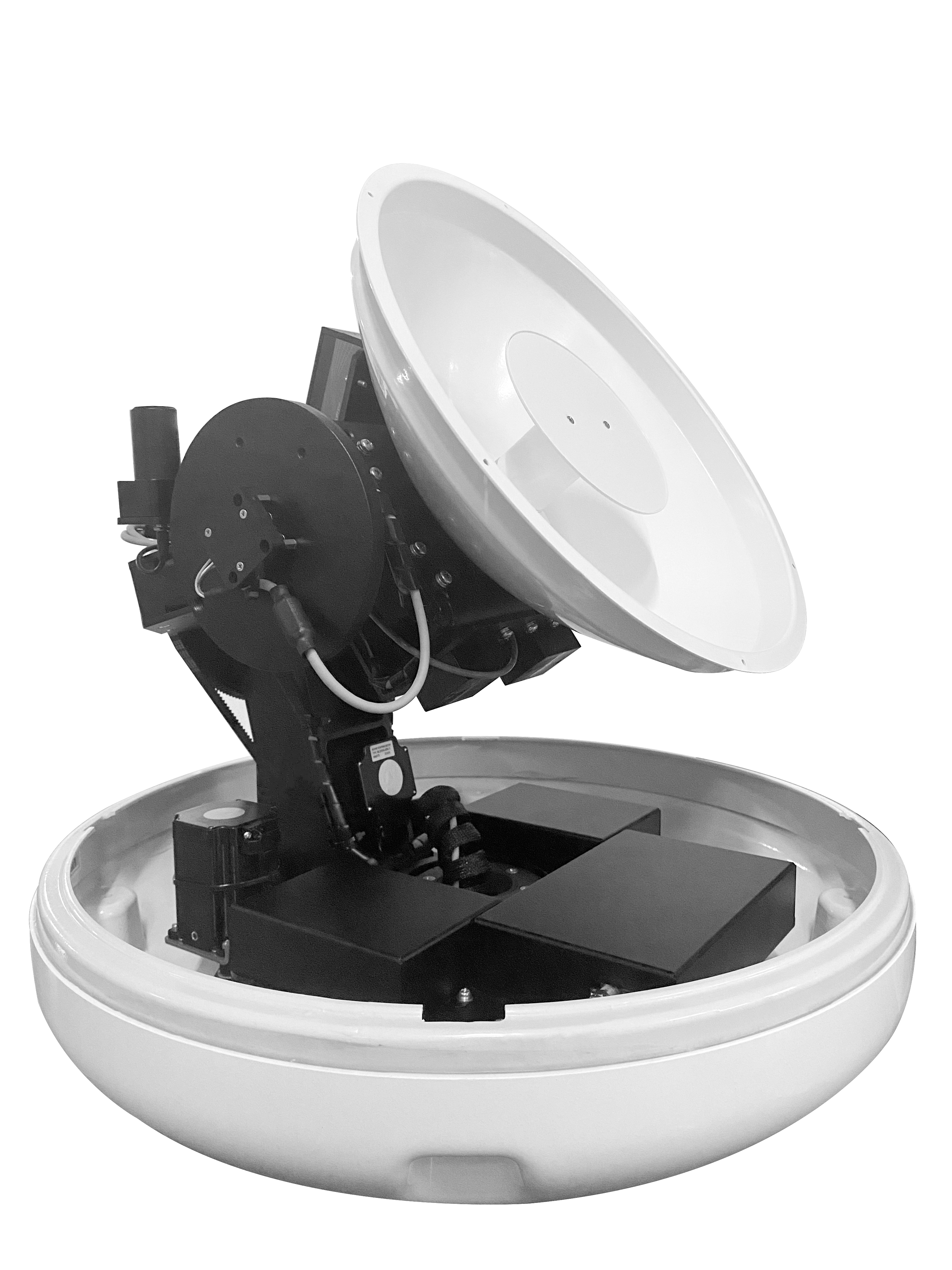

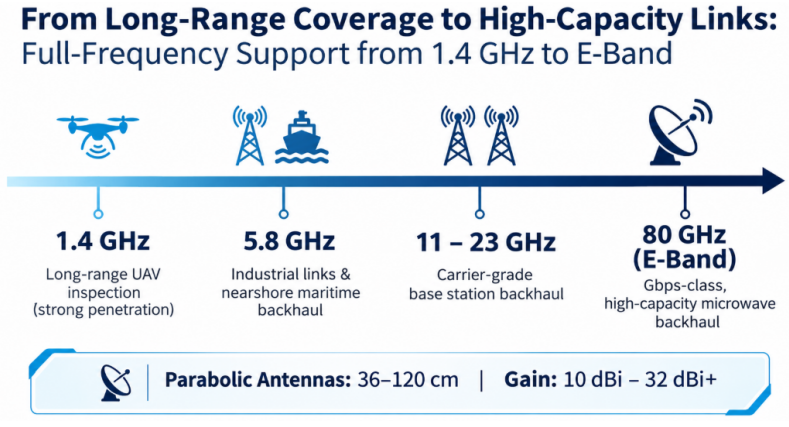
As wireless communications, 5G non-terrestrial networks (5G-NTN), low-altitude applications, and digitalization in the maritime sector continue to advance, wireless links must operate in increasingly complex environments. Requirements range from the penetration and beyond-line-of-sight capabilities associated with lower-frequency 1.4 GHz links, to 5.8 GHz industrial wireless bridges and gigabit-capacity microwave backhaul at 18 GHz, 23 GHz, and even E-Band (80 GHz millimeter wave). Each application places different demands on operating frequency, RF interfaces, and tracking performance under motion.
Conventional microwave antennas with fixed operating bands or limited form factors can struggle to accommodate non-standard frequencies and a wide range of installation platforms. The result can be fragmented hardware designs and costly additional development work.
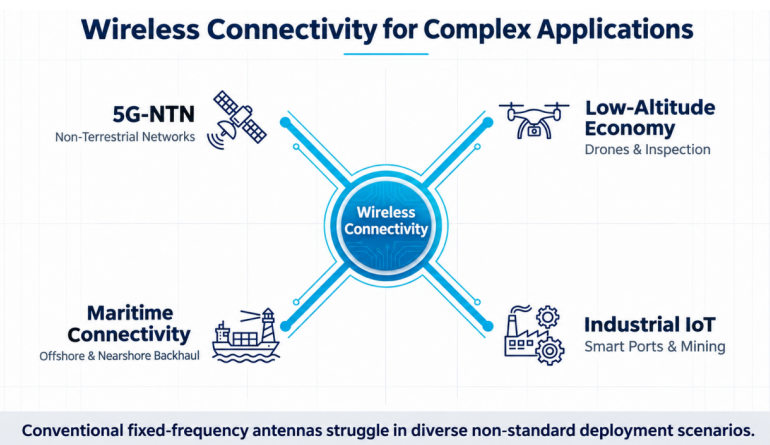
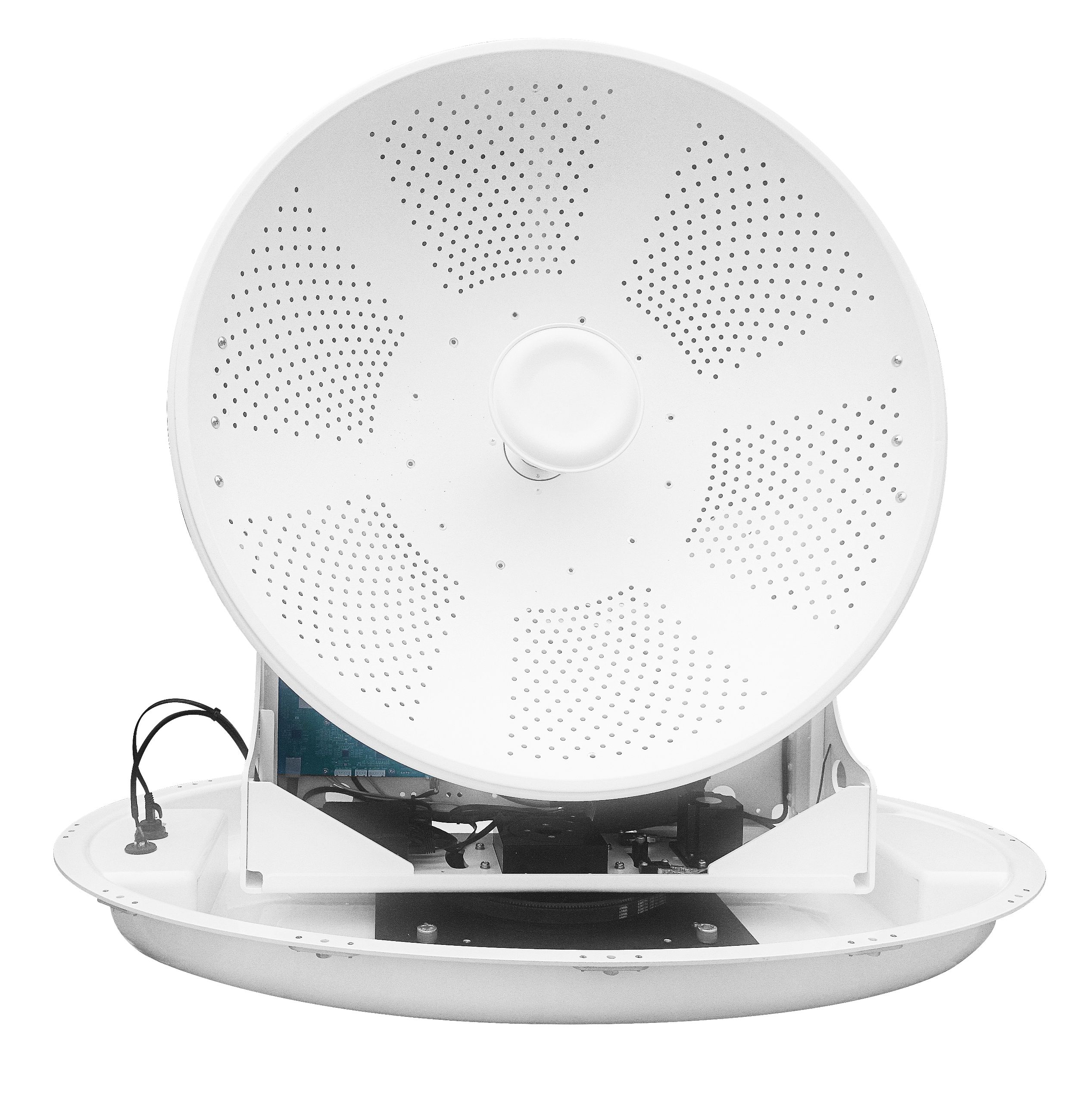
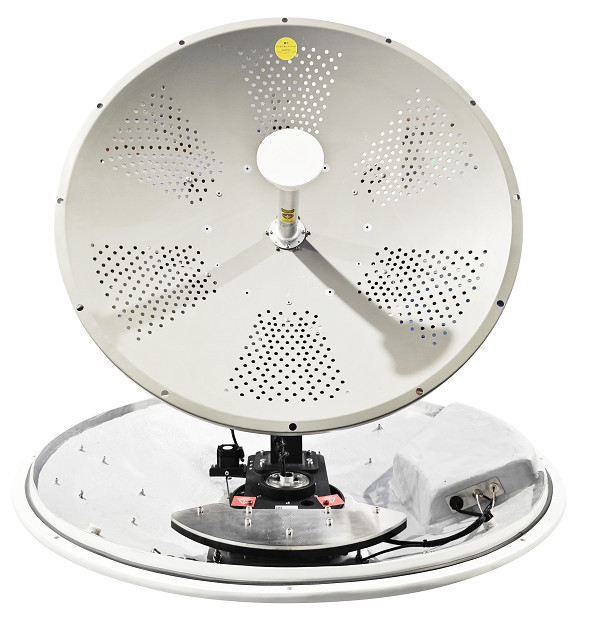
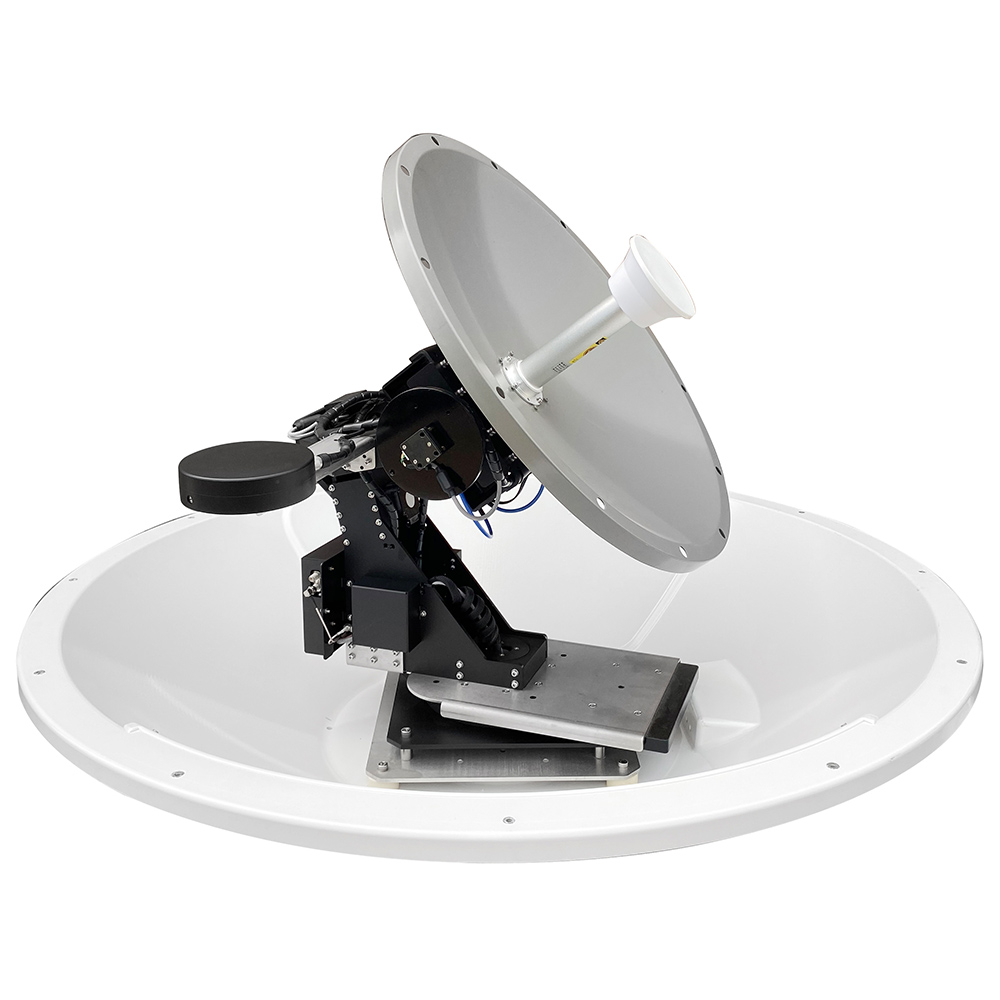
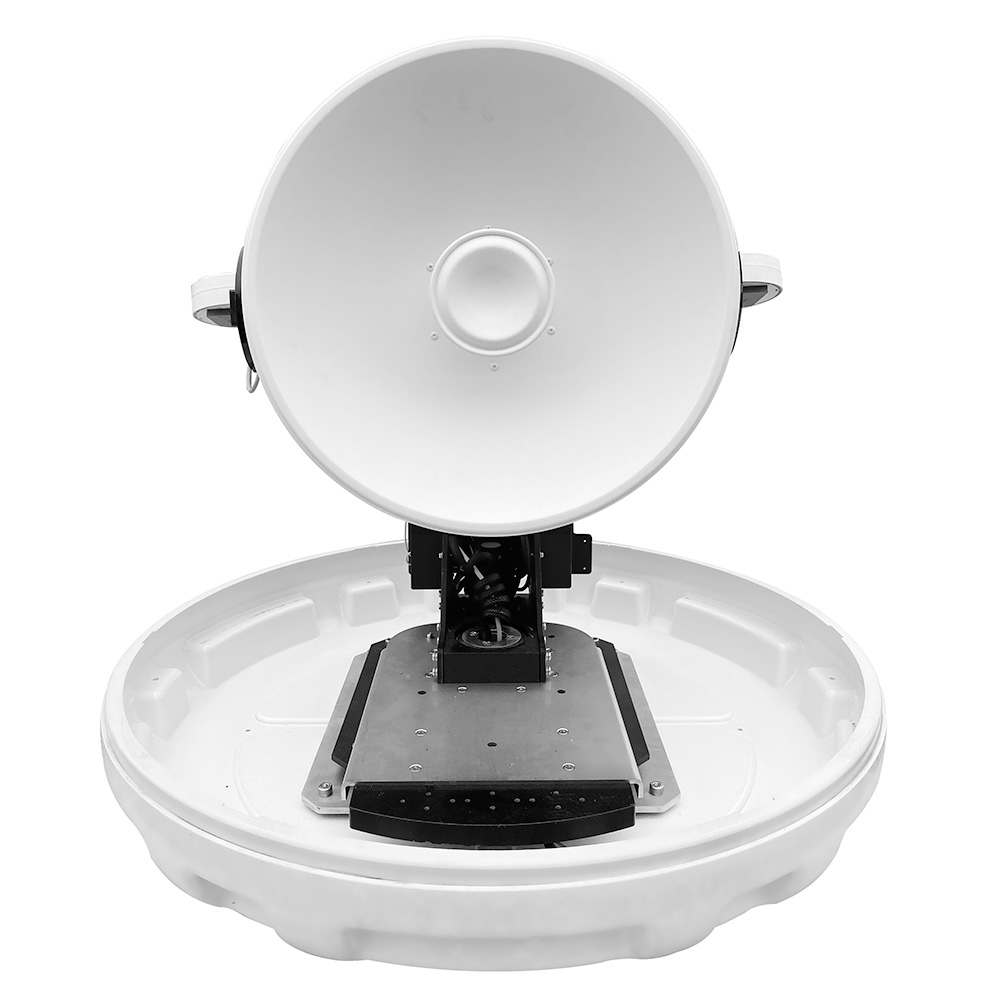
As a specialist manufacturer of automatic-tracking antennas for maritime and land-based applications, KINGSAT combines established dynamic-tracking algorithms with an open, modular architecture. Its customizable microwave antenna portfolio spans 1.4 GHz to E-Band (80 GHz) and can be adapted to a wide range of platforms—bringing greater flexibility to demanding wireless deployments.
1. The Challenge: Integrating Non-Standard Frequencies and Diverse Platforms
When building reliable point-to-point (PtP), point-to-multipoint (PtMP), and dynamic mesh networks, system integrators and private-network operators typically face three major challenges:
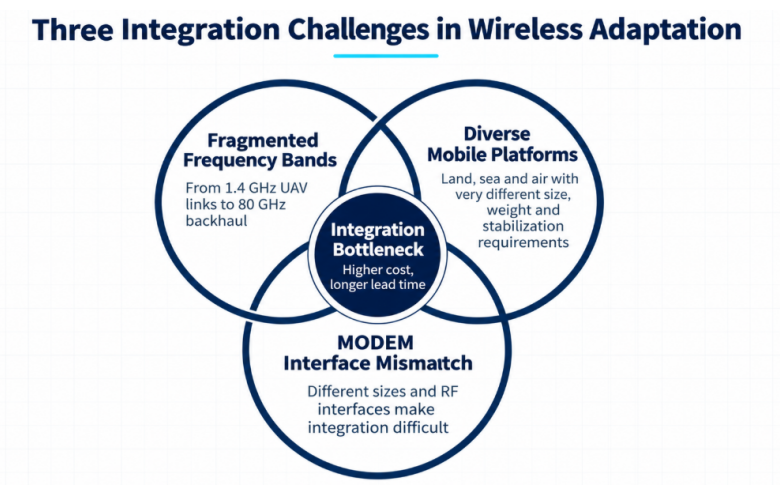
- Fragmented frequency requirements. Different industries and applications rely on different bands. Beyond-line-of-sight UAV inspection links may favor 1.4 GHz; industrial wireless bridges and nearshore maritime backhaul commonly use 5.8 GHz; and carrier-grade base-station backhaul may call for 11 GHz, 18 GHz, 23 GHz, or E-Band (80 GHz millimeter wave). Single-band antenna designs offer limited flexibility when a project requires frequency-specific customization.
- Diverse platforms and demanding motion conditions. Wireless nodes may be installed on fixed towers, emergency command vehicles, temporary mobile base stations, oceangoing vessels, floating production, storage and offloading (FPSO) units, offshore buoys, lightweight UAVs, or tethered balloons. Each platform imposes different constraints on antenna weight (including approximately 1.5 kg for some UAV applications), wind loading, dimensions, and the number of tracking axes (one, two, or three).
- Incompatible modem interfaces and mechanical layouts. Microwave modems, 5G-NTN modules, and mesh-network gateways from different suppliers vary in RF connectors and physical dimensions. Integrators can encounter mechanical fit and interface compatibility problems when pairing an antenna with a modem, potentially delaying delivery.
2. The KINGSAT Solution: Frequency and Platform Customization from 1.4 GHz to E-Band
To address these integration challenges, KINGSAT draws on its RF engineering capabilities and modular design approach to offer a range of automatic-tracking microwave antennas that can be extensively customized to project requirements.
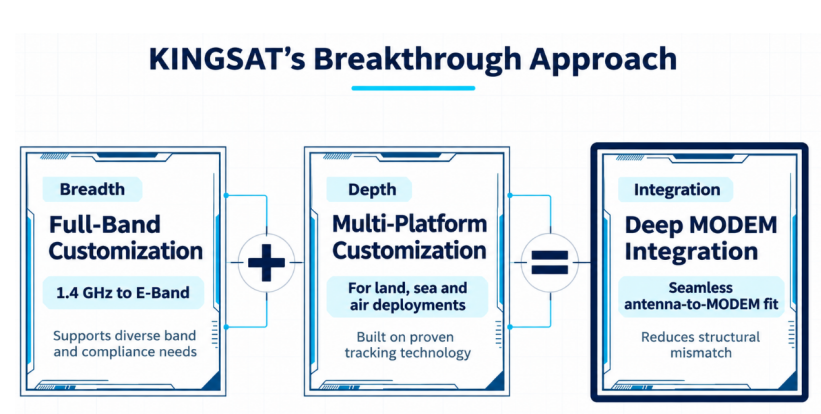
2.1 Frequency Customization from 1.4 GHz to E-Band and High-Gain Reflector Options
- Frequency options tailored to the application. KINGSAT can customize microwave tracking antenna solutions for 1.4 GHz, 2.4 GHz, 4.9–5.8 GHz, 6 GHz, 7 GHz, 8 GHz, 11 GHz, 13 GHz, 15 GHz, 18 GHz, 23 GHz, and E-Band (80 GHz millimeter wave), according to bandwidth requirements and applicable radio regulations.
- High-gain antennas in multiple sizes. Options include precision parabolic reflectors and microstrip antenna arrays, with aperture sizes from 36 cm through 60 cm and 90 cm to 120 cm (including M4, M6, M9, and M12 models). Antenna gain ranges from 10 dBi to more than 32 dBi. Depending on system configuration, solutions can deliver backhaul throughput of up to 1,500 Mbps, offering a high-capacity, fiber-like wireless link.
2.2 Open, Modular Architecture for Modem Integration
- Customized modem integration. KINGSAT antenna designs offer flexible internal space and interfaces for integrating a variety of third-party microwave modems, whether mounted internally or connected externally. This enables an integrated antenna-and-modem solution designed for straightforward deployment.
- Intelligent frequency selection and interference resistance. Supported features include intelligent frequency selection and AES encryption, along with non-line-of-sight (NLOS) transmission capabilities and interference mitigation. Solutions can be configured for PtP, PtMP, and self-organizing mesh networks.
2.3 Antenna Platforms for Land, Sea, and Air
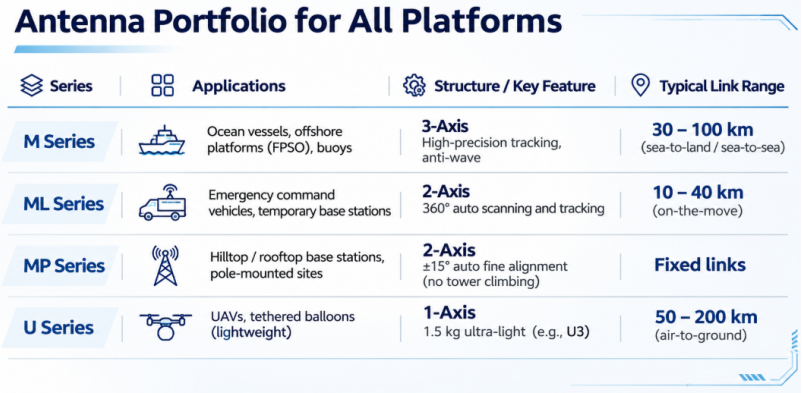
KINGSAT offers a portfolio of automatic-tracking antennas tailored to different mobile and fixed platforms:
- M Series — Three-Axis Maritime Antennas. Designed for oceangoing vessels, offshore oil and gas facilities, and marine buoys, the M Series uses a precision three-axis servo-stabilization system to compensate for vessel motion in rough seas. Stated sea-to-shore and ship-to-ship link distances range from 30 to 100 km.
- ML Series — Two-Axis Vehicle-Mounted Antennas. Designed for emergency command vehicles and temporary mobile base stations, the ML Series features 360° automatic scanning and tracking, with stated land-based links of 10–40 km during mobile operation.
- MP Series — Two-Axis Pole-Mounted Antennas. Intended for hilltop and rooftop base stations and tower installations, the MP Series provides 60° sector scanning and intelligent fine alignment over ±15°, reducing the need for technicians to climb towers for routine troubleshooting.
- U Series — Single-Axis Lightweight UAV Antennas. Developed for UAVs and tethered balloons, the U Series includes the U3, which weighs approximately 1.5 kg and offers 10 dBi directional gain. Stated air-to-ground transmission distances range from 50 to 200 km.
3. Benefits: From Workarounds to Purpose-Built Integration
For system integrators and private-network customers, KINGSAT’s customizable microwave tracking antenna portfolio offers several potential technical and commercial benefits:

- Shorter delivery times and less custom development. According to the original product description, delivery cycles can be reduced by 70%. With an open mechanical and RF integration architecture, customers do not need to develop a servo system or corrosion-resistant enclosure from scratch. KINGSAT can supply an integrated antenna-and-modem assembly, reducing development and commissioning work.
- Fast, precise tracking for high-capacity wireless links. With a stated tracking speed of at least 90°/s and precision target locking, the antennas are designed to maintain link quality during rapid UAV maneuvers or significant vessel motion. One reported 33 km field test recorded 23.87 ms latency and 0% packet loss. The product description also cites backbone throughput of up to 1,500 Mbps.
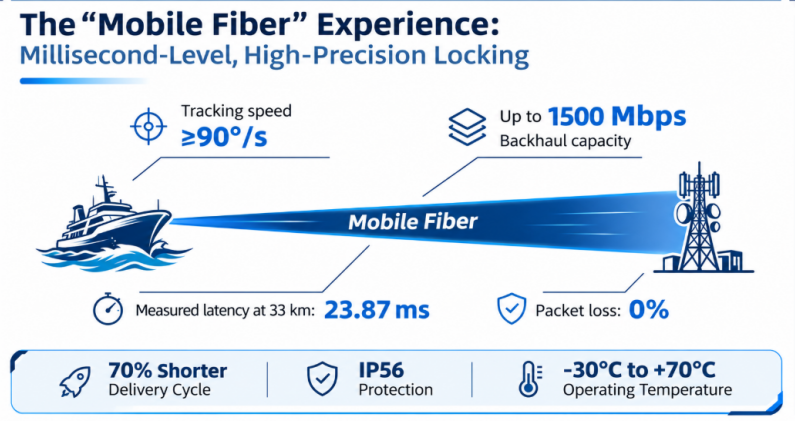
Rugged, industrial-grade design for demanding environments. Building on a stated 20-year track record of maritime-oriented quality control, the products are described as offering IP56 ingress protection and an operating-temperature range of −30°C to +70°C. They are intended for conditions such as salt-laden marine environments, high-altitude wind farms, and areas with significant electromagnetic interference, helping customers manage lifecycle operating expenses (OPEX) and service-level commitments (SLAs).
4. Applications: Four Typical Deployment Scenarios
With frequency customization and interference-resistant designs, KINGSAT microwave tracking antennas can be deployed across a wide range of complex wireless environments:
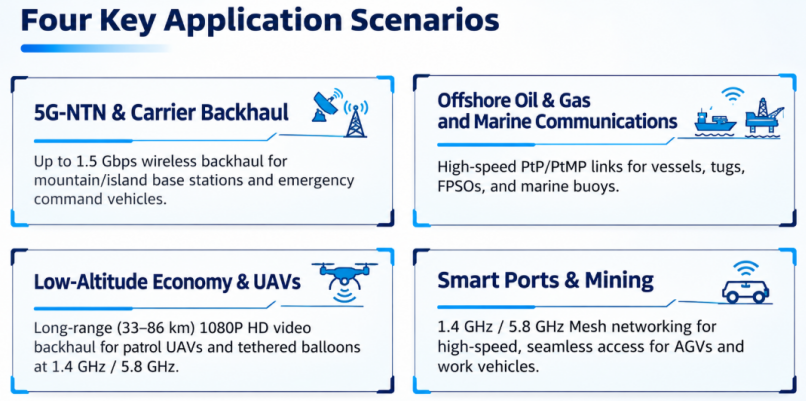
- 5G-NTN and carrier wireless backhaul (fixed-to-fixed / temporary base station-to-node). High-capacity wireless backbone connections of up to 1.5 Gbps can link hilltop and island base stations, emergency command vehicles, and fiber-network access points.
- Offshore oil and gas and marine aquaculture communications (fixed-to-mobile / mobile-to-mobile). High-speed PtP or PtMP networks can connect oceangoing cargo vessels, tugboats, FPSO facilities, and offshore buoys.
- Low-altitude UAV operations and beyond-line-of-sight video links (air-to-ground). At 1.4 GHz or 5.8 GHz, these solutions are designed to support long-range 1080p HD video backhaul between patrol UAVs, tethered balloons, and ground command vehicles. The original description cites measured link distances of 33–86 km.
- Smart ports and mining automation (dynamic mesh networking). In rubber-tyred gantry (RTG) container yards and smart mining sites, 1.4 GHz/5.8 GHz mesh networking and fast roaming can support continuous, high-speed connectivity for automated guided vehicles (AGVs) and service vehicles.
Conclusion
As modern wireless networks demand greater speed, reliability, and interoperability across applications, antennas should enable integration rather than constrain it. With frequency-specific customization spanning 1.4 GHz to E-Band (80 GHz), an open architecture for modem integration, and solutions designed for land, sea, and air, KINGSAT helps address complex wireless integration challenges.
Contact us: sales@kingsat-tech.com Official website: www.kingsat-tech.com
Youtube: http://www.youtube.com/@kingsatmaritimeantennas4640