
In low-altitude and industrial inspection applications such as power-line patrols, oil and gas pipeline inspections, forest fire prevention and response, and post-disaster emergency rescue, beyond visual line of sight (BVLOS) drone inspections have become essential for improving operational efficiency. Yet field engineers and video link maintenance teams often face a difficult problem: once inspection distances extend to tens of kilometers, 1080p HD video feeds frequently freeze, experience packet loss, or even drop out completely, severely limiting the inspection radius and emergency command and response.
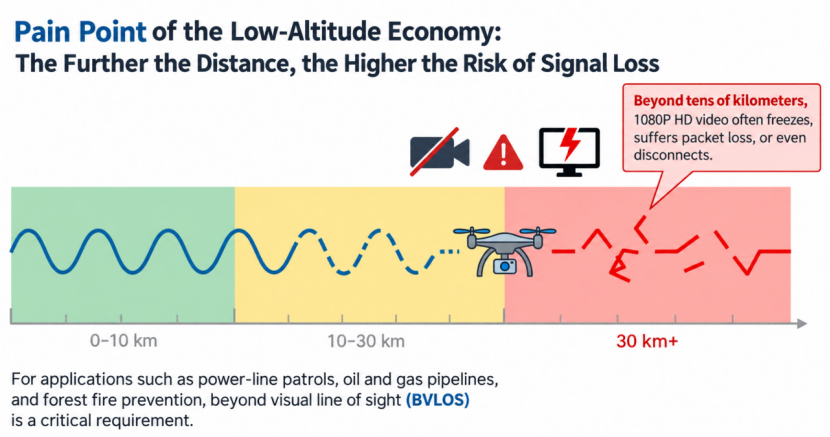
Why do conventional video transmission solutions struggle to support BVLOS video backhaul? And how can this limitation be overcome at the physical layer of the wireless link?
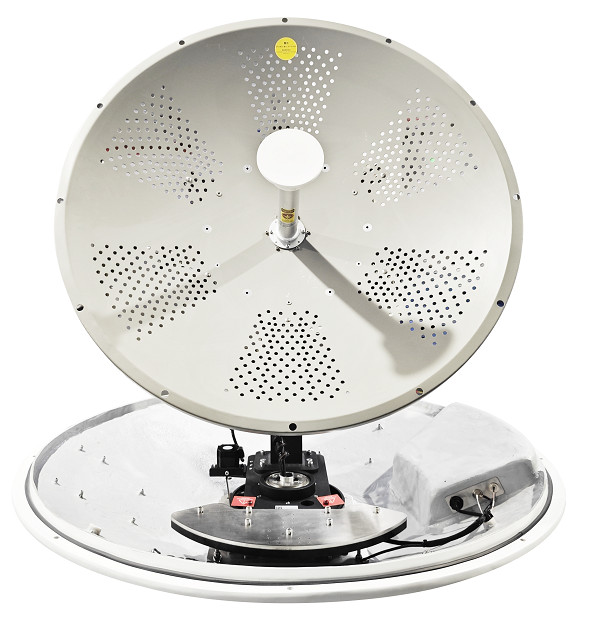
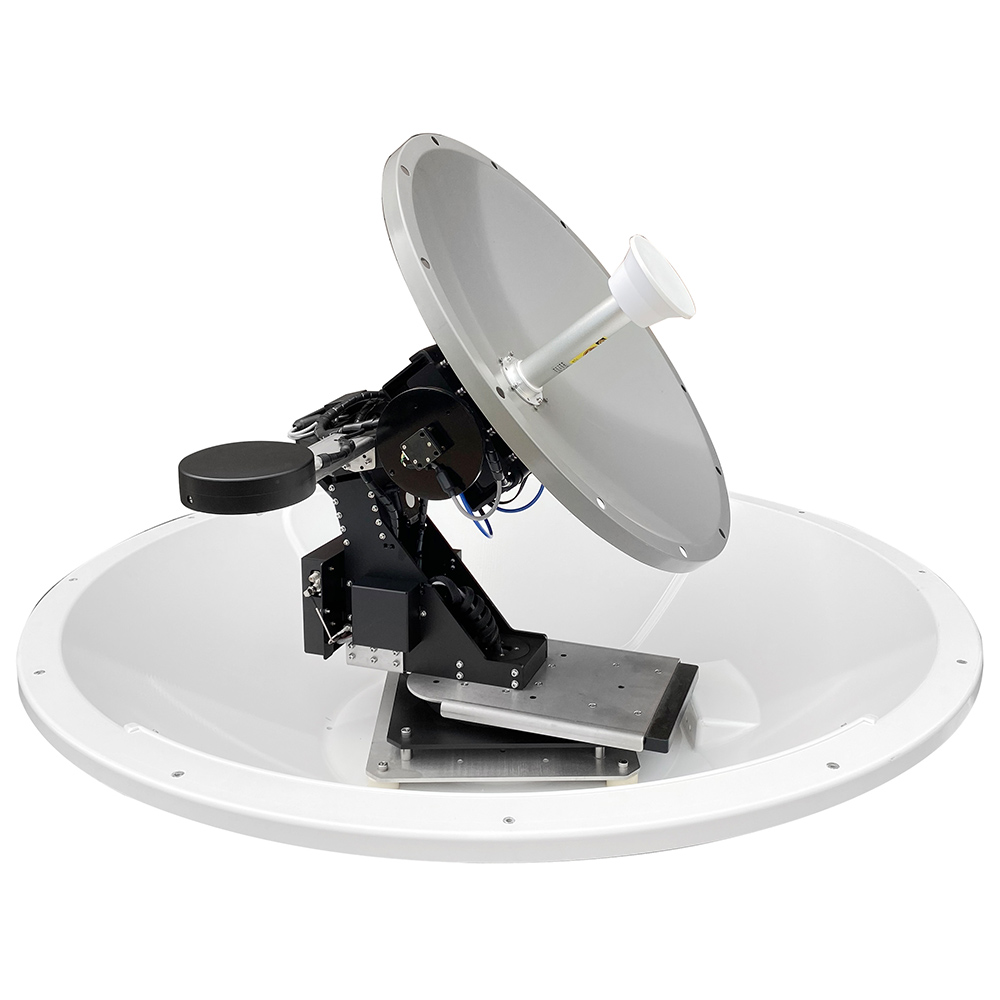
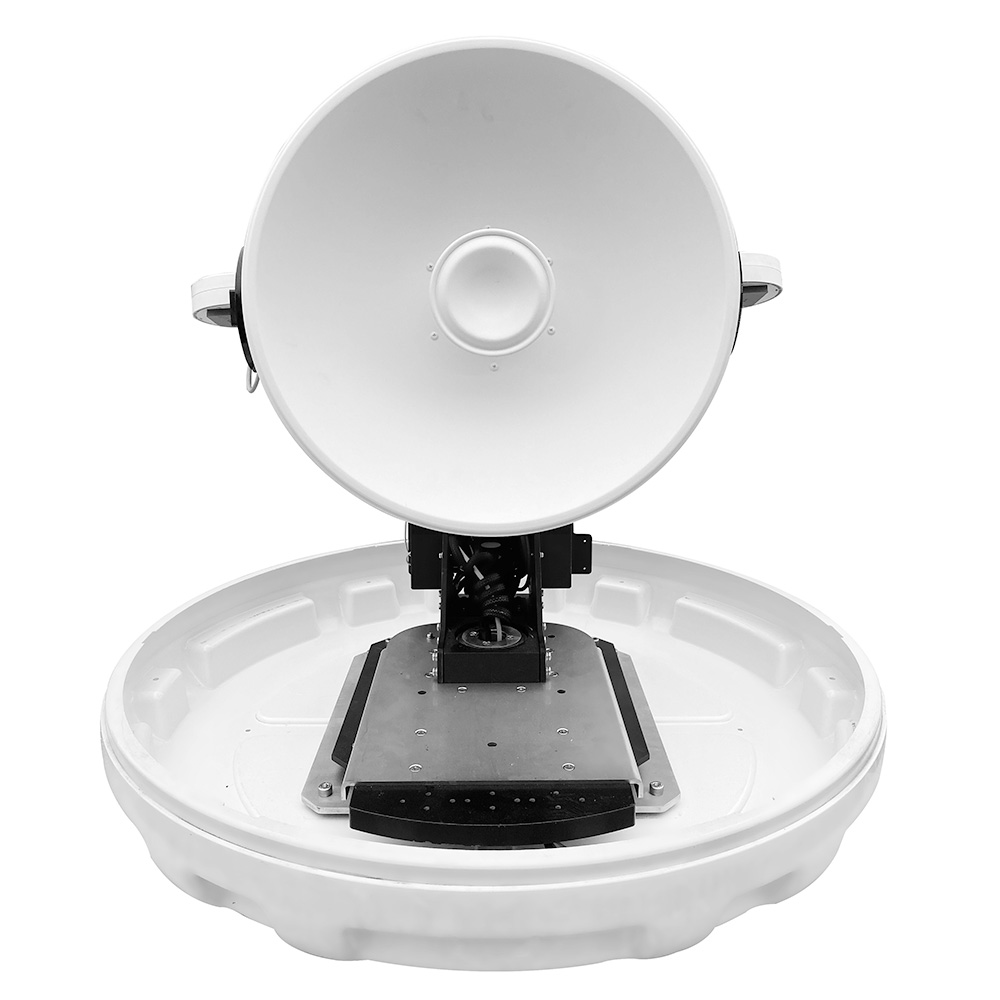
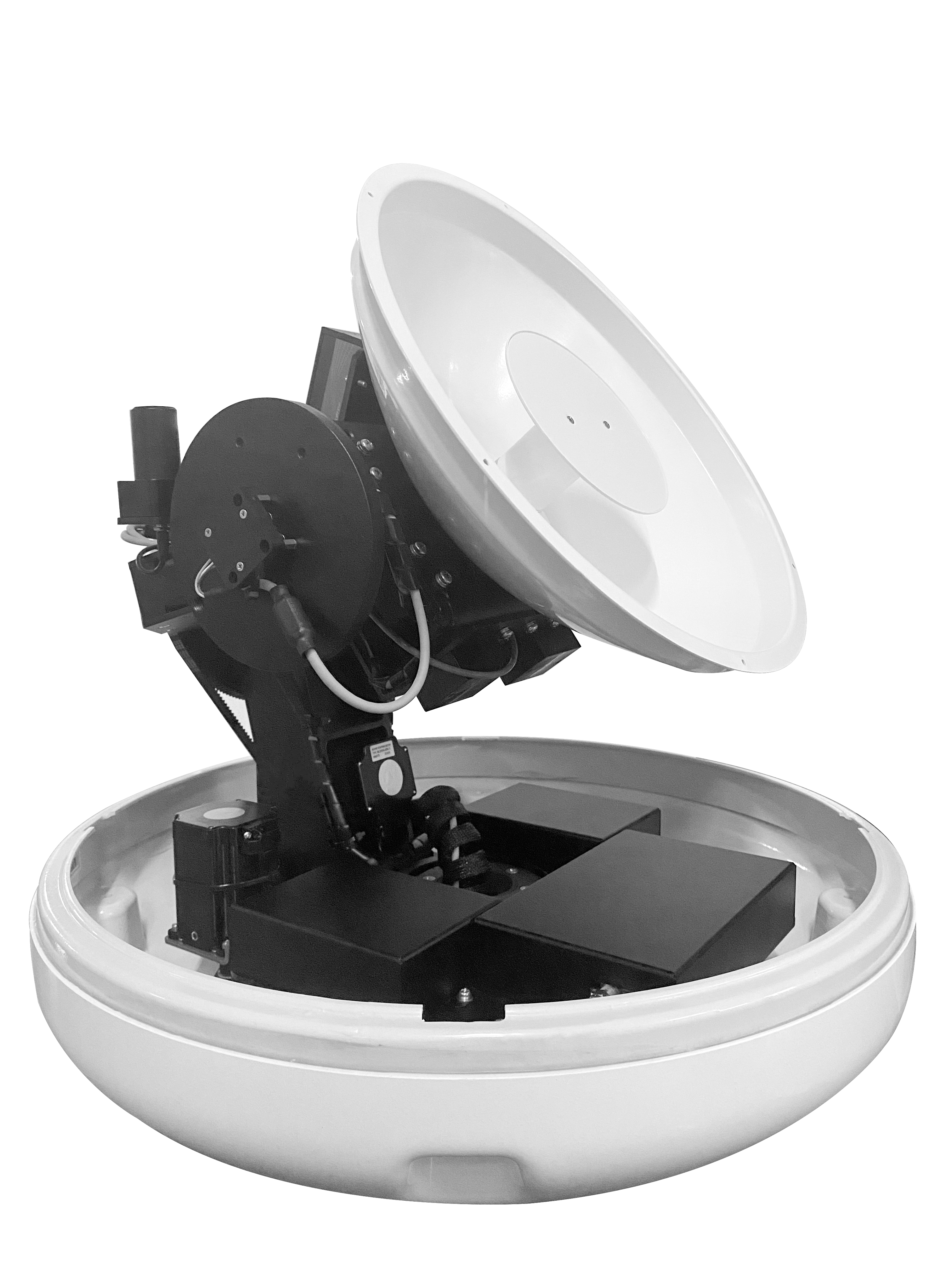
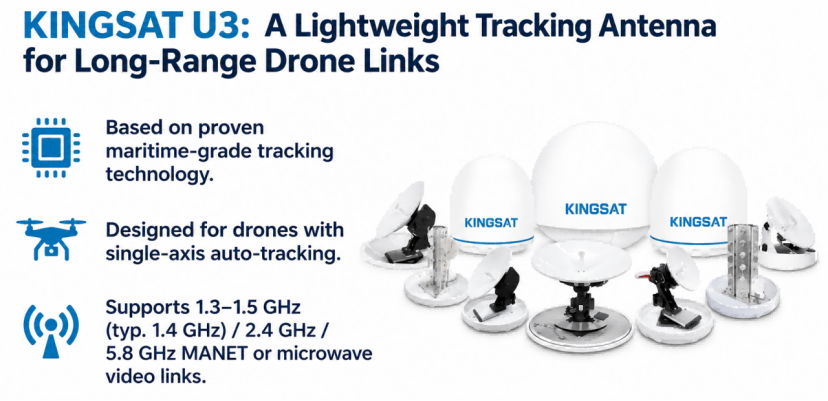
Drawing on its experience in maritime and low-altitude auto-tracking antennas, KINGSAT has developed the U3 based on its proven precision signal-tracking technology. Engineered specifically for BVLOS drone video links, the U3 is a lightweight directional auto-tracking antenna.
Challenge: Three Key Challenges in BVLOS Video Transmission
During BVLOS operations, establishing a stable, high-bandwidth, low-latency wireless video backhaul link presents three key technical challenges:
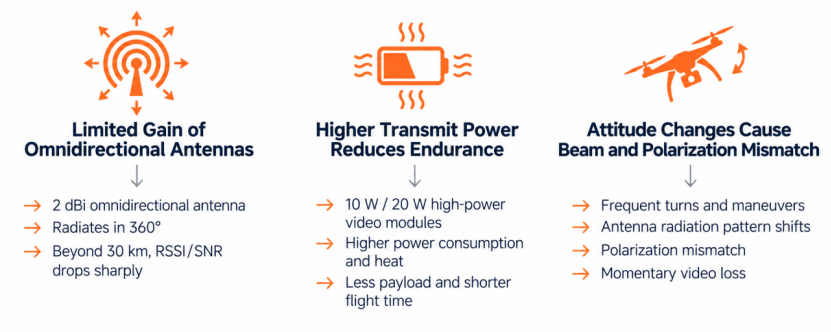
1. Limited gain of omnidirectional antennas:
Conventional drones often use 2 dBi omnidirectional whip antennas. Because an omnidirectional antenna radiates RF energy across 360°, the energy is widely dispersed. Once the transmission distance exceeds 30 km, received signal strength (RSSI) and signal-to-noise ratio (SNR) can fall sharply, resulting in dropped video frames or a complete link outage.
2. High-power video transmission comes at the expense of drone endurance:
A conventional way to extend range is simply to increase transmit power, using 10 W or even 20 W high-power MANET video modules. However, this significantly increases power consumption and heat dissipation requirements, drains the battery faster, and leaves less capacity for mission payloads while reducing the drone’s effective inspection range.
3. Changes in heading and attitude can cause beam and polarization mismatch:
During inspection missions, a drone frequently turns, circles, and changes attitude. The radiation pattern of a conventional fixed antenna tilts with the airframe, which can cause polarization mismatch and lead to momentary video freezing or signal loss at critical points in the mission.
Solution: KINGSAT U3 1.5 kg Lightweight Directional Auto-Tracking Antenna
To address these challenges, KINGSAT adapted its proven maritime-grade satellite tracking technology into a compact, lightweight design, creating the U3, a single-axis directional auto-tracking antenna specifically designed for the airborne side of drone communication links.
1. Ultra-Lightweight, Low-Drag Design
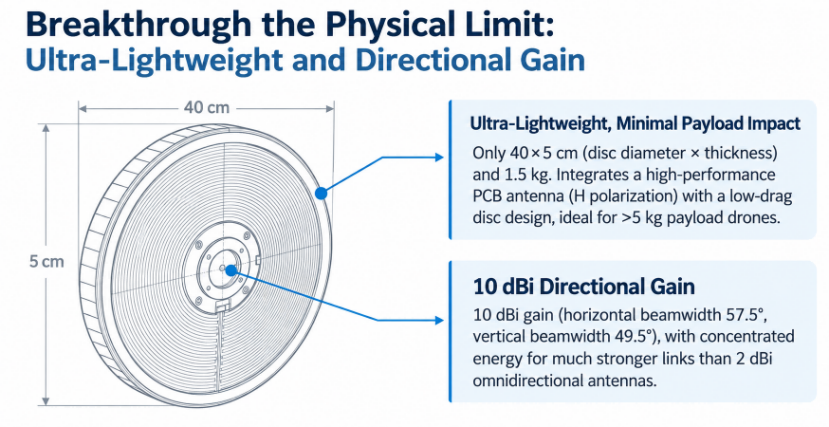
Ultra-light and slim: The U3 measures just 40 × 5 cm (disc diameter × thickness) and weighs only 1.5 kg. For medium and large inspection drones with a payload capacity above 5 kg, it has minimal impact on the drone’s available payload capacity.
Low-drag disc design: The U3 integrates a high-performance PCB antenna with horizontal (H) polarization and supports MANET or microwave video transmission modules operating at 1.3–1.5 GHz (typically 1.4 GHz), 2.4 GHz, and 5.8 GHz.
2. 10 dBi Directional Gain with Continuous 360° High-Speed Tracking
Directional energy concentration: The U3 provides up to 10 dBi of directional gain, with a 57.5° horizontal beamwidth and a 49.5° vertical beamwidth. Compared with a conventional 2 dBi omnidirectional antenna, it concentrates significantly more radiated energy in the intended direction.
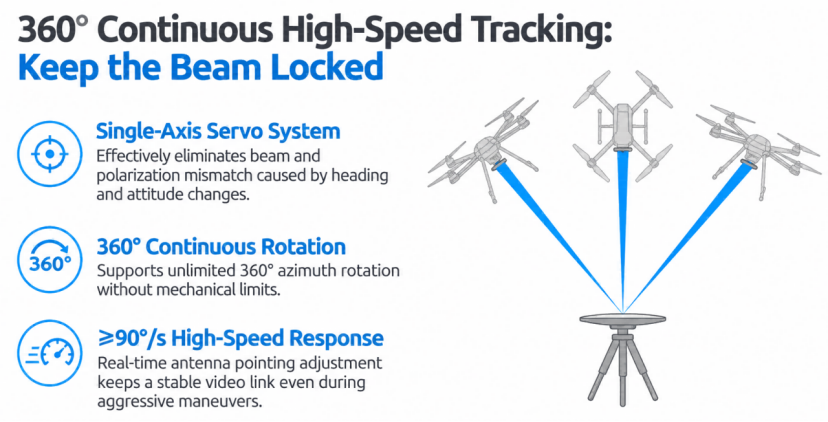
Single-axis stabilization and continuous rotation: A built-in 1-axis servo stabilization system provides continuous 360° azimuth rotation without mechanical limits.
High-speed tracking response: With a tracking speed of ≥90°/s, the U3 can rapidly adjust antenna pointing even when the drone makes sharp turns or aggressive attitude maneuvers, keeping the beam locked on the ground station in real time.
3. Reducing Transmit Power Through Higher Antenna Gain
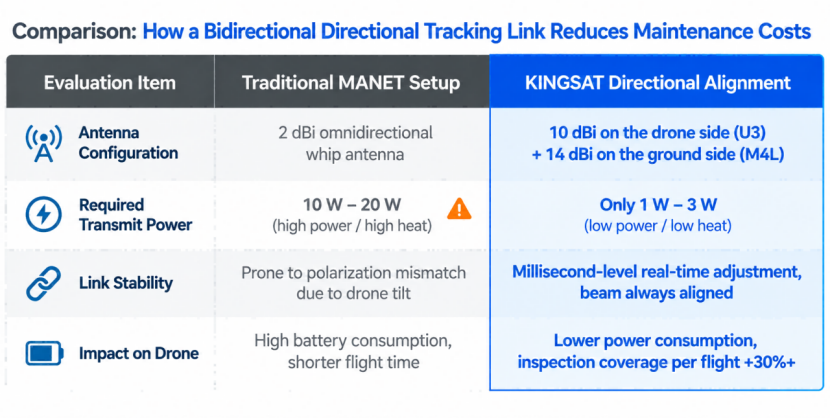
For BVLOS link deployment, a U3 directional tracking antenna (10 dBi) on the airborne side can be paired with a KINGSAT M4L on the ground (36 cm parabolic antenna, 14 dBi gain) or an ML4/M6 tracking antenna to establish a robust bidirectional tracking link. This high-gain directional architecture allows the airborne MANET module to reduce its transmit power from 20 W to 10 W, or from 10 W to 3 W. While maintaining sufficient bandwidth for HD video transmission, this approach significantly reduces video transmission module costs, power consumption, and thermal-management requirements.
Benefits: Real-World Test Data Redefine the SLA for Low-Altitude Communications
Deploying the 1.5 kg KINGSAT U3 lightweight tracking antenna can deliver substantial improvements for BVLOS inspection operations:
1. 33 km Field Test: 7.51 Mbps Backhaul with 0% Packet Loss for 1080p Video
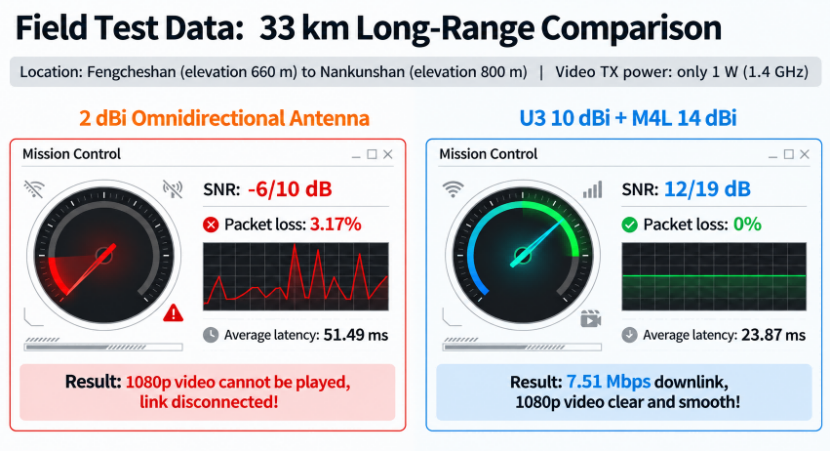
In a 1.4 GHz long-range field test conducted by KINGSAT R&D, a 33 km wireless link was established between Fengcheshan in Longhua Town (elevation: 660 m) and Nankunshan (elevation: 800 m).
U3 configuration: A U3 (10 dBi) on the airborne side was paired with an M4L (14 dBi) on the ground and a 1 W video transmission module. Measured received signal strength was -103/-106 dBm, with an SNR of 12/19 dB. Downlink throughput reached 7.51 Mbps, packet loss was 0%, and average latency was only 23.87 ms. The 1080p HD camera feed remained clear and smooth.
Omnidirectional antenna comparison: At the same 33 km distance, using a 2 dBi omnidirectional whip antenna reduced the received SNR to -6/10 dB, increased the packet loss rate to 3.17%, and raised average latency to 51.49 ms. The 1080p video feed became unplayable.
2. Wireless Link Successfully Established at an Extreme Range of 86 km
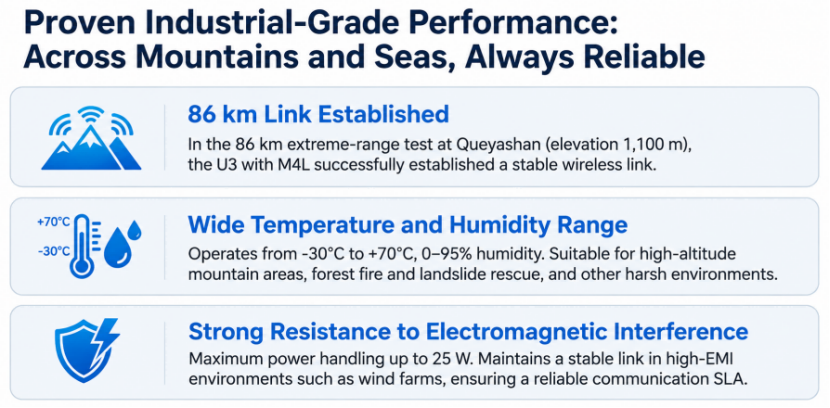
At the 86 km extreme-range test site at Queyashan (elevation 1,100 m), the U3 paired with the M4L high-gain directional antenna successfully established a wireless link, demonstrating reliable long-range connectivity over distances of tens of kilometers.
3. Extended Drone Endurance and a Larger Effective Operating Radius
With 10 dBi of directional gain on the airborne side, the required video-link transmit power can be significantly reduced, for example from 10 W to 3 W. Lower total airborne power consumption leaves more battery capacity available for flight, increasing the area covered in a single inspection mission by more than 30%.
4. Industrial-Grade Environmental Robustness
The U3 follows KINGSAT’s stringent quality-control standards. It supports a wide operating temperature range of -30°C to +70°C, an operating humidity range of 0–95%, and a maximum power handling capacity of 25 W. It is designed for stable operation in high-altitude mountainous areas, areas with strong electromagnetic interference at wind farms, and emergency-response sites affected by forest fires or landslides.
Conclusion
The real value of BVLOS drone inspection is built on a video link that reaches farther, delivers clear images, and remains stable. With its lightweight 1.5 kg design and 10 dBi directional tracking capability, the KINGSAT U3 overcomes the physical limitations of conventional omnidirectional antennas and high-power video transmission systems.
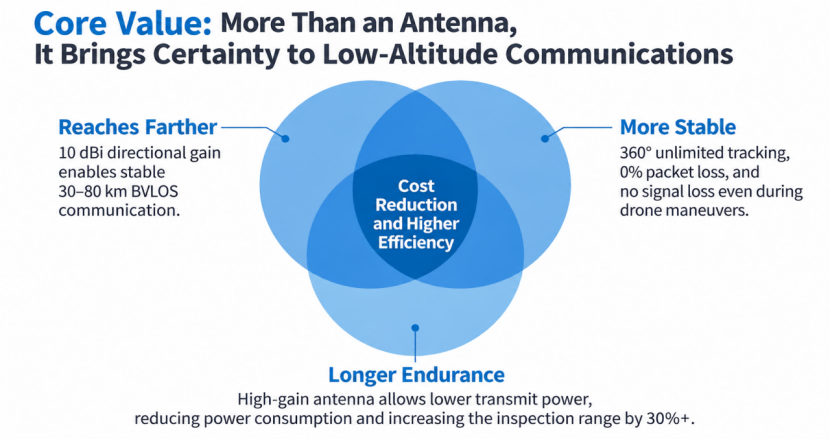
Choosing the KINGSAT U3 means more than adding a precisely aligned high-gain antenna to an inspection drone. It brings greater reliability and efficiency to the entire low-altitude communications system, enabling low-power, ultra-long-range, seamless video backhaul.
Contact us: sales@kingsat-tech.com Official website: www.kingsat-tech.com
Youtube: http://www.youtube.com/@kingsatmaritimeantennas4640