
Across deep-sea shipping, offshore oil and gas operations, offshore aquaculture, maritime law enforcement, and deep-sea research, real-time CCTV monitoring is essential for safe operations, preventing unauthorized activities, and supporting emergency response. However, because vessels and offshore platforms operate far from shore, they rely primarily on VSAT (Ku/Ka-band), FBB, Inmarsat, or other low-bandwidth wireless links for data transmission.
Over these costly, bandwidth-constrained links, conventional video transmission faces a difficult trade-off: maintaining clear video requires expensive satellite bandwidth, while reducing data usage can result in freezing and stuttering, making effective remote monitoring difficult.

How can we bridge the gap between HD video and bandwidth-constrained satellite links?
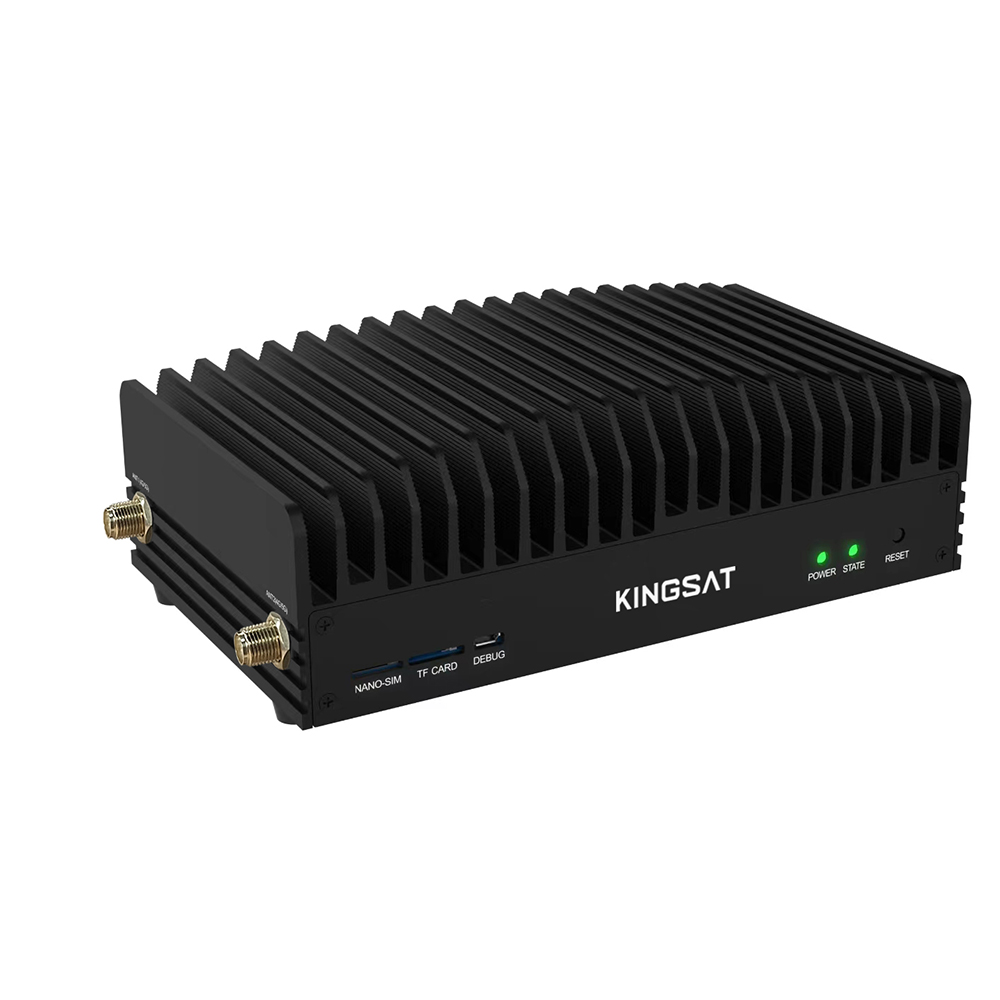
As a provider of maritime satellite communication and video transmission solutions, KINGSAT has developed an ultra-narrowband video compression system. By reducing video traffic by more than 90%, the system enables HD video that would normally require Mbps-level bandwidth to be transmitted smoothly and clearly in real time over VSAT links with bandwidth as low as 32–128 Kbps.
I. Challenges: High Satellite Costs and the Limits of Video Transmission over Narrowband Links
In offshore communication environments far from terrestrial networks, conventional video transmission faces two major constraints: limited bandwidth and high operating costs.
1. Video Bandwidth Requirements vs. VSAT Costs
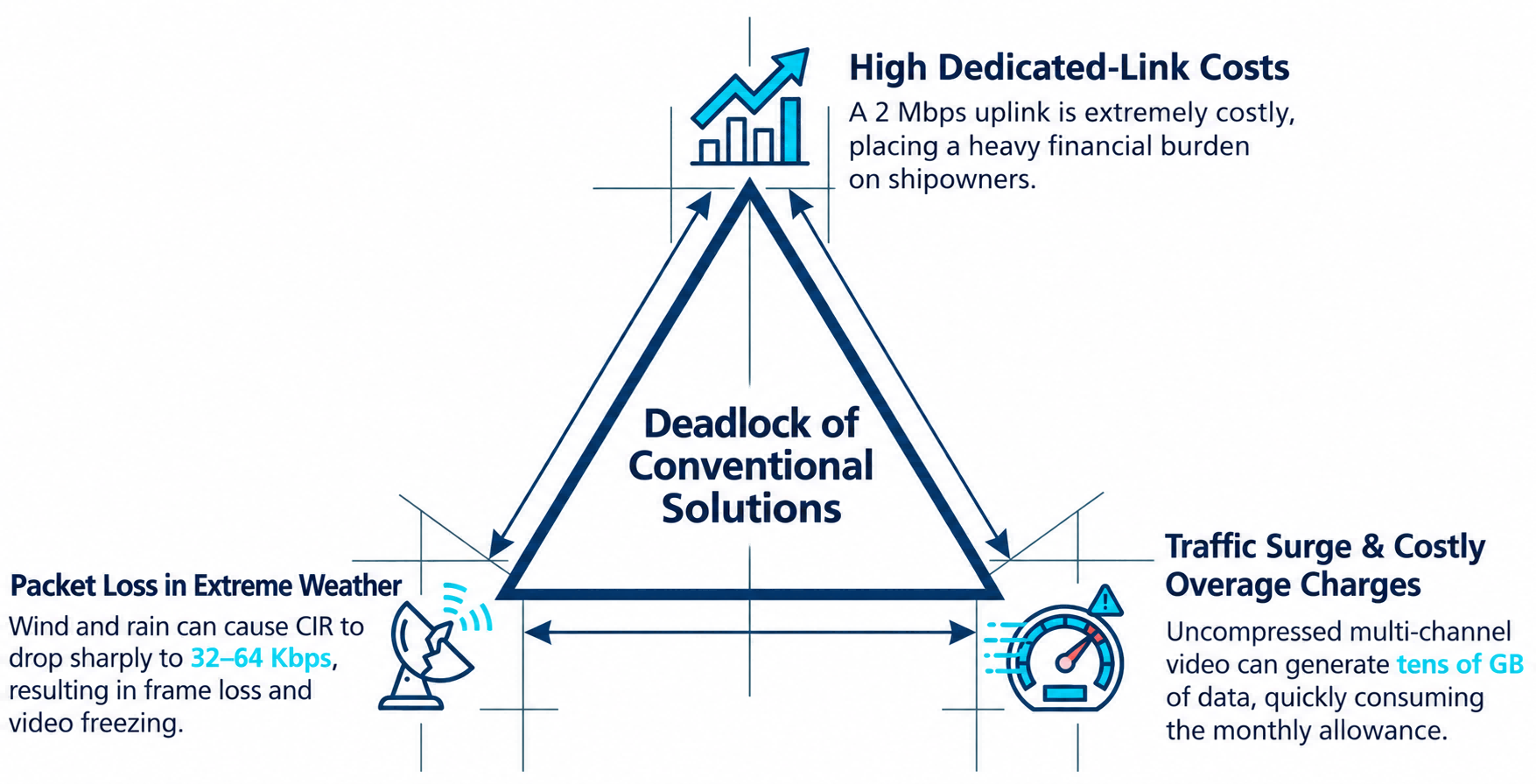
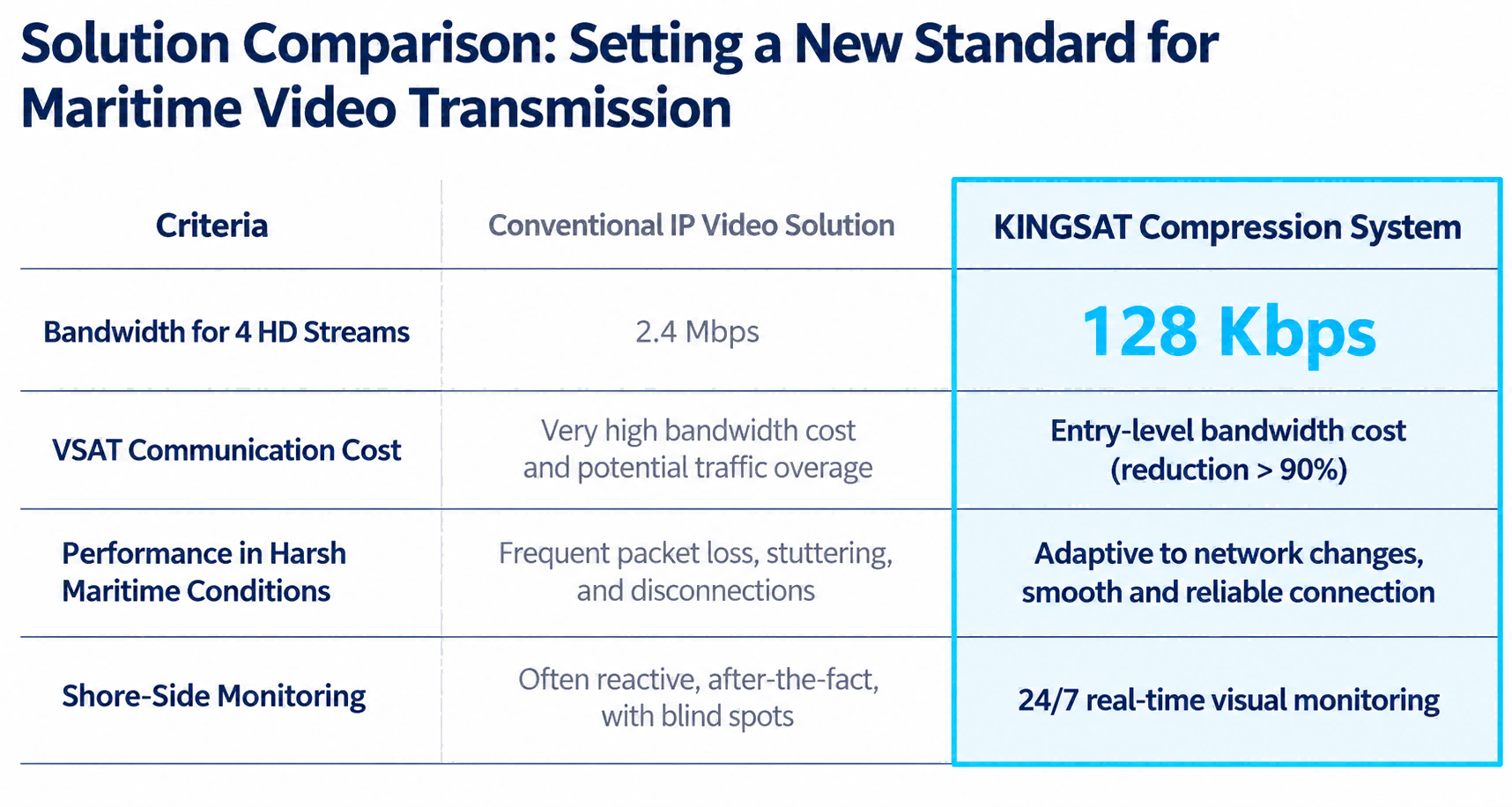
A conventional IP camera or DVR/NVR transmitting 1080P HD video typically requires 2–3 Mbps of bandwidth, and in some cases 4–5 Mbps. Even a single 540P–720P video stream requires around 600–800 Kbps of uplink bandwidth. With four cameras onboard, the total bandwidth requirement can reach 4 × 600 Kbps = 2.4 Mbps.
On a VSAT network, an uplink with a CIR (Committed Information Rate) above 2 Mbps can result in very high monthly service costs, creating a significant cost burden for shipowners and operators.

2. High Data Usage and Overage Costs
For satellite services charged by data usage, such as plans billed by GB or MB, a single uncompressed camera streaming continuously can generate tens of gigabytes of data per day. With multiple cameras transmitting simultaneously, the monthly data allowance can be consumed quickly, resulting in substantial overage charges.
3. Network Fluctuations and Packet Loss
Maritime satellite links can be affected by vessel motion, rain fade, and changing weather conditions, causing available uplink bandwidth to fluctuate significantly and, in extreme cases, drop to only 32–64 Kbps. Conventional video transmission lacks the adaptive compression and packet-loss optimization needed for ultra-narrowband satellite links, which can lead to severe frame loss, video freezing, or even transmission interruption.
II. Solution: KINGSAT Ultra-Narrowband Video Compression System
To address the challenges of VSAT and other low-bandwidth maritime links, KINGSAT has developed an end-to-end video compression system based on its expertise in wireless communications and video encoding. The system integrates a high-efficiency video encoder with a high-concurrency decoder server.

1. Core Technology: Up to 100:1 Compression for Smooth Video Transmission at 32–128 Kbps
- Stable video transmission over ultra-narrow bandwidth: The KINGSAT Video Compression System features two compression modes, Intelligent Sense and Quality Balance. It can compress 1080P video that would normally require 2–3 Mbps, or 720P video requiring 600–800 Kbps, achieving compression ratios of 28:1 to 116:1 or even higher.

- Tested performance under extremely low CIR:
Single-channel 720P transmission: With a VSAT uplink CIR of only 32 Kbps, the system can still deliver clear and smooth 720P video (1280 × 720 @ 8 FPS), using just 31.2 Kbps of actual uplink bandwidth.
Four concurrent 1080P/720P streams: With an uplink CIR of 128 Kbps, the system can transmit four concurrent 720P or 1080P HD video streams, requiring only 32–36 Kbps per stream while maintaining smooth video playback. A four-channel monitoring system that would normally require 2.4 Mbps can therefore operate over a 128 Kbps CIR satellite link.

2. Broad Compatibility and Flexible Deployment
- Broad protocol compatibility: The onboard video compression unit supports RTSP, GB28181, ONVIF, as well as proprietary protocols from major brands including Hikvision, Dahua, and Uniview, ensuring compatibility with existing cameras and DVR/NVR systems.
- Flexible hardware options:
External industrial-grade compression unit: 190 × 114 × 65 mm, DC 12V/5A, with an operating temperature range of -20°C to +60°C.
Ultra-compact Mini board: 62.5 × 62.5 × 29 mm.
1U standard rack-mount unit: Can also be integrated directly into the antenna ACU enclosure to accommodate the installation requirements of different vessels and unmanned platforms.
- Dynamic adaptive bitrate adjustment: With Adaptive Coding enabled, the system can dynamically adjust the encoding bitrate and frame rate according to the available satellite uplink bandwidth, such as 64 Kbps or 32 Kbps. This allows video quality and smoothness to adapt to network fluctuations while maintaining a stable connection.
3. High-Concurrency Cloud / Private Decoder Server Architecture

- High-capacity video access: A single server can connect to and manage up to 2,000 channels of 1080P video, while supporting up to 800 concurrent channels for live viewing, storage, and forwarding.
- Flexible deployment: Customers can use a KINGSAT cloud server, such as one deployed in Singapore, or deploy a dedicated decoder server on premises or in a private cloud to meet their data security and privacy requirements.
III. Benefits: Significantly Lower Satellite OPEX and Improve the ROI of Maritime Video Monitoring
Deploying the KINGSAT Ultra-Narrowband Video Compression Transmission System can deliver significant cost savings and operational benefits for maritime companies and private-network users.
1. Reduce Satellite Communication Costs by More Than 90%
Video transmission that would normally require a costly VSAT uplink of more than 2 Mbps—or an expensive usage-based satellite data plan—can be supported with a CIR of just 128 Kbps or even 32 Kbps. This can reduce bandwidth and data costs by more than 90%, saving shipowners hundreds of thousands of RMB in satellite service costs each year.
2. Real-Time Shore-Side Video Monitoring
Shore-based management teams can access live CCTV footage from ocean-going vessels or offshore platforms anytime, anywhere via a web browser or mobile app, with support for remote live viewing, cloud storage, and recorded video playback. This enables real-time remote monitoring and helps identify safety risks before they develop into incidents.
3. Reliable Video Transmission over Unstable Links
Even when severe weather causes significant satellite signal degradation and the CIR drops as low as 32 Kbps, the compression system can still maintain smooth transmission of at least one clear 720P video stream, ensuring critical video remains visible and clear when it matters most.
4. Multiple Channel Options and Reliable Performance
KINGSAT offers 2-, 4-, 8-, and 16-channel video compression terminals. Backed by 20 years of R&D experience in wireless RF and maritime communications, together with stringent quality control, the equipment is designed for long-term stable operation in marine environments with high salt spray, high humidity, and wide temperature ranges.
Conclusion
As maritime operations become increasingly digital and connected, remote video monitoring should no longer be constrained by high satellite data costs. With bandwidth requirements as low as 32–128 Kbps and traffic compression of more than 90%, the KINGSAT Ultra-Narrowband Video Compression Transmission System enables real-time HD video monitoring over bandwidth-constrained VSAT links.
With KINGSAT, reliable and cost-effective remote video monitoring becomes a practical solution for vessels operating far offshore.


Contact us: sales@kingsat-tech.com Official website: www.kingsat-tech.com
Youtube: http://www.youtube.com/@kingsatmaritimeantennas4640