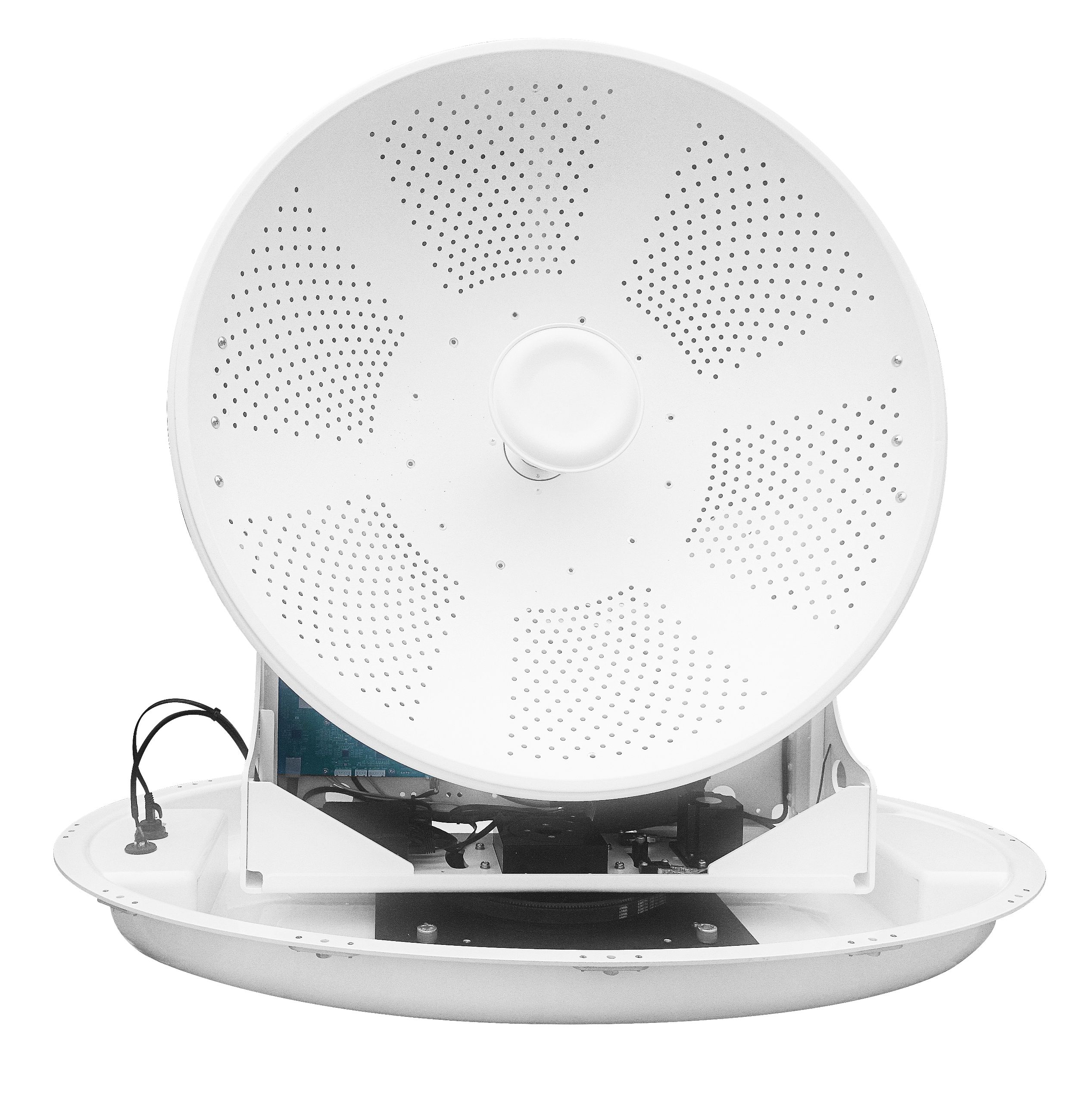

As the maritime economy expands and demand grows for smart-island infrastructure and nearshore network coverage, islands and offshore facilities, including marine aquaculture sites, oil and gas platforms, and tourist islands, increasingly need fast, reliable mobile connectivity. Yet backhaul remains one of the biggest obstacles to deploying island base stations. Remote locations and harsh sea conditions make conventional terrestrial cabling impractical, leaving some base stations with local coverage but no viable connection to the wider network. The industry therefore needs wireless backhaul solutions that combine high bandwidth, cost efficiency, and flexible deployment.

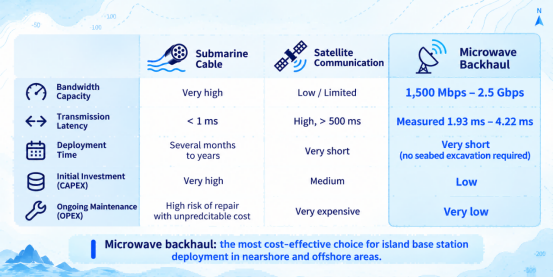
I. Comparing Three Backhaul Technologies
II. Deployment Requirements for Cross-Sea Microwave Backhaul
Given these advantages, what conditions are required to deploy microwave backhaul for island connectivity?
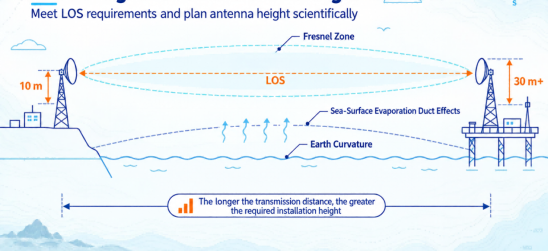
- Line-of-Sight Requirements and Antenna Height
Microwave links require a clear line of sight (LOS). Antenna mounting heights must be carefully planned to account for Earth's curvature, Fresnel-zone clearance, and propagation conditions over the sea. Depending on the link distance and site conditions, installation heights may need to be 10 m, 30 m, or higher.
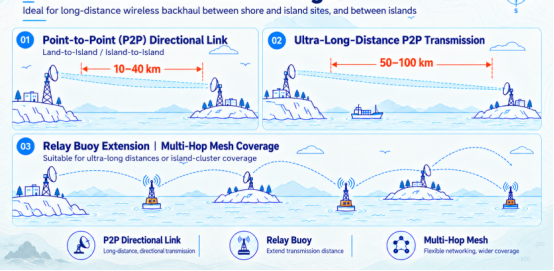
- Transmission Distance
Typical applications include 10–40 km point-to-point (P2P) links between the mainland and islands or between islands, with longer-distance links potentially reaching 50–100 km. For very long distances or groups of islands, relay buoys or mesh networking can support multi-hop connectivity.
- Weather Resistance and Wind Loading
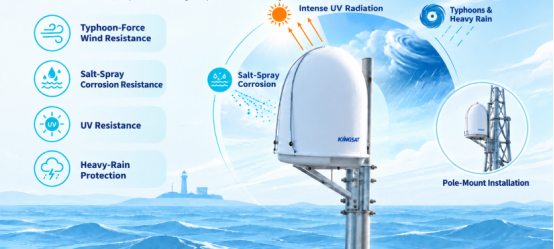
Island installations face salt spray, intense UV exposure, typhoons, and heavy rain. Both the antenna and its mounting structure must therefore provide marine-grade environmental protection and withstand high wind loads.
III. Technical Advantages of KINGSAT Auto-Tracking Antennas
Designed for inter-island and tower-to-tower backhaul applications, KINGSAT 5G-NTN microwave auto-tracking antennas integrate advanced technologies to ensure reliable and stable link performance.
- Intelligent Self-Alignment and Automatic Tracking
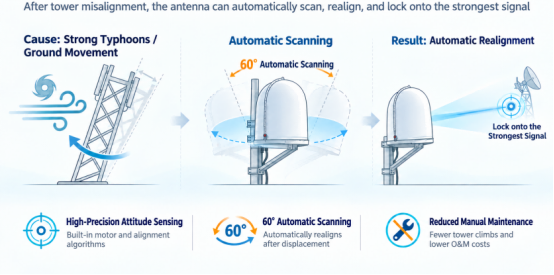
The KINGSAT MP series of pole-mounted antennas features built-in motors, high-precision orientation sensing, and intelligent alignment algorithms, enabling automatic scanning and alignment over a 60° range. If a typhoon or ground movement causes a tower to tilt or shift out of alignment, the antenna can automatically realign and lock onto the strongest signal. This minimizes manual intervention, reduces the need for tower climbs, and lowers operation and maintenance costs.
- High Bandwidth and Low Latency
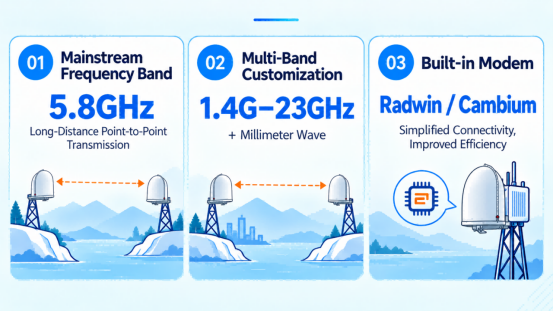
The antennas support widely used frequency bands such as 5.8 GHz, with customizable frequency options spanning 1.4–23 GHz, as well as millimeter-wave bands. Carrier-grade microwave modems from manufacturers such as RADWIN and Cambium can be integrated into the antenna enclosure, reducing external equipment and cabling requirements while simplifying installation.
- Precision Alignment and Geofencing
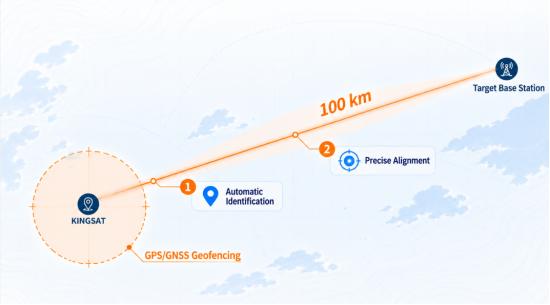
Integrated high-precision GPS/GNSS positioning and geofencing capabilities enable the system to identify and accurately align with a target base station using site coordinates. When paired with a narrowband VHF system, the solution can also provide coordinated alignment guidance and rapid link establishment over distances of up to 100 km.
IV. Business Value of Microwave Backhaul
Beyond its technical advantages, KINGSAT microwave auto-tracking antenna solutions deliver tangible business benefits for island network developers and operators.
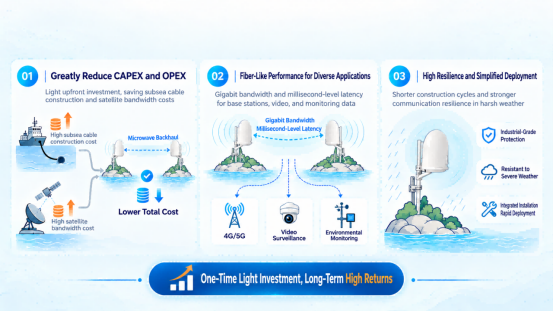
- Lower CAPEX and OPEX
Compared with subsea fiber deployment, microwave backhaul eliminates the need for costly seabed cable-laying work and reduces the risk of future cable repair expenses. Compared with satellite communications, it avoids high recurring bandwidth subscription fees, enabling lower upfront investment and greater long-term cost efficiency.
- Fiber-Like Performance for Diverse Applications
With gigabit-class bandwidth and millisecond-level latency, the solution can support 4G/5G mobile base station backhaul, multi-channel 1080p/4K video surveillance, and marine environmental monitoring data transmission.
- High Resilience and Simplified Deployment
Industrial-grade protection and simplified, integrated installation help shorten deployment times on islands while improving communication resilience under challenging weather conditions.
Conclusion
As 5G-NTN (Non-Terrestrial Networks) advances and communications become increasingly integrated across space, air, land, and sea, microwave, fiber, and satellite technologies have complementary roles to play. With high bandwidth, low latency, resilience to harsh marine conditions, and cost efficiency, KINGSAT microwave auto-tracking antenna solutions provide a competitive solution for cross-sea connectivity and island base station deployments, addressing the challenges of difficult subsea cable installation and high satellite bandwidth costs.
Contact us: sales@kingsat-tech.com Official website: www.kingsat-tech.com
Youtube: http://www.youtube.com/@kingsatmaritimeantennas4640