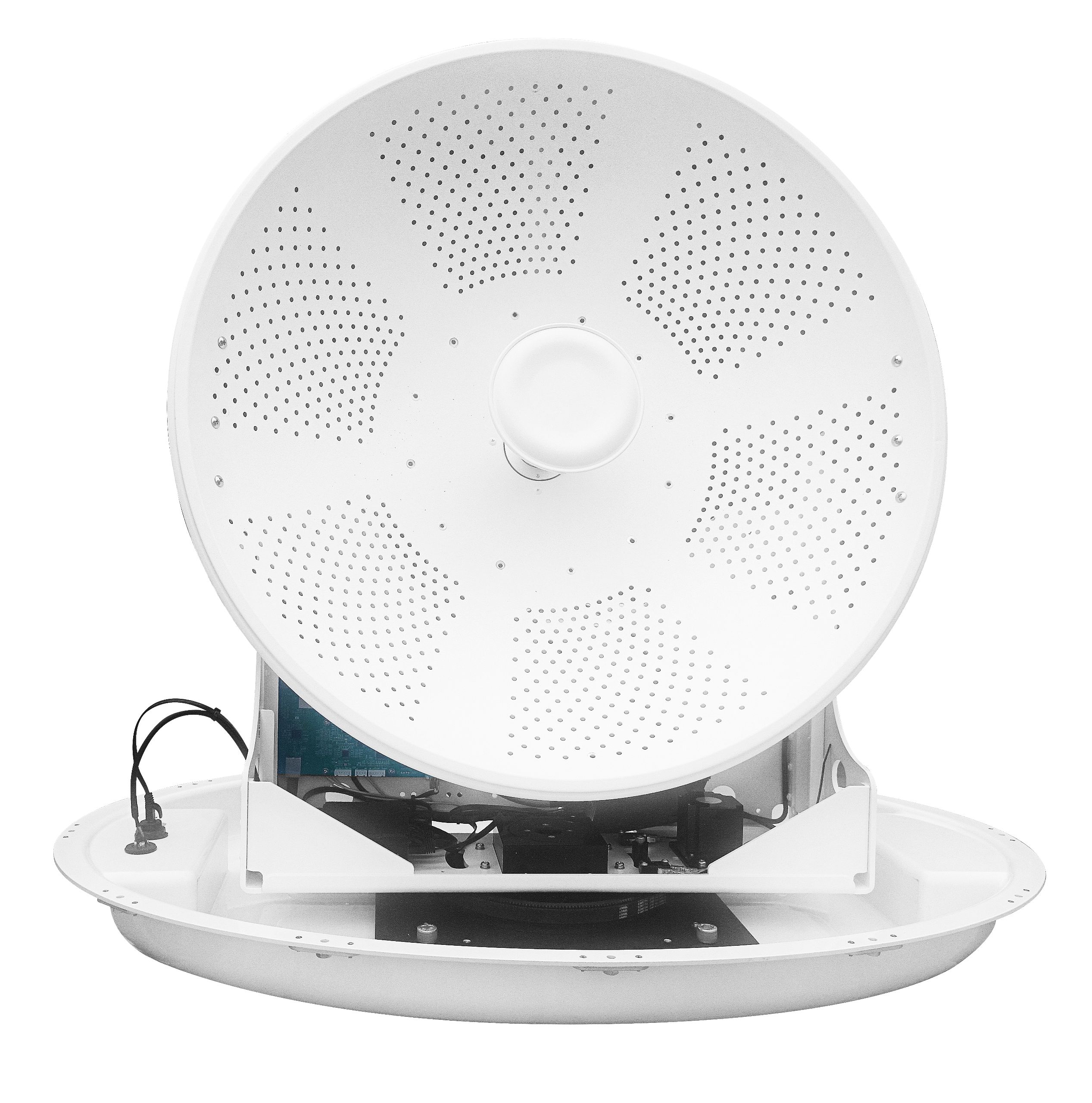

In today's rapidly evolving communications landscape, high-bandwidth, low-latency point-to-point (PtP) microwave links play a critical role in backbone networks connecting mainland sites, islands, remote facilities, and offshore infrastructure. From mountain-top base station backhaul spanning tens of kilometers to emergency communications for offshore operations, microwave links provide a fast and cost-effective alternative to physical fiber deployment.
However, maintaining these links can become a serious challenge when antennas are installed on towers tens or even hundreds of meters above ground. Traditional fixed microwave antennas perform well when precisely aligned. But typhoons, geological movement, tower settlement, and structural deformation can gradually shift the antenna away from its optimal pointing direction. Once this happens, restoring the link often requires technicians to climb the tower and manually realign the antenna, adding maintenance costs, safety risks, and network downtime.
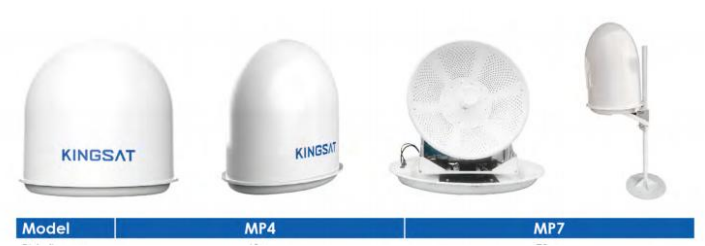
To address this challenge, KINGSAT has applied its experience in maritime satellite auto-tracking and alignment technology to terrestrial microwave backhaul, developing the MP Series pole-mounted self-calibrating microwave antenna.
⚡The Challenge: Why Fixed Microwave Antennas Lose Alignment
Point-to-point microwave links rely on narrow, highly directional beams with concentrated RF energy. Maintaining a stable link therefore requires highly precise alignment between the antennas at both ends. Even a small pointing deviation can have a significant impact on link performance.
In real-world deployments, traditional fixed microwave antennas face three major challenges.
1. Narrow Beams Leave Little Margin for Misalignment
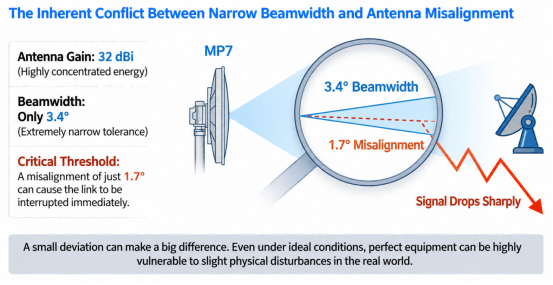
Take the MP7 with a 72 cm parabolic reflector as an example. To achieve a gain of up to 32 dBi, the antenna has an extremely narrow beamwidth of only 3.4°.
Such a narrow beam leaves very little tolerance for pointing deviation. If the antenna shifts by just 1.7° on the tower, the received signal level can drop sharply, resulting in link interruption.
2. Environmental Factors Can Cause Antenna Misalignment
Microwave antennas remain exposed on towers year after year and are inevitably affected by environmental and structural changes.
Typhoons and strong coastal winds:
The high wind loads and shear forces generated by severe typhoons can physically shift a fixed antenna out of alignment or loosen its mounting through prolonged vibration.
Geological movement and tower settlement:
Earthquakes, landslides, other minor ground movements, or gradual foundation settlement over time can affect the vertical alignment of the tower and, in turn, change the antenna's pointing direction.
Thermal expansion and tower deformation:
Large temperature variations can cause slight expansion, contraction, or deformation of the metal tower structure. For an antenna with a beamwidth of only 3.4°, even a small change in tower geometry can be enough to affect alignment and link performance.
3. Manual Realignment Means Higher Risk, Higher Cost, and Slower Recovery
Once a fixed antenna becomes misaligned, restoring the link requires technicians to climb the tower and manually realign the antenna.
For towers tens or even hundreds of meters high, maintenance teams may need to dispatch trained tower-climbing personnel with lifting and test equipment, often in difficult terrain or challenging weather conditions.
Each maintenance visit brings not only significant safety risks, but also additional labor costs, vehicle expenses, work-at-height insurance, and other OPEX. If access to the site is delayed by severe weather or difficult terrain, troubleshooting and recovery may take several days, during which the resulting private-network or base-station outage can lead to substantial operational losses.
🧗KINGSAT Solution: MP Series Pole-Mounted Self-Calibrating Microwave Antenna
To address these challenges, KINGSAT, a leading manufacturer of maritime satellite communication systems, draws on more than seven years of R&D experience in precision dynamic tracking and RF technologies for TVRO and VSAT systems. By adapting its proven vessel-motion compensation and self-alignment technology to terrestrial microwave applications, KINGSAT has developed the MP Series two-axis pole-mounted self-calibrating microwave antenna.
1. ±15° Two-Axis Intelligent Self-Alignment and 60° Automatic Scanning
The KINGSAT MP Series integrates a precision compact motorized servo mechanism, moving from conventional fixed mechanical alignment to intelligent active alignment.
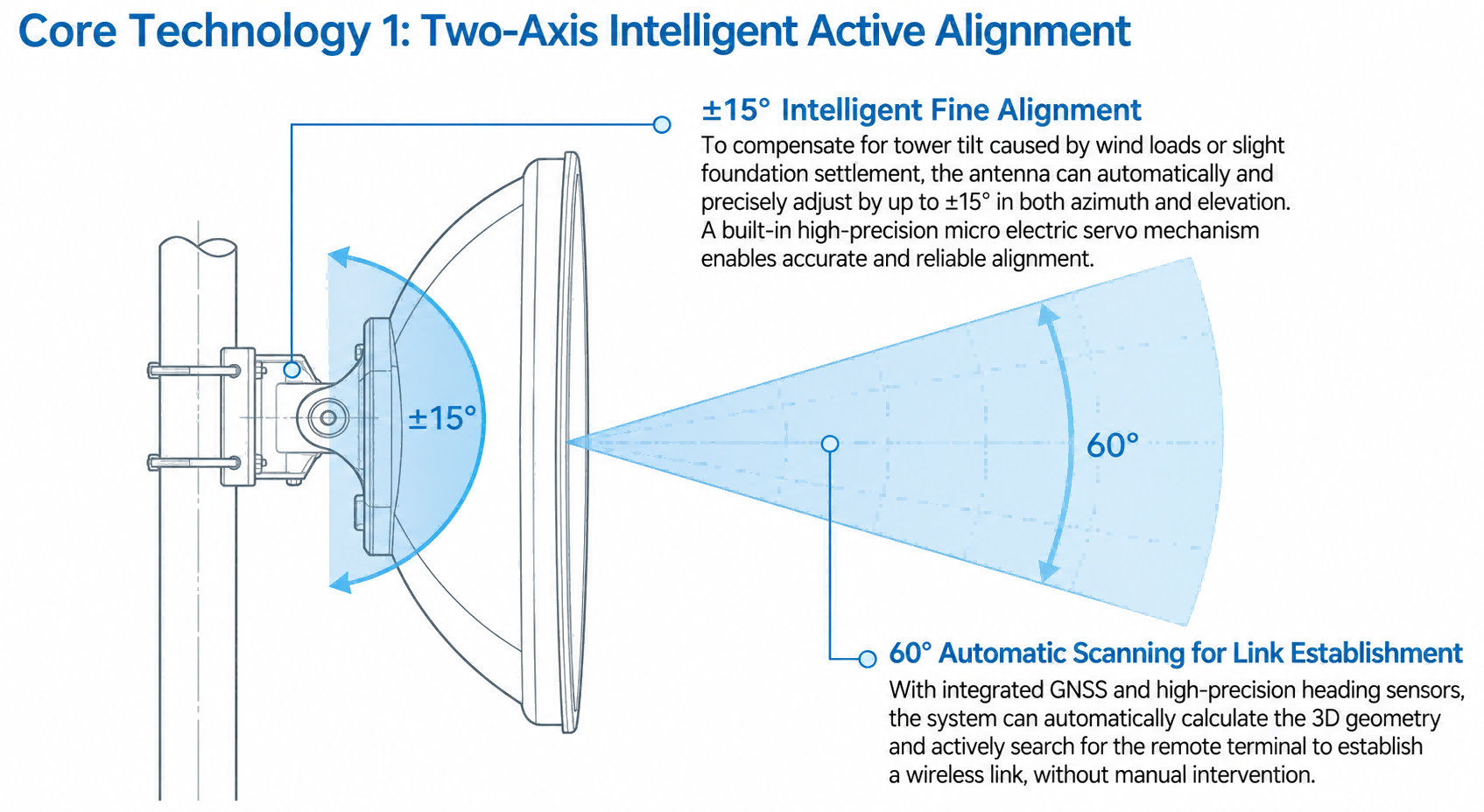
±15° Intelligent Fine-Alignment Range:
When temperature-induced tower deformation, wind-induced tilt, or minor foundation settlement causes pointing deviation, the antenna automatically performs high-precision self-calibration in both azimuth and elevation within a range of up to ±15°.
60° Automatic Scanning and Link Establishment:
With integrated GNSS and high-precision compass sensors, the system automatically calculates the required 3D pointing geometry upon startup, actively searches for the remote terminal, and establishes the wireless link without manual intervention.
2. Status Telemetry and Reporting Every Five Seconds

KINGSAT provides an advanced cloud-based telemetry and remote monitoring platform as an optional service. When enabled, the antenna uploads operating logs to the cloud server every five seconds, including AZ/EL pointing, real-time AGC signal level, GPS coordinates, operating voltage, and other system data.
O&M engineers can monitor antenna status in real time through a web interface or mobile app and perform remote commissioning, troubleshooting, or one-click calibration from the office. This significantly reduces the need for technicians to climb towers for on-site troubleshooting and realignment.
💎Benefits: Lower OPEX and Improved Network ROI
The KINGSAT MP Series pole-mounted self-calibrating microwave antenna can deliver immediate operational and financial benefits for network operators and private network users.
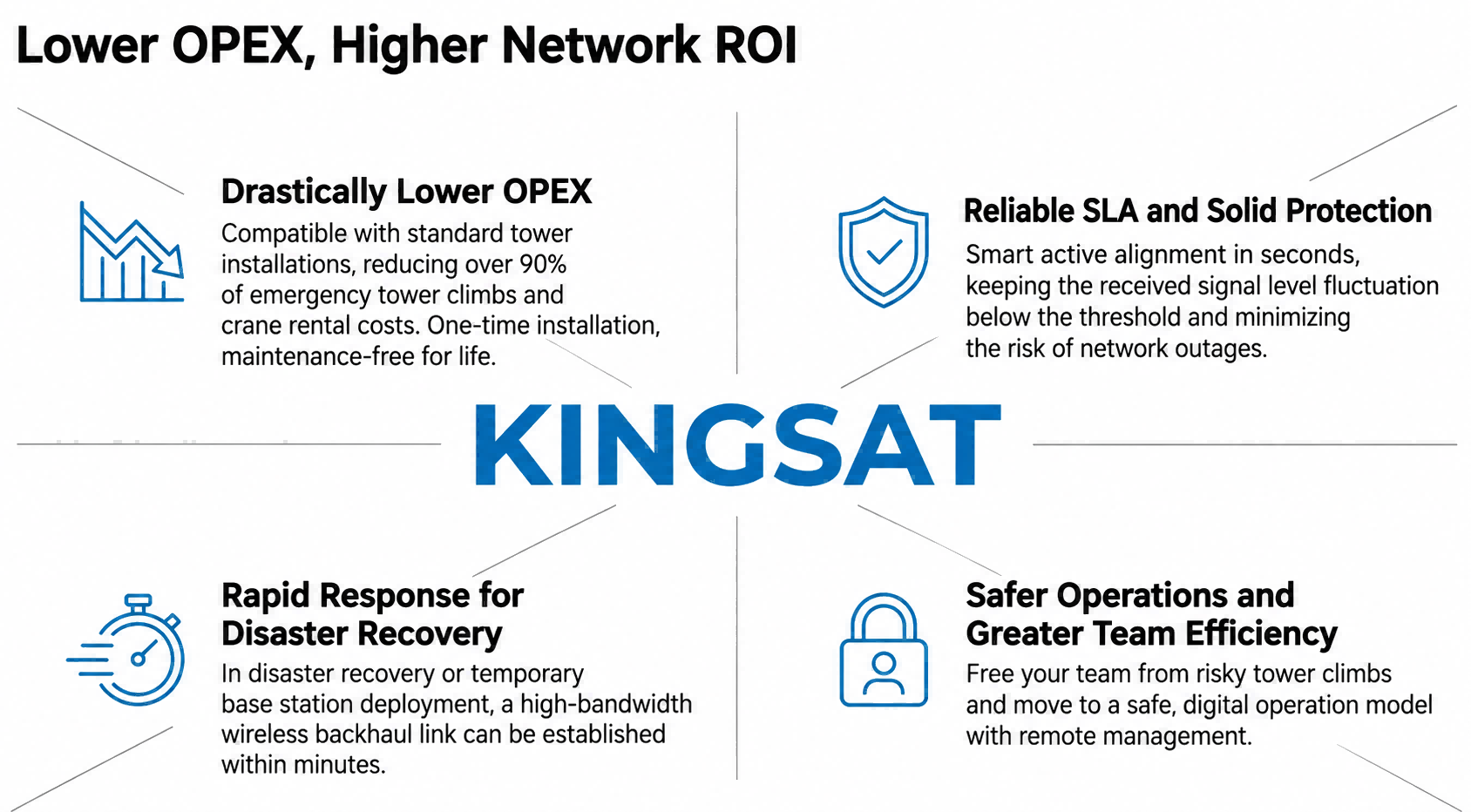
Significant OPEX Reduction:
The MP antenna features a lightweight pole-mounted design compatible with standard tower installations. Its self-calibration and remote commissioning capabilities can eliminate more than 90% of the emergency site visits and crane requirements associated with tower-based antenna realignment, significantly reducing maintenance costs and the need for manual intervention.
Improved Link Availability and SLA Performance:
For cross-sea links in typhoon-prone areas and backbone networks in remote mountainous regions, the antenna can intelligently correct pointing deviations within seconds. It keeps RMS fluctuations in received signal levels below critical thresholds, helping minimize the risk of network downtime.
Rapid Link Establishment for Disaster Recovery and Emergency Communications:
Following floods, earthquakes, or typhoons, the MP Series can support emergency communication networks and temporary base station deployments. With high-precision 3D automatic alignment and self-organizing networking capabilities, the system can establish high-bandwidth wireless backhaul links within minutes.
Safer and More Efficient O&M:
Remote monitoring, commissioning, and calibration allow O&M teams to move away from high-risk tower climbing toward centralized, cloud-based network management, improving both maintenance efficiency and personnel safety.
Conclusion
As high-speed broadband networks continue to expand, reliable microwave links should not be held back by a recurring cycle of strong winds, antenna misalignment, and risky tower climbs for manual realignment.
With the KINGSAT MP Series self-calibrating microwave antenna, operators gain more than a stable, high-bandwidth backbone link with fiber-like performance. Automatic self-alignment also reduces the need for technicians to work at height, allowing the antenna to automatically correct pointing deviations caused by wind, tower movement, and other environmental changes.
The result is a microwave link that can better adapt to changing conditions while reducing maintenance risks and keeping high-bandwidth connectivity stable and reliable.
Contact us: sales@kingsat-tech.com Official website: www.kingsat-tech.com
Youtube: http://www.youtube.com/@kingsatmaritimeantennas4640