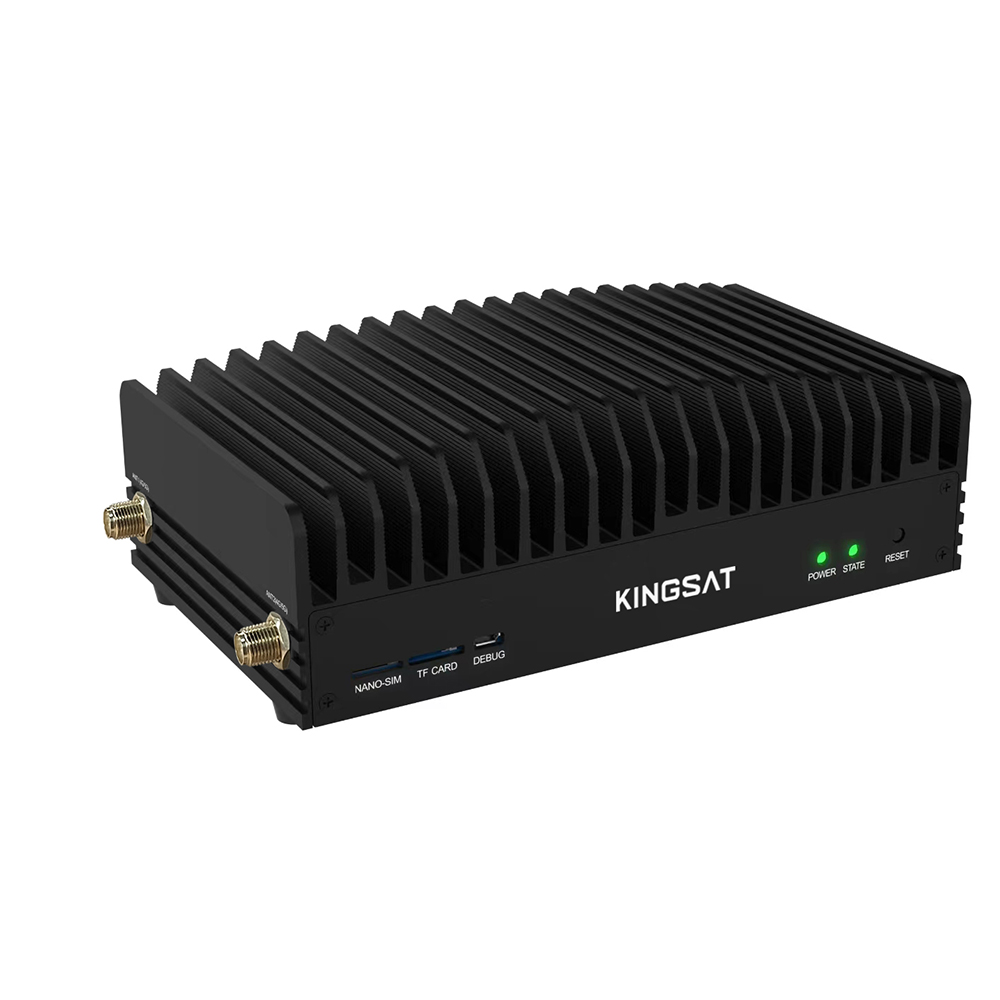

For ocean-going vessels, offshore operations, unmanned vessels, and remote worksites, real-time CCTV video monitoring has become an important tool for remote management. However, continuous transmission from multiple video channels can consume substantial network resources, placing pressure on bandwidth, data usage, and storage across maritime communication links such as VSAT, Starlink, FBB, and Inmarsat.
How can multiple video feeds be transmitted more efficiently when communication resources are limited? KINGSAT Video Compression System compresses video before it enters the communication link, enabling remote transmission at a lower bitrate and reducing the network resources continuously consumed by CCTV.

1. Why Does Video Consume So Much Satellite Bandwidth?
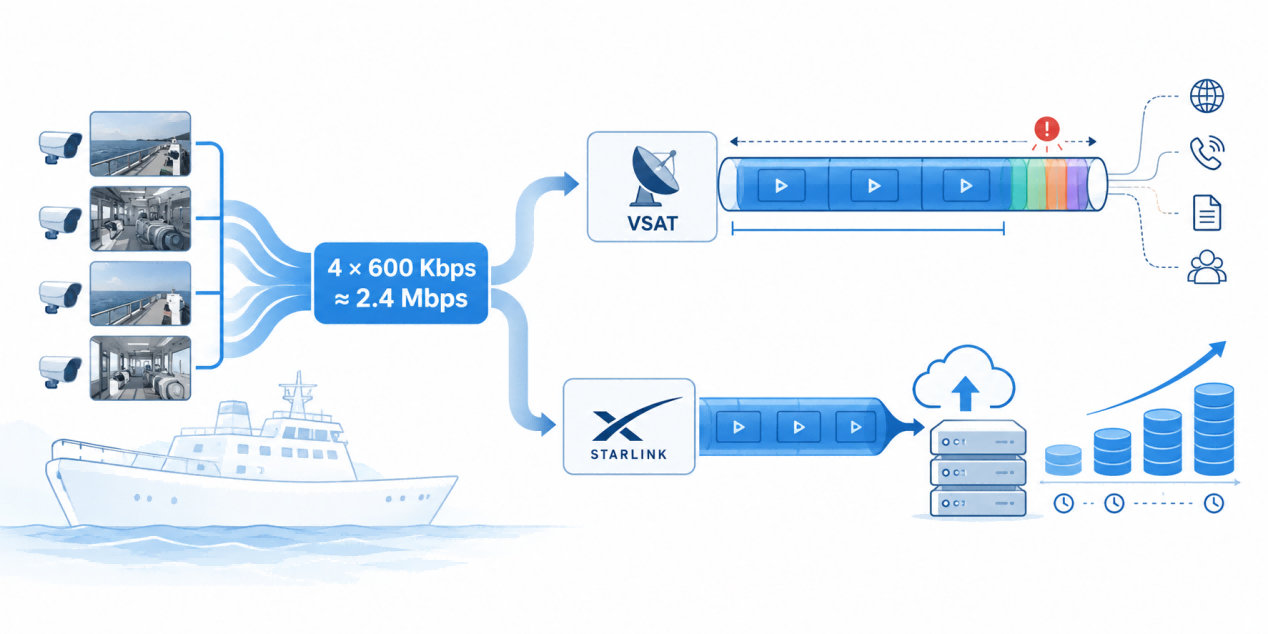
Let’s start with a simple bandwidth calculation. Under conventional video transmission, a single 540P–720P video stream typically requires around 600–800 Kbps of bandwidth. If four video streams are transmitted simultaneously from a vessel, even at 600 Kbps per stream, approximately 2.4 Mbps of uplink bandwidth is required.
VSAT — Limited uplink bandwidth: A vessel’s satellite link is not dedicated to CCTV alone. Ship-to-shore data, voice services, and other network applications all share the available bandwidth. When multiple CCTV streams continuously occupy the uplink, less bandwidth is available for other services. For VSAT projects with a specified CIR, the higher the video bitrate, the more uplink bandwidth is required.
Starlink — Continuous data usage: Starlink can provide vessels with greater network capacity, but continuous transmission from multiple CCTV cameras still generates a large volume of video data. This is especially true for projects with multiple cameras operating around the clock, where video is continuously uploaded from the vessel to shore-based servers or the cloud. As the number of cameras and operating hours increase, so do the total data volume and recording storage requirements. For Starlink service plans that involve data management or usage-based billing, this can lead to higher data consumption and operating costs.
In practice, these antennas encounter constant environmental challenges that can gradually or abruptly disrupt their alignment.
Ground Settlement & Thermal Expansion: Even the slightest physical shift, tilt, or foundation settling of a tower or mounting pole can throw the narrow microwave beam off target, causing severe signal degradation or complete link failure.
Extreme Weather & Typhoons: High winds, monsoons, and typhoons subject elevated antennas to intense mechanical stress. When an antenna is knocked out of position, the link loses alignment, disrupting critical communications precisely when they are needed most.
High Maintenance & Realignment Costs: Regaining alignment often requires a professional crew to climb the tower and manually readjust the antenna. In remote areas, offshore platforms, or harsh weather, this manual process is time-consuming, costly, and inherently hazardous.
2. How Does Video Compression Lighten the Load on VSAT/Starlink Links?
To address the bandwidth and data traffic challenges of continuous multi-channel video transmission, KINGSAT has developed a Video Compression System for maritime and remote communication environments.
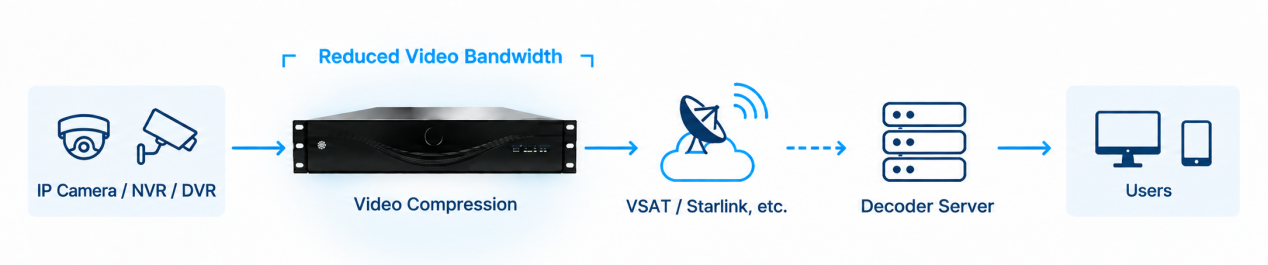
Video from cameras or NVR/DVR systems is first compressed and encoded, then transmitted over VSAT or Starlink to a remote Decoder Server. This creates an end-to-end workflow covering video input, compressed transmission, and remote viewing:
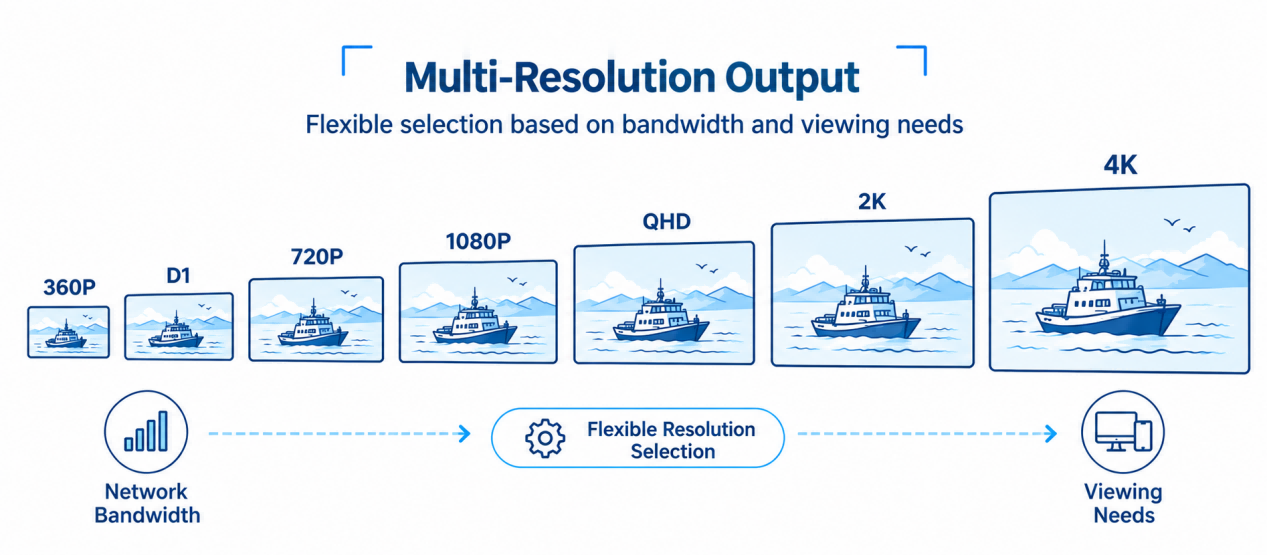
Rather than simply reducing HD video to a lower resolution, the system allows video output parameters to be flexibly configured based on available bandwidth and viewing quality requirements.
Multi-Resolution Output: The system supports 360P, D1, QHD, 720P, 1080P, 2K, and 4K, allowing users to select the appropriate output resolution based on available bandwidth and remote viewing requirements.
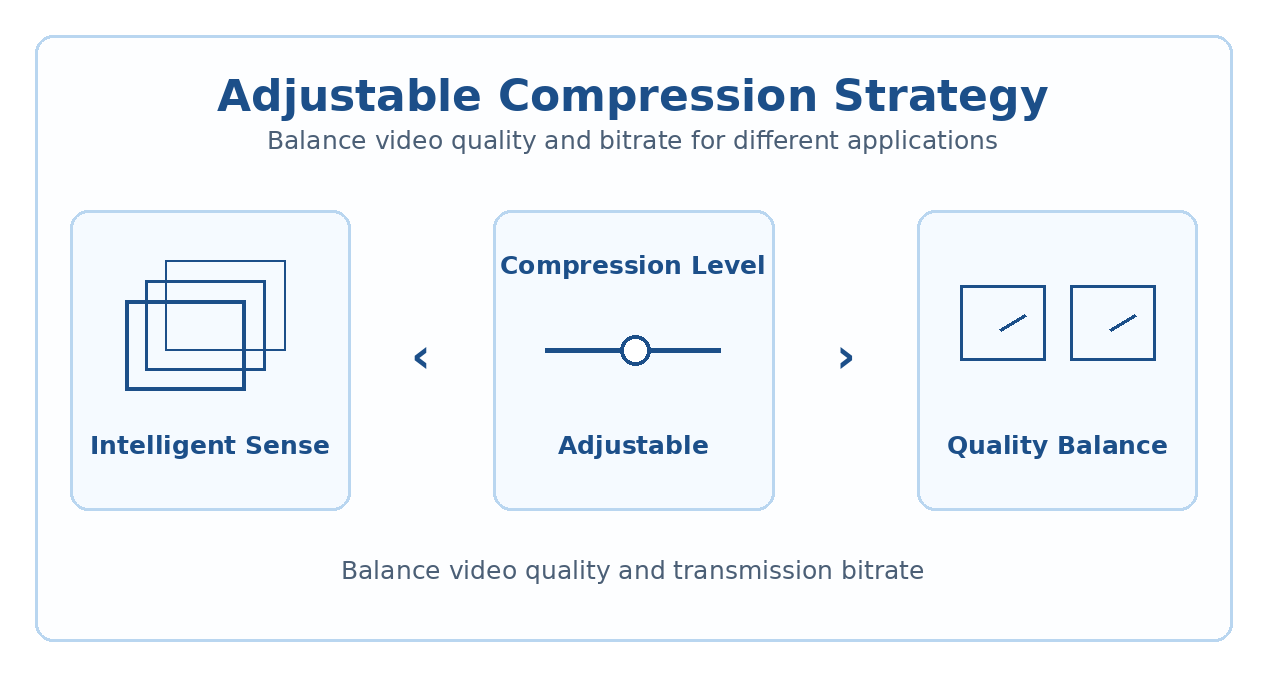
Adjustable compression strategies: The system offers two compression modes, Intelligent Sense and Quality Balance, with adjustable compression levels to balance image quality and transmission bitrate.
Adaptive bitrate: The device supports Adaptive Coding, allowing the average bitrate to be set according to the actual available network bandwidth so that video transmission can better adapt to different link conditions.
3. What Are the Practical Benefits of Video Compression?
a. Transmit More Video with Less Bandwidth and Reduce Satellite Communication Costs
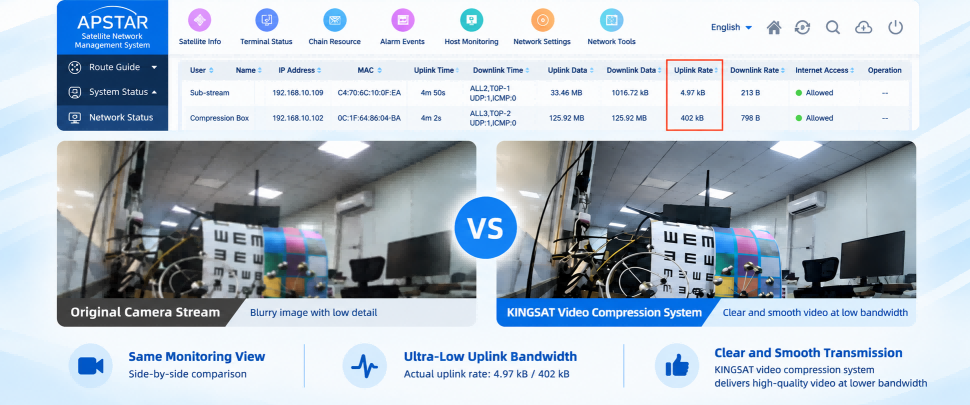
Significantly lower bandwidth requirements: Under conventional transmission, four 540P–720P video streams at 600 Kbps per stream require approximately 2.4 Mbps of uplink bandwidth. With the KINGSAT video compression solution, each 720P stream can be configured at approximately 50 Kbps, reducing the total bitrate for four streams to around 200 Kbps. In a typical configuration, a 256 Kbps CIR is sufficient to support the transmission.
Stable video transmission over low-bandwidth links: KINGSAT test data shows that with a VSAT uplink CIR of only 32 Kbps, a single 720P video stream at 8 FPS can still be transmitted clearly and smoothly. With a 128 Kbps uplink CIR, four 720P streams at 8 FPS can also be transmitted smoothly.
Free up bandwidth for other services: By reducing the video bitrate, CCTV consumes less VSAT uplink capacity, leaving more bandwidth available for ship-to-shore data, voice, and other communication services.

b. Reduce Video Data Volume and Ease Starlink Traffic and Storage Pressure
Reduce video data usage: When the video bitrate is compressed from approximately 600 Kbps to about 50 Kbps, the amount of data that must be transmitted over Starlink during the same period is reduced accordingly. This is particularly useful for long-duration, multi-channel CCTV transmission.
Reduce storage requirements: For one video stream running continuously for seven days, the data volume can be reduced from approximately 45 GB to about 3.8 GB, significantly easing recording-storage requirements on shore-based servers or in the cloud.
Optimize long-term operating costs: For Starlink service plans that involve data management or usage-based charging, smaller video data volumes can reduce data consumption while also lowering the storage resources required for long-term recording.

Conclusion: Reduce the Video Load, Get More from Limited Bandwidth
In maritime and other remote communication environments, the bandwidth and data pressure caused by video transmission does not always need to be addressed by adding more network capacity. By compressing video before it enters the communication link, the same video can be transmitted using less data, reducing VSAT bandwidth usage and the amount of data continuously carried over Starlink.
This is where the KINGSAT video compression solution delivers value: it reduces the amount of data required for transmission at the source, easing the load on the communication link. Whether for vessel CCTV, unmanned vessels, drones, or other remote applications, KINGSAT enables more efficient video transmission even when bandwidth is limited.
Contact us: sales@kingsat-tech.com Official website: www.kingsat-tech.com
Youtube: http://www.youtube.com/@kingsatmaritimeantennas4640