
In ocean-going shipping, offshore oil and gas platforms, offshore aquaculture, maritime law enforcement, and similar environments, fire-related safety violations pose a serious risk. Far from shore, where emergency response may not be immediately available, crew smoking in prohibited areas, sleeping on duty, or failing to wear required personal protective equipment (PPE) can lead to serious accidents with potentially devastating consequences.
However, conventional onboard safety supervision and video surveillance have long faced persistent limitations: manual patrols inevitably leave blind spots, traditional CCTV is mainly useful for post-event review, and the most fundamental bottleneck is the high cost of satellite communications, which makes real-time transmission of onboard CCTV video to shore economically impractical.
Even if onboard cameras capture a smoking violation, shore-based managers may remain unaware if live video cannot be transmitted back at a practical cost. The key question is how to bridge the gap between HD video transmission and narrowband satellite channels while effectively detecting unsafe behavior and potential fire hazards.
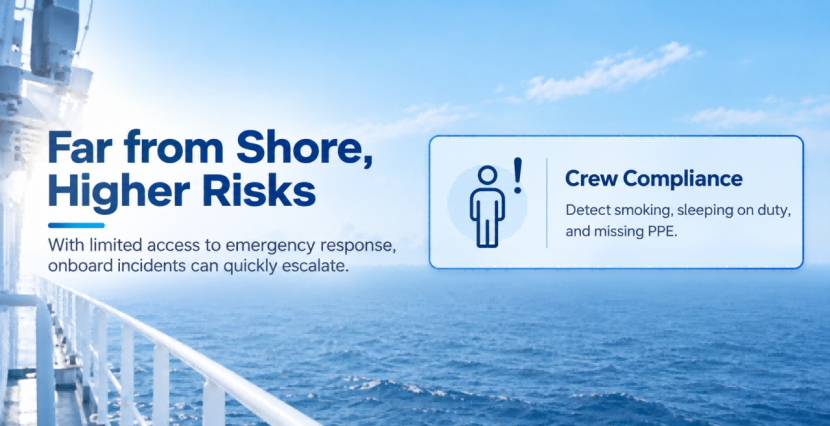
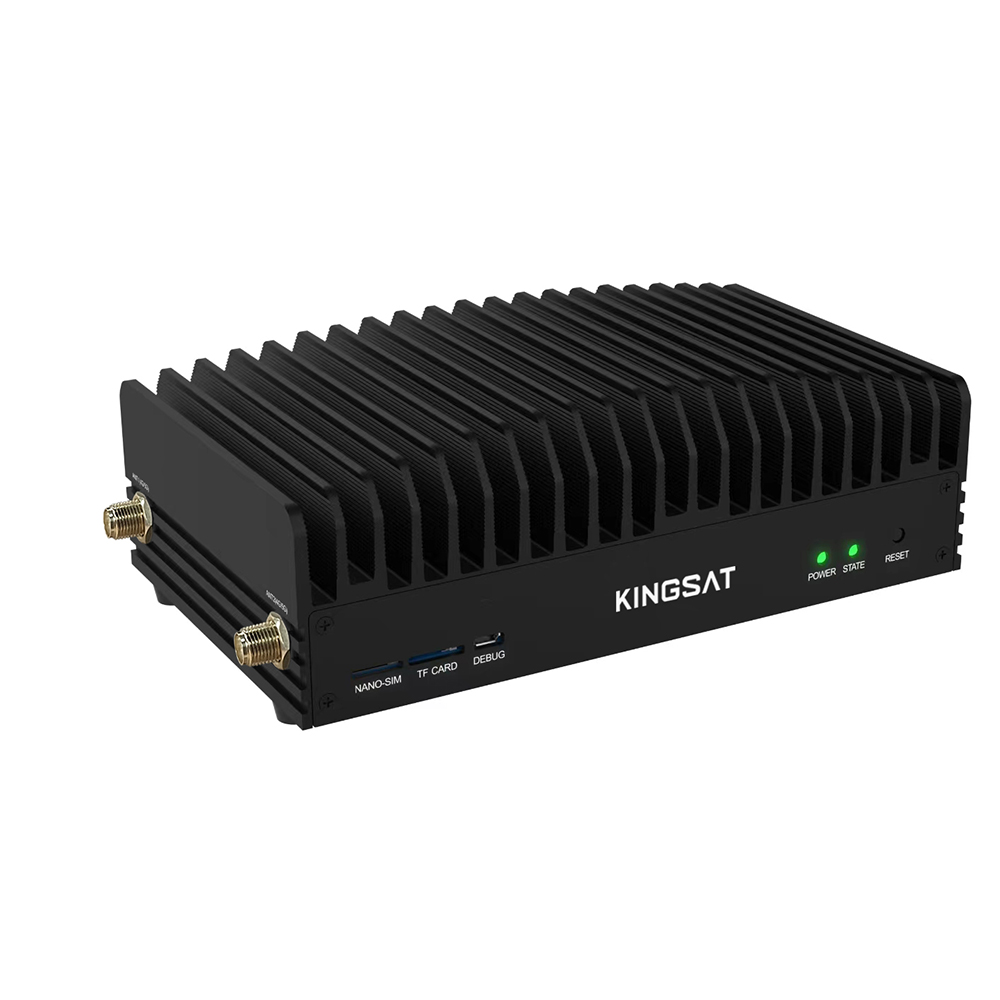
As a specialist in maritime auto-tracking antennas and marine connectivity solutions, KINGSAT integrates edge AI visual event alert algorithms into its industrial-grade ultra-narrowband video transmission system. The AI algorithms support smoking violation detection, PPE compliance detection, and other safety event detection.
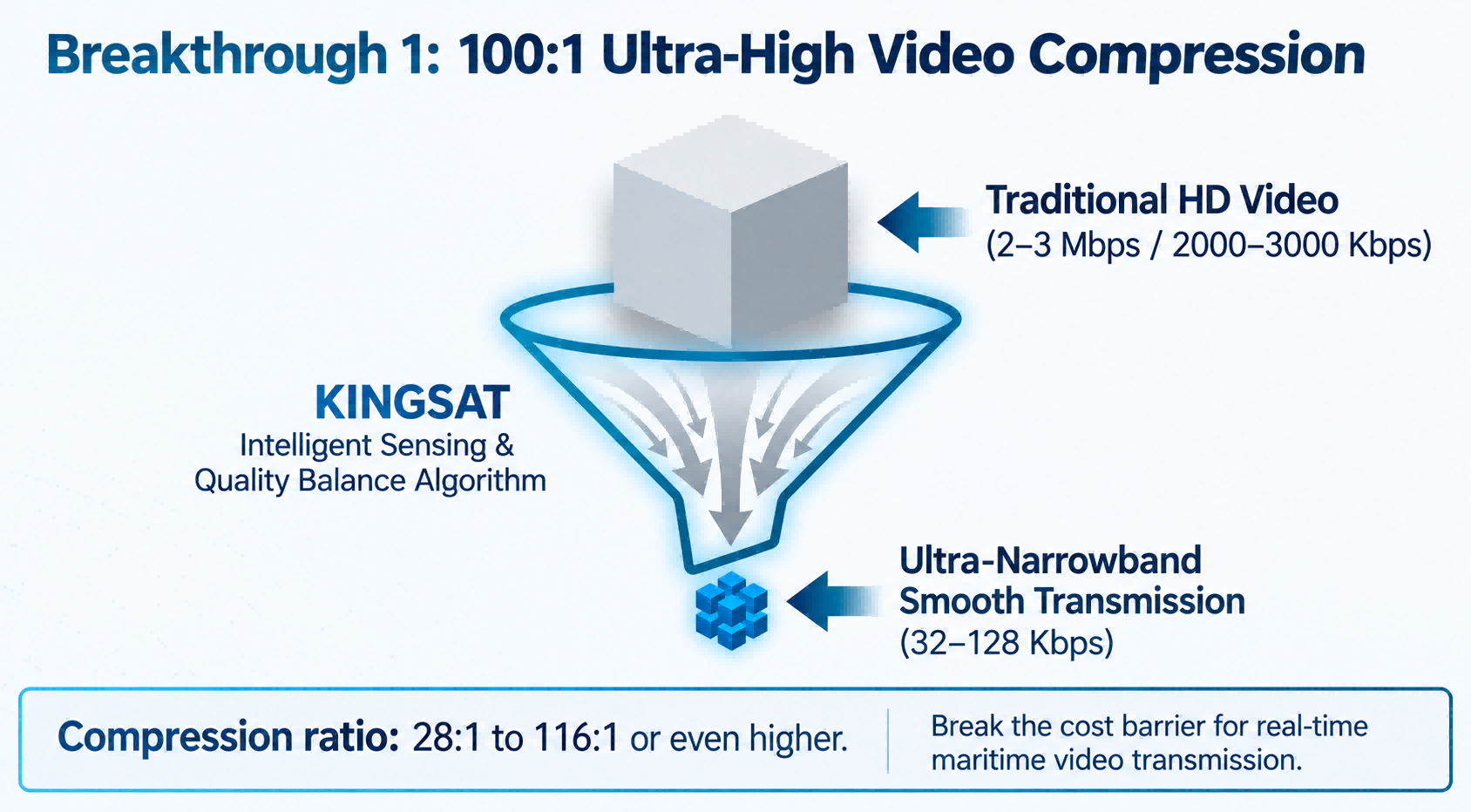
With more than 90% video traffic compression, HD surveillance video and event alerts that would normally require Mbps-level bandwidth can be transmitted smoothly in real time over narrowband VSAT links using just 32–128 Kbps of bandwidth.
The Challenge: Three Major Pain Points in Maritime Safety Monitoring
In complex maritime environments far from shore, onboard safety monitoring and hazard prevention face two major constraints: limited bandwidth and high operating costs.
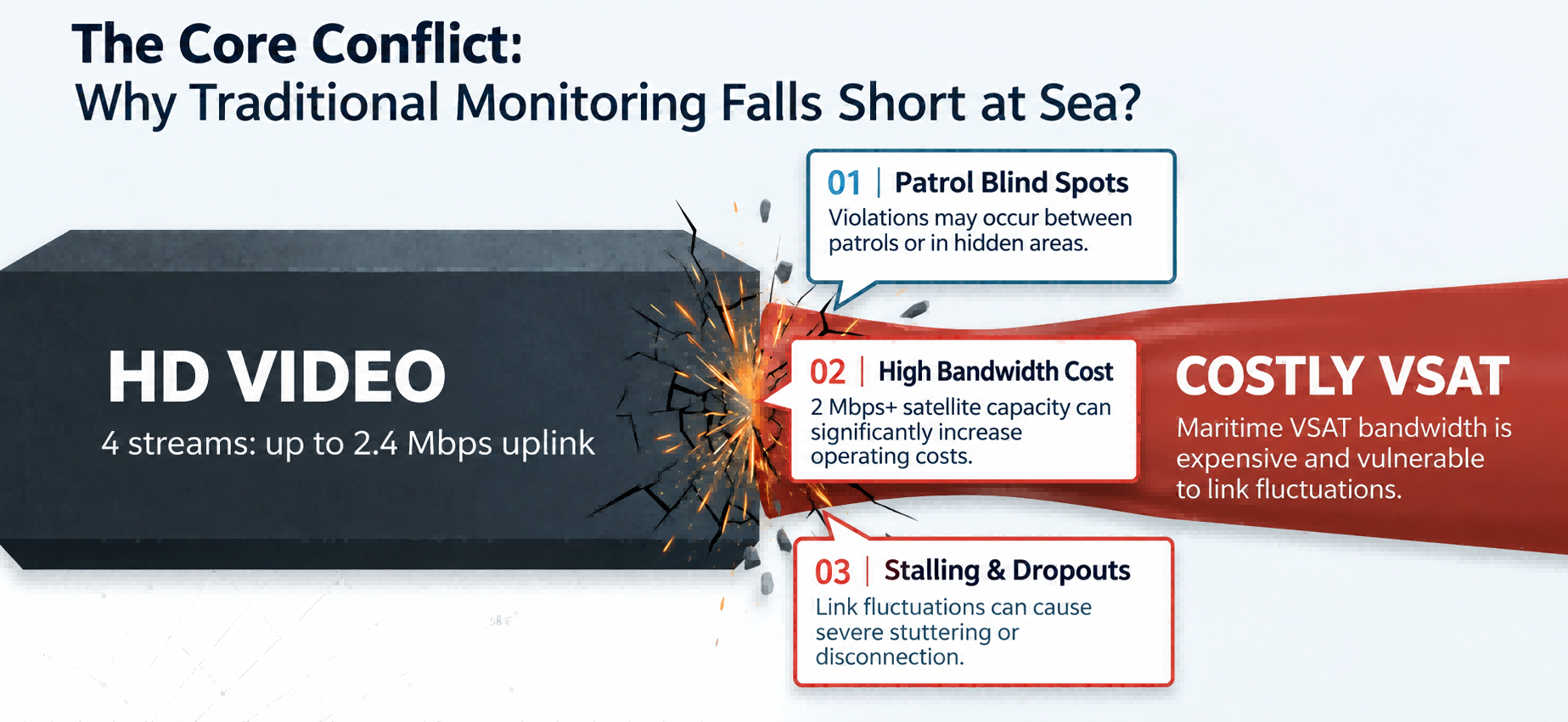
1. Hidden violations and blind spots in manual patrols
Areas such as decks, storerooms, and engine rooms are large, with personnel spread across different locations. Violations such as smoking or sleeping on duty may occur briefly or in hidden areas, making it difficult for periodic patrols alone to provide 24/7 coverage.
2. Conflict between video bandwidth requirements and VSAT costs
A conventional 1080P HD video stream typically requires 2–3 Mbps of bandwidth. Even at 720P, a single stream may require 600–800 Kbps of uplink bandwidth. With four onboard cameras, the total bandwidth requirement can reach 2.4 Mbps. Over a VSAT satellite link, a guaranteed bandwidth connection of more than 2 Mbps can be extremely expensive.
3. Video stuttering and interruptions caused by network fluctuations and packet loss
Maritime satellite links can be affected by vessel motion and changing weather conditions, causing significant fluctuations in available uplink CIR bandwidth. Conventional video transmission lacks the adaptive compression and optimization needed for ultra-narrowband channels, which can result in severe stuttering or even connection loss.
The Solution: KINGSAT Edge AI Event Alerting and Ultra-Narrowband Video Transmission System
To address the challenges of VSAT and other low-speed maritime links, KINGSAT combines its expertise in wireless communications and video processing in an end-to-end video compression and transmission system featuring a high-efficiency video compression Encoder and a high-capacity Decoder Server.
1. Core Technology: Up to 100:1 Compression for Smooth Video Transmission at 32–128 Kbps
Stable ultra-narrowband transmission: The KINGSAT Video Compression System features two processing modes—Intelligent Sense and Quality Balance. HD video that would normally require 2–3 Mbps can achieve compression ratios of 28:1 to 116:1, or even higher.
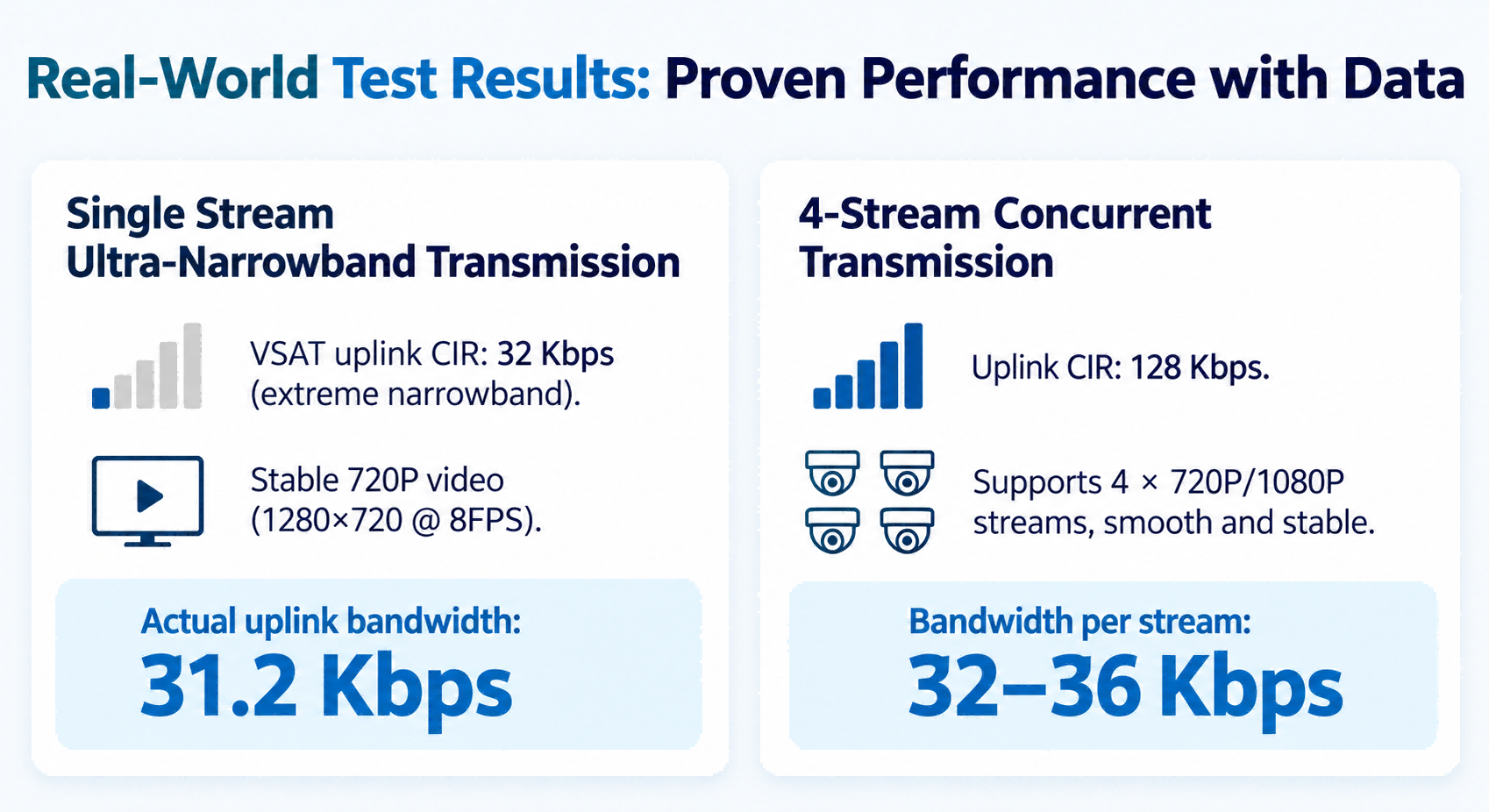
Measured performance under ultra-narrowband CIR conditions:
Single-stream 720P transmission: With VSAT uplink CIR limited to just 32 Kbps, the system can still deliver clear 720P video (1280×720 @ 8 FPS) while using only 31.2 Kbps of actual uplink bandwidth.
Four-stream concurrent transmission: With an uplink CIR of 128 Kbps, the system can carry four concurrent 720P or 1080P HD video streams using only 32–36 Kbps per stream, with smooth playback and no stuttering. Four-camera monitoring that would otherwise require 2.4 Mbps can therefore operate over a 128 Kbps CIR satellite link.
2. Lightweight AI Event Alerting and Adaptive Transmission
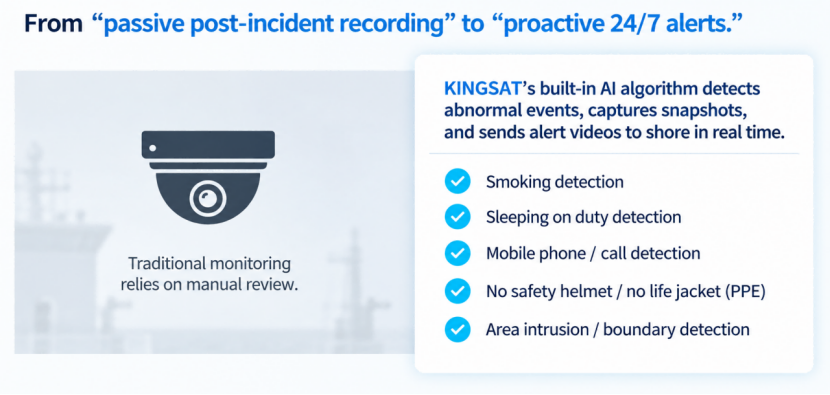
Assisted detection of smoking and other unsafe behavior: The KINGSAT video terminal features an AI algorithm module that supports assisted detection and event capture for smoking violations, sleeping on duty, mobile phone use or calls, failure to wear a safety helmet or life jacket, and area intrusion or line-crossing events. When an abnormal event is detected, the system automatically captures a snapshot and a short alert video clip.
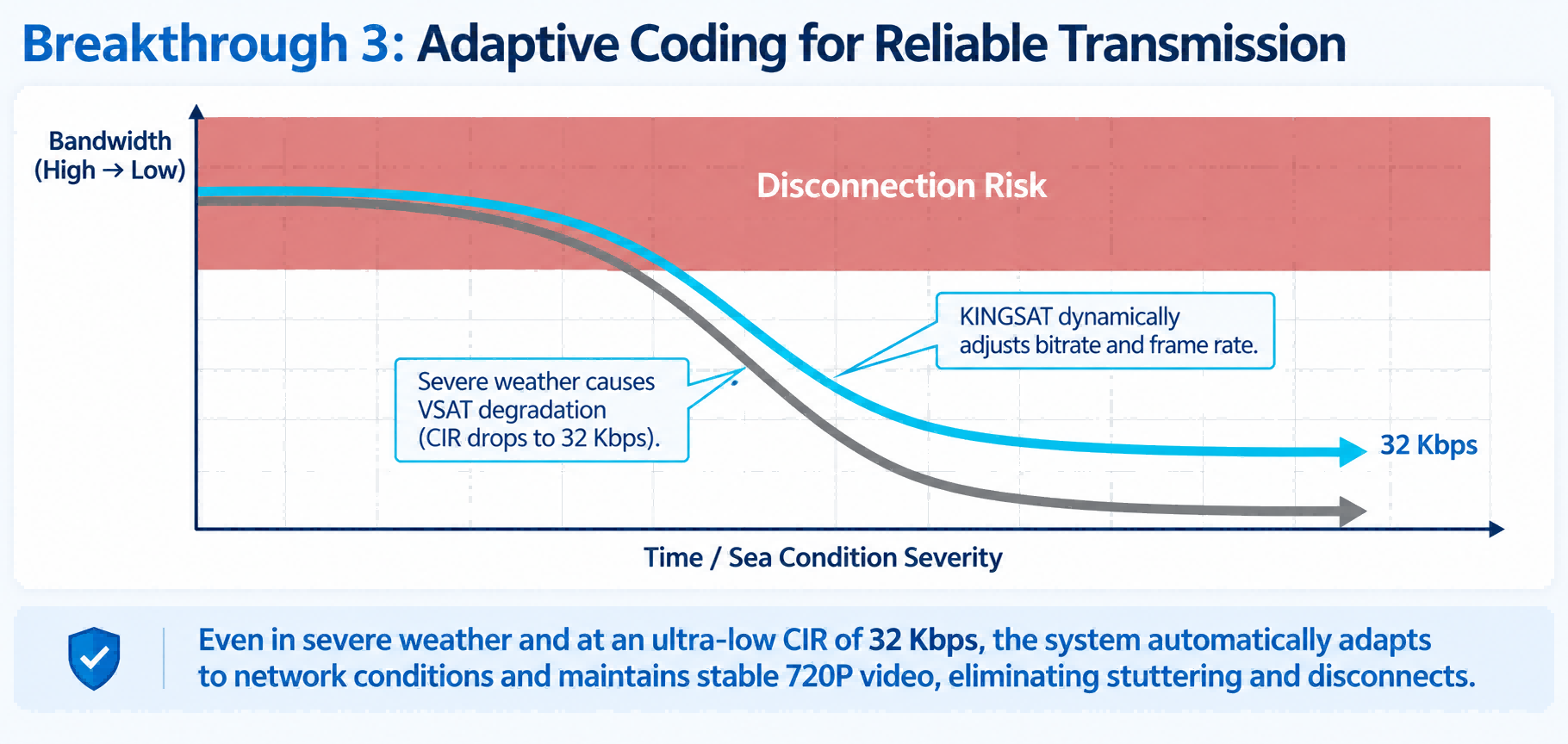
Dynamic adaptive bitrate adjustment: Adaptive Coding can be enabled to dynamically adjust the encoding bitrate and frame rate according to real-time satellite bandwidth constraints, such as 64 Kbps or 32 Kbps. This allows video quality and smoothness to adapt to network fluctuations while helping maintain a continuous video link.
3. Broad Compatibility and High-Capacity Cloud Decoding
Compatibility with existing systems and industrial-grade design: The system supports RTSP, GB28181, ONVIF, and proprietary protocols from mainstream vendors, allowing it to work with existing onboard cameras. Hardware is available as an external compression box, Mini board, or 1U rack-mount unit and supports an operating temperature range of −20°C to +60°C.
High-capacity decoding: A single Decoder Server can connect to and manage up to 2,000 channels of 1080P video and support 800 concurrent channels for live preview and storage. Snapshots and video can be transmitted in real time to the Vessel Track fleet management cloud platform, with access within seconds through a web browser or mobile app.
Benefits: Significantly Lower Satellite OPEX and Improved ROI for Maritime Safety
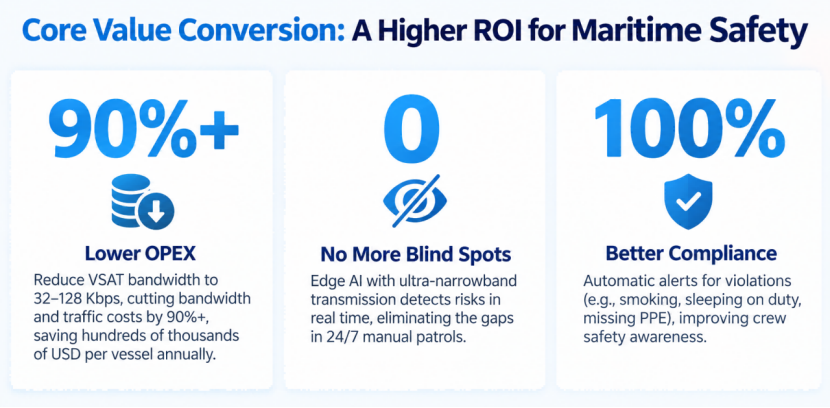
• Significantly lower satellite costs (over 90% reduction in OPEX):
The required VSAT bandwidth can be reduced to a CIR of just 128 Kbps or even 32 Kbps, cutting bandwidth and data costs by more than 90% and potentially saving shipowners hundreds of thousands of RMB annually.
• Improved safety compliance:
Real-time event alerts and snapshots for smoking violations, sleeping on duty, and unauthorized entry help improve crew compliance with safety procedures.
• Real-time shore-side visibility:
Shore-based management teams can remotely access CCTV feeds from ocean-going vessels at any time and verify safety violations or abnormal events within seconds, reducing monitoring blind spots.
• Reliable video transmission over degraded links:
Even when severe weather causes satellite signal degradation and CIR drops to as low as 32 Kbps, the system can still maintain smooth 720P video transmission.
Conclusion
Maritime safety leaves no room for complacency; prevention is always better than response after an incident. With bandwidth usage as low as 32–128 Kbps and traffic compression of more than 90%, the KINGSAT Ultra-Narrowband Video Compression Transmission System removes a major cost barrier to real-time video transmission over narrowband VSAT links.
KINGSAT provides a cost-effective and reliable path to maritime video connectivity, making real-time safety monitoring for ocean-going operations far more practical.
Contact us: sales@kingsat-tech.com Official website: www.kingsat-tech.com
Youtube: http://www.youtube.com/@kingsatmaritimeantennas4640