

Other

From the North Atlantic to the Tropical Equator: The X-Series antenna solves all the TV reception challenges on global routes!

2026-03-03

With the development of the global shipping industry, shipping routes are increasingly characterized by cross-regional, cross-latitude, and long-duration continuous voyages. During the monotonous ocean voyages, the demands of crew and passengers for quality of life and access to information on board are constantly increasing. Therefore, a stable satellite television service has become one of the important features of modern ocean-going vessels.


However, ocean-going vessels face severe challenges in actual navigation: 
  • • Large Latitudinal Span: The route crosses low-latitude (equator) and high-latitude regions, resulting in drastic changes in satellite elevation angle. 

  • • Rough Sea Conditions: Ships sway violently, and traditional antennas are prone to losing satellite signals. 

  • • Extreme Environments: Significant differences in the environment of different climate zones place extremely high demands on the weather resistance of equipment. 

  • • Maintenance Difficulties: Due to the long sailing time and limited maintenance conditions, the equipment needs to have extremely high long-term operational stability. 
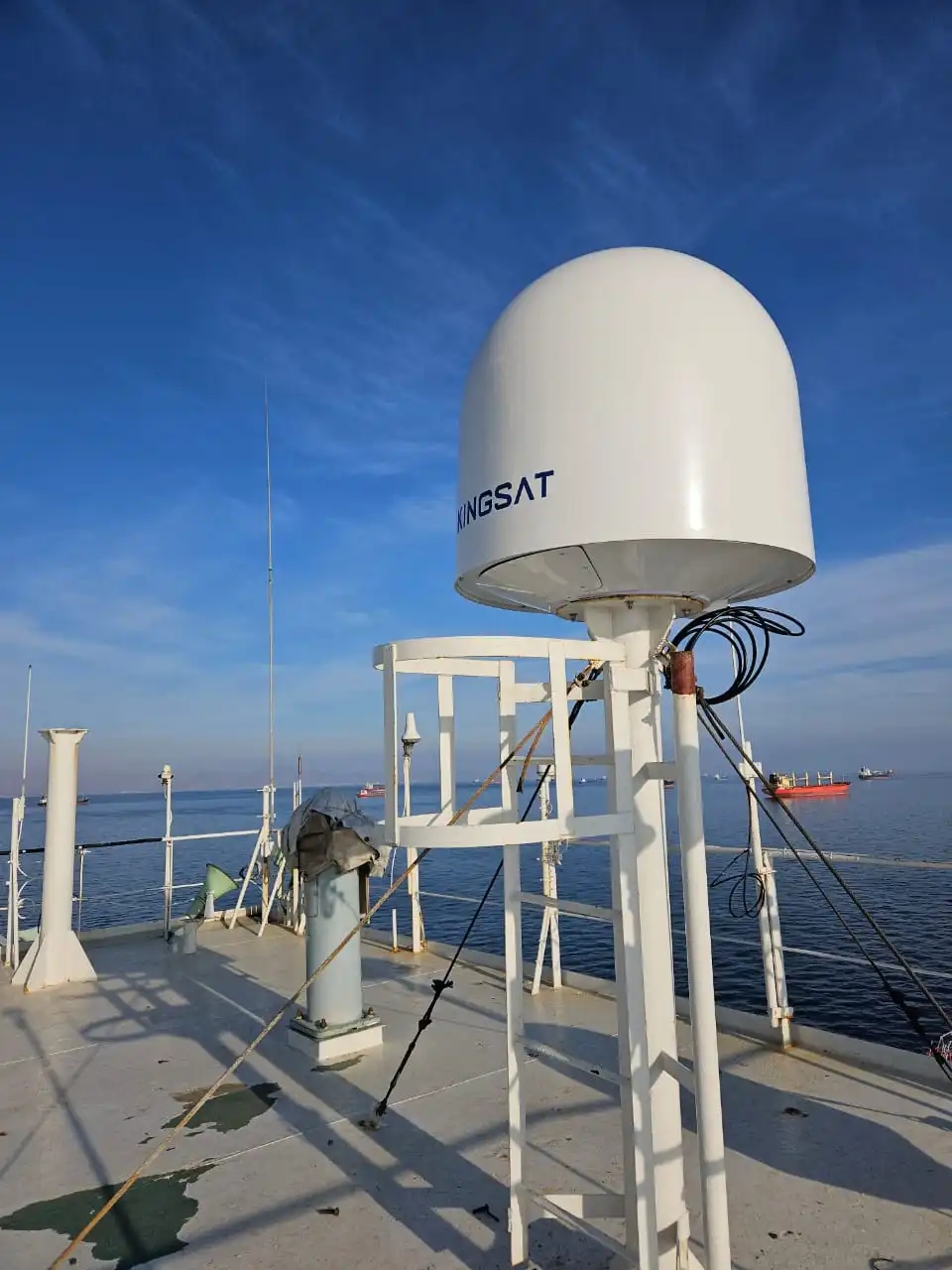
     
The KINGSAT X series antennas are designed to address these challenges, providing a comprehensive global satellite television reception solution that offers high flexibility, stability, and reliability for ships sailing around the world.
1. System Overall Plan 
The X-series system is an integrated and intelligent receiving system, mainly composed of the following core components: 
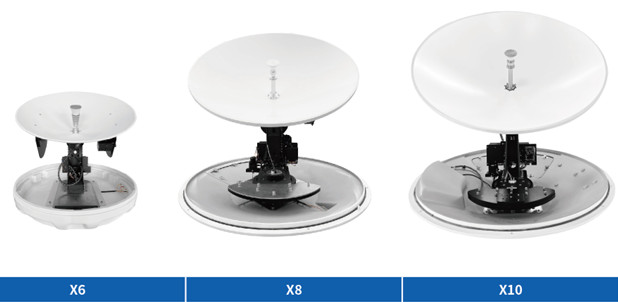
  • • X-Series Antenna (Outdoor Units): include parabolic antennas of different apertures (such as 64cm, 85cm, 105cm) responsible for capturing satellite signals. 
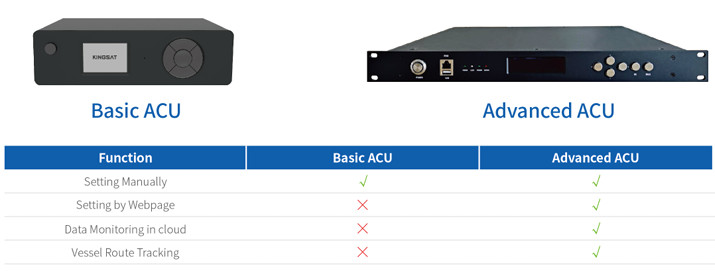
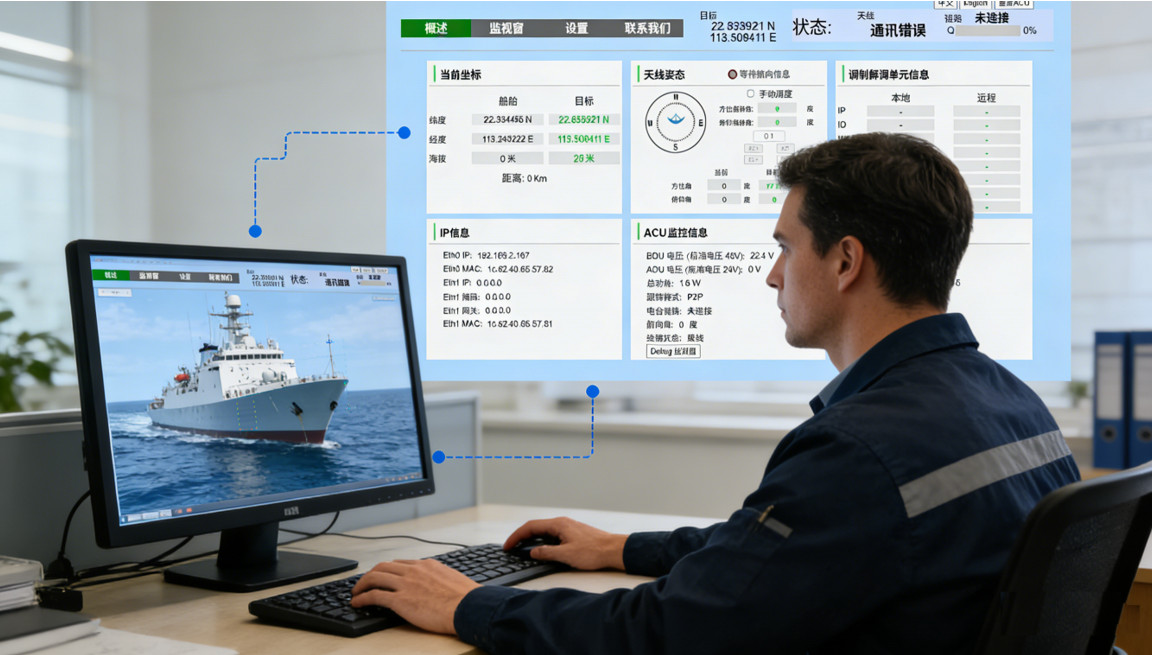
  • • Antenna Control Unit (ACU): Available in Standard and Advanced versions. The Advanced ACU supports a web-based management interface, GNSS track tracking, and Vessel-Track cloud server connectivity. 
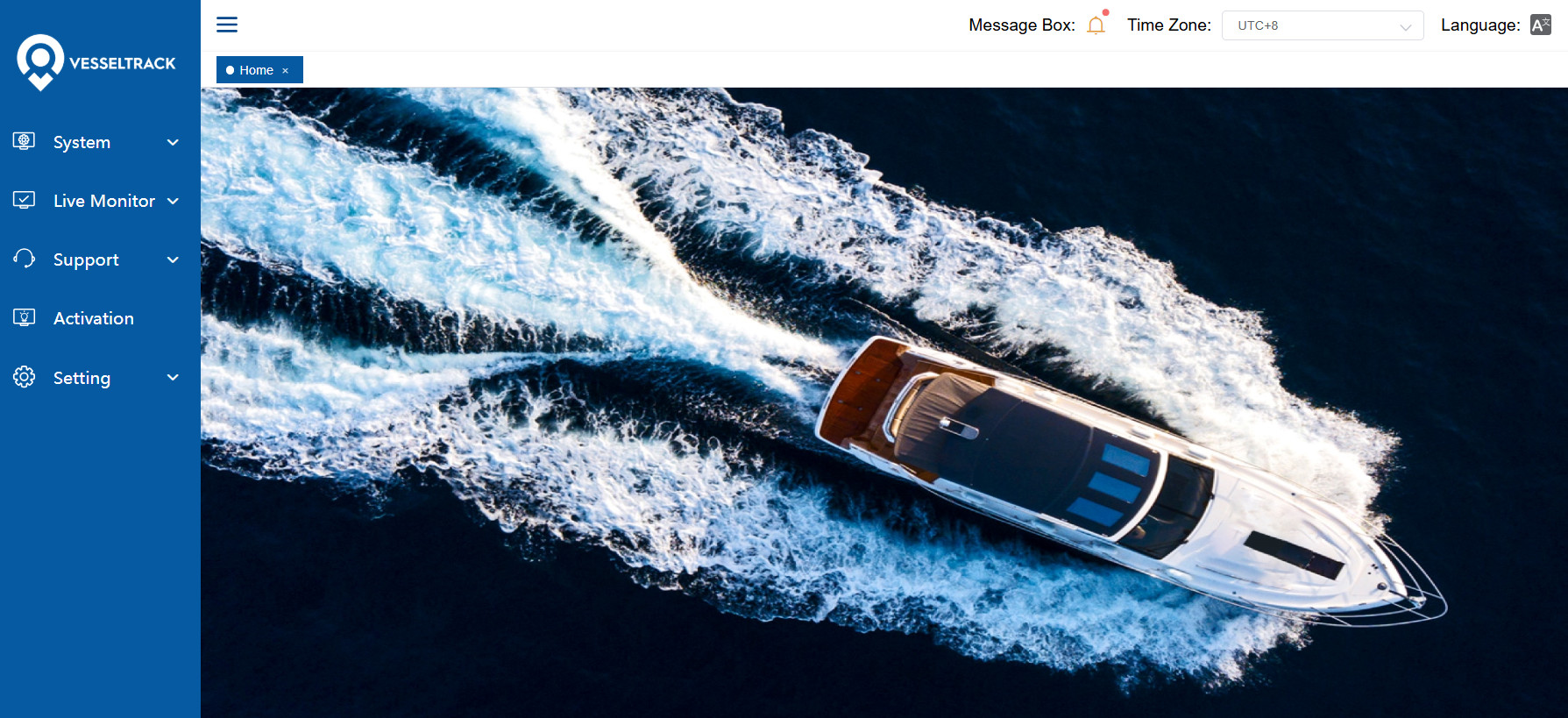
  • • Vessel-Track Cloud Server Platform: Enables remote centralized management of multiple ships and multiple antennas, and real-time monitoring of antenna operating status. 
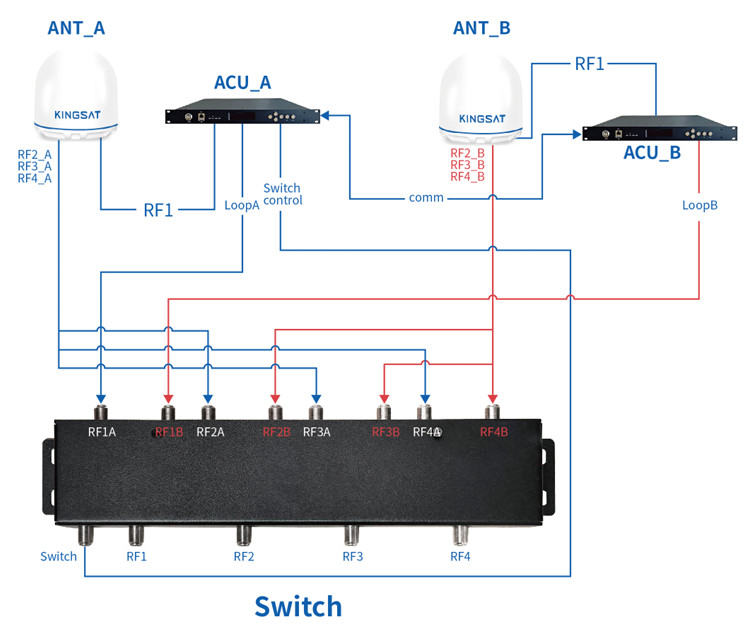
  • • Dual-Antenna Switching Scheme (Optional): Two antennas (main/backup) are connected via a switch to ensure that the signal remains uninterrupted even when one antenna is blocked by the ship's structure. 
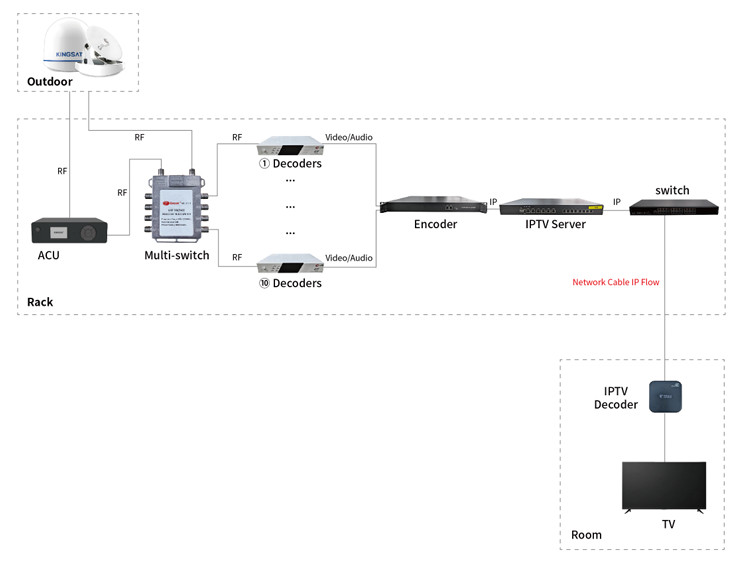
  • • IPTV Solution (Optional): This solution integrates an IPTV server and encoder to convert satellite TV signals into network streams and distribute them to TV terminals in all cabins throughout the ship.
 
2. Core Advantages of X-Series Antennas 
2.1 Ultimate Three-Axis Stabilization Technology 
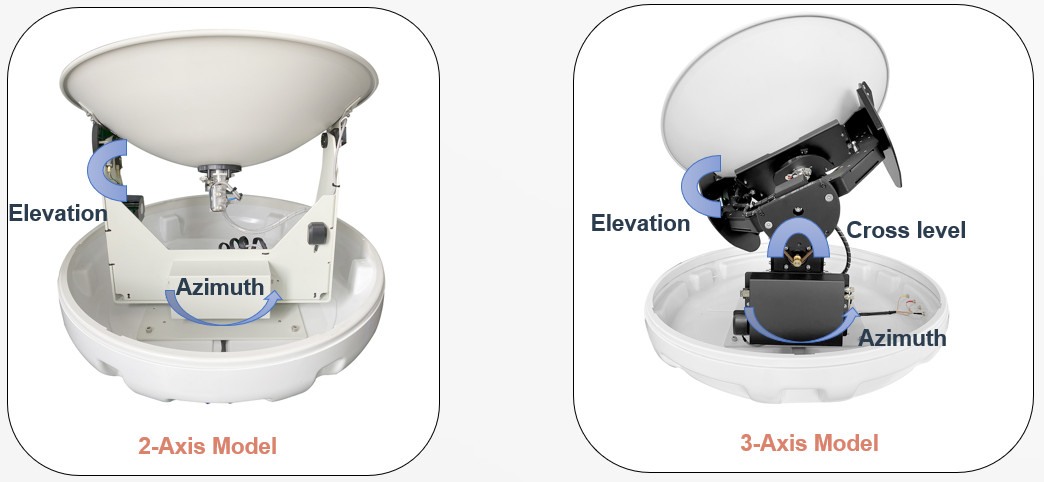
The X-series antennas employ advanced three-axis full attitude compensation technology (azimuth, elevation, and roll), which offers a generational advantage over traditional two-axis systems (azimuth and elevation). 
  • • All-Round Anti-Sway: The antenna can compensate for the vessel's attitude changes in any direction in real time, effectively canceling the violent roll (Roll ±35°) and pitch (Pitch ±15°) caused by large waves. The tracking rate can be maintained at >90°/s, ensuring that the antenna is always accurately aligned with the satellite under highly dynamic sea conditions. 
  • • Fourth-Axis Polarization Compensation: Building upon the three-axis stabilization mechanism, the X-series also features an automatic polarization angle adjustment (fourth-axis) system. During transoceanic voyages, the antenna can automatically adjust its polarization angle to ensure the signal link is always in optimal condition, significantly reducing bit error rate and the risk of dropped connections.
2.2 Global Route Adaptation 
The X-series is designed specifically for global navigation, solving the problem of large changes in satellite elevation angle during cross-latitude navigation. 
  • • Ultra-Wide Elevation Angle Range: Its elevation angle coverage ranges from -15° to 120° (some models range from -5° to 115°), adapting to high elevation angle variations in low-latitude equatorial regions and low elevation angle variations in high-latitude routes, far exceeding traditional antennas. 
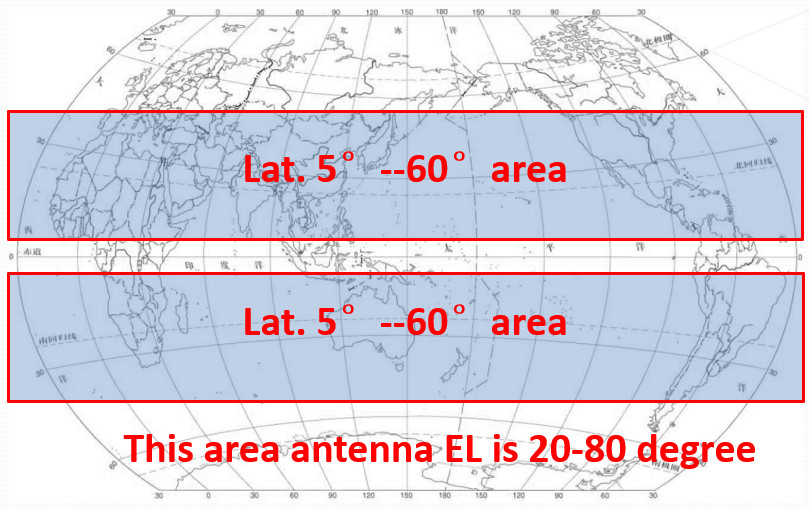
  • • Full Coverage Across High and Low Latitudes: It can adapt to low elevation angle locking on high-latitude routes and perfectly suit the high elevation angle tracking requirements exceeding 85° in the low-latitude equatorial region, meeting the international ocean-going needs of merchant ships sailing globally. Within the blue area in the diagram below, a traditional two-axis antenna can be used; however, if the ship needs to navigate outside the blue area, a three-axis antenna is required.
2.3 Supports Dual-antenna Switching 
To address the potential physical signal obstruction caused by the hull structure of large ships, the X series offers a complete dual TVRO antenna redundancy solution. 
  • • Seamless Switching: Two antennas are connected via a dedicated switch. When the primary antenna (Antenna A) is blocked, the system will automatically switch to the backup antenna (Antenna B) based on the reception quality. 
  • • Uninterrupted Signal Transmission: The TV signal remains stable during switching, making it particularly suitable for scenarios with extremely high requirements for signal continuity, such as cruise ships and offshore vessels.
2.4 Excellent Environmental Adaptability 
The X series has undergone significant structural and technological enhancements to address extreme marine environments. 
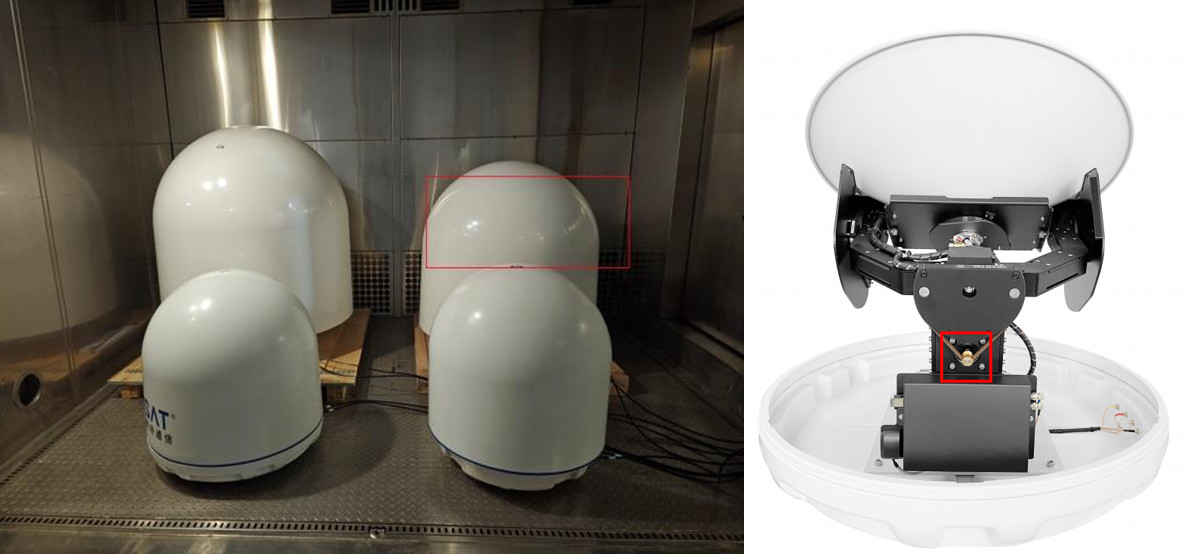
  • • Wide Temperature Range and Weather Resistance: It has IP56 waterproof and windproof capabilities, supports a wide operating temperature range of -30°C to 70°C, and has the ability to start at a low temperature of -15°C, ensuring long-term stable operation in subarctic and harsh winter sea areas, and adapting to climatic conditions from tropical and temperate to subarctic and cold sea areas. 
  • • Sealing Structure: Key interfaces and joints are treated with sealing rings and waterproofing technology to further improve the reliability of long-term outdoor operation. 
  • • Conformal Coating Process: The main control circuit board and key components of the motor are all coated with conformal coating, which can effectively prevent moisture, salt spray corrosion and mold. It can prevent short circuits, leakage or parameter drift caused by moisture condensation. It is suitable for marine and coastal environments, avoids metal corrosion and solder joint oxidation. Moreover, in high temperature and high humidity environments, it can inhibit the growth of mold to the greatest extent, ensure long-term stable operation, and significantly extend the service life of electronic modules in high temperature and high humidity marine environments.
3. Advantages of ACU and Cloud Platform (Suitable for Fleet Management) 
3.1 ACU Web Management Interface 
The X-series advanced antenna control unit (ACU) introduces a digital management approach. 
  • • Visualized Web Management: Administrators can check the antenna's operating status in real time through a web-based browser interface without physically operating the equipment. 
  • • Remote Parameter Modification: Supports modifying antenna parameters and target satellites in the background, greatly facilitating crew operations and remote support from the technical team.
3.2 Vessel-Track Cloud Server 
For fleet managers, KINGSAT offers the Vessel-Track cloud server platform. 
  • • Centralized Management: Supports centralized monitoring of multiple ships and multiple antenna systems. 
  • • Real-time Data Monitoring: The platform can acquire various operational data and working status of antenna equipment in real time, enabling digital control of global assets from the shore end.
3.3 GNSS Tracking 
Utilizing the built-in positioning capabilities of the advanced version of the ACU, the system provides powerful GNSS trajectory tracking functionality. 
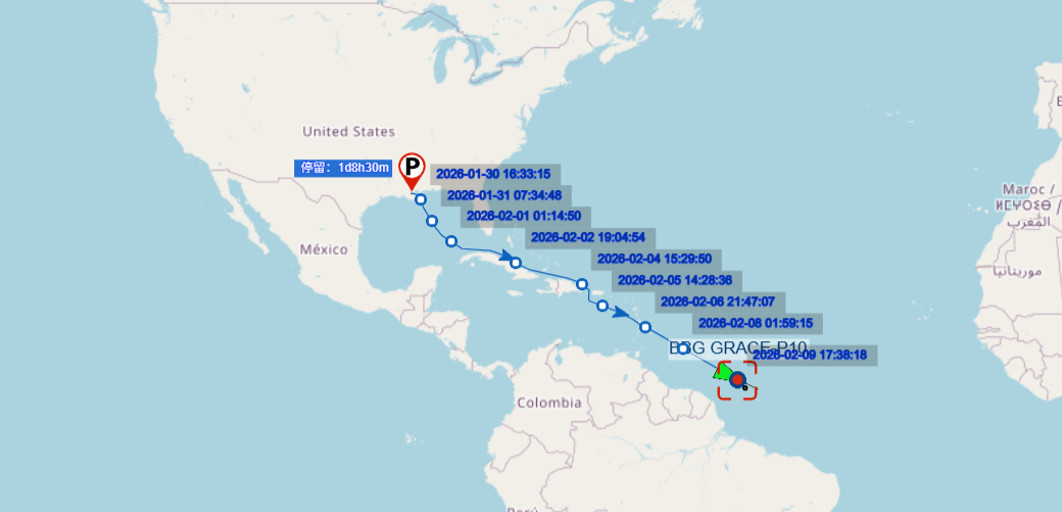
  • • Historical Track Query: You can query the ship's past track and intuitively display the changes in the ship's geographical location. 
  • • Assisted Operation and Maintenance Analysis: By combining route track data with operational status such as antenna signal quality and elevation angle changes, technicians can perform more accurate fault analysis and provide remote operation and maintenance support.
4. Typical Application Scenarios 
4.1 Global Shipping Routes For Ocean-Going Merchant Vessels (Container Ships, Bulk Carriers, Tankers) 
Ocean-going merchant ships typically engage in long-distance voyages across continents and latitudes, facing extremely complex geographical and climatic challenges. 
  • • Challenges and Solutions: When ships pass through low-latitude regions such as the equator, satellite elevation angles are extremely high (exceeding 85°), and ordinary two-axis antennas often cannot track them due to mechanical limitations; while in high-latitude regions, elevation angles are extremely low and azimuth changes rapidly. The X-series has an ultra-wide elevation angle range of -15° to 120°, which can perfectly adapt to signal switching from the equator to high-latitude sea areas. 
  • • Global Reception Example: Merchant ships can receive SES 9 satellite signals in Southeast Asia, switch to Astra 1N in European waters, and receive Galaxy 19 in North America, ensuring a stable TV signal throughout the entire voyage. 
  • • Extreme Stability: When facing severe sea conditions in the North Atlantic or North Pacific, its three-axis full attitude compensation technology (azimuth, pitch, roll) can offset the violent swaying caused by large waves in real time, significantly reducing signal jitter and the risk of dropped connections.
4.2 Large Cruise Ships and Passenger Vessels 
Cruise ships have extremely high requirements for passengers' entertainment experience, and the continuity of the signal and the ease of distribution are core demands. 
  • • Dual-antenna Redundancy Solution: Large cruise ships have complex superstructures, and a single device is easily obstructed by masts or funnels. The X-series supports a dual TVRO antenna switching solution, connecting the primary and backup antennas via a switch. When the primary antenna signal is blocked, the system automatically and seamlessly switches to the backup antenna, ensuring uninterrupted television programming. 
  • • IPTV Solution Integration: By combining an IPTV server and encoder, the system can convert the received satellite signals into a network stream and distribute them to every cabin terminal through the ship's local area network, meeting the needs of large-scale concurrent viewing.
4.3 Offshore Engineering and Special Operation Vessels (Offshore Engineering Vessels, Survey Vessels, and Work Vessels) 
These types of vessels often operate in extreme sea areas for extended periods, placing stringent requirements on the weather resistance and stability of their equipment. 
  • • Extreme Environmental Adaptability: Offshore operations often face high salt spray and high humidity. Key components of the X series (motor and mainboard) are treated with a three-proof coating process, which can effectively prevent short circuits and corrosion. 
  • • High and Low Temperature Resistance: It has IP56 waterproof and windproof rating, supports a wide operating temperature range of -30°C to 70°C, and supports low temperature start-up at -15°C, meeting the long-term operation needs of cold or hot sea areas around the world. 
  • • High Dynamic Tracking: When performing special operations (such as towing and dynamic positioning), the ship's attitude changes frequently. The X-series tracking accuracy is maintained at <0.2°. After encountering a sudden deflection of more than 90°, the system can quickly complete signal reacquisition within 2 seconds, ensuring that the antenna can always lock onto the satellite.
     
4.4 Centralized Management of Digital Fleet 
For shipping companies with multiple vessels, the X Series offers robust digital management support.
  • • Remote Monitoring and Maintenance: By connecting to the Vessel-Track cloud server platform via the advanced version of ACU, administrators can query the working status and operation data of antennas on ships around the world in real time from the shore. 
  • • GNSS Tracking: Combined with the built-in positioning module, the system can query and track a vessel's historical tracks. The technical team can combine these tracks with signal quality data to assist in remote fault analysis and maintenance support, significantly reducing overseas maintenance costs.
4.5 Vessels with Cross-Regional and Unpredictable Routes 
For vessels that do not have fixed routes, the X-Series offers a high degree of flexibility. 
  • • Rapid Satellite Acquisition and Lock-On: Utilizing a built-in global satellite database and integrated GPS, the system supports rapid blind scans. After initial power-on or a change of route zone, it can typically lock onto a target satellite within 2 minutes. 
  • • Digital Interaction: Crew members can access the ACU web management interface via mobile phone or computer, change the target satellite with one click, and operate in a simple and intuitive way without the need for professional communication knowledge.
     
With its all-attitude compensation technology, all-latitude adaptability, and digital cloud management , the KINGSAT X series provides a stable, efficient, and traceable global television reception solution for ocean shipping, luxury cruise ships, and special offshore engineering vessels . While improving the quality of life at sea, it greatly reduces the difficulty and cost of global operation and maintenance through technological means .
More website news